Climbing China’s sacred mountain and Buddha’s fire
15 minutes

I was visiting Taiwan in the spring of 1983, when I first heard rumours that China was open to travellers, but nobody had met anyone who had actually been there. When I got to Hong Kong, I asked around at the hostel, and was shown the bunk bed of a woman who had just come back from China. I waited impatiently for the chance to meet her, and when I finally did, Jackie was a down to earth and well informed traveller from Manchester. Over the next several days, she lent me a book on the way the Chinese government fooled foreign sympathisers, went with me to see a newly released film from China, (the marvellous True Story of Ah Q) and gave me the low-down on getting a visa. Whilst the Chinese embassies around the world were only giving visas to people on organised holidays, in Hong Kong you could get one from a single travel agency within 48 hours, and for $50. This kept the low budget visitors to a minimum, and allowed the Chinese government to learn to deal with the low-bagger crowd. For me, it was an opportunity too good to miss.
When I got to China, I found travelling was difficult, as the Chinese were more or less forbidden to talk to foreigners. Students would often come up to me on the street, and we would have a short conversation. But they would refuse to join me for a meal. When I did persuade someone to come with me for a beer, they were interrogated by a Party snooper, and reported to their work unit. A big part of the pleasure of travelling is meeting local people, and this was almost entirely blocked.
Also in 1983, foreigners were only allowed to visit a limited number of places, and were restricted to a short list of cities and a few tourist sites. Fortunately, the system was so new that it was possible to get off their beaten track and explore. I was particularly interested in getting out of the city and visiting the mountains, and decided to hike the pilgrim route to the summit of Emei Shan, a 3,099-meter-tall (10,167ft) mountain in Sichuan province, and the highest of the Four Sacred Buddhist Mountains of China.
I was looking forward to clean air, exercise and mountain views, but in the hotel room I shared with five other travellers in the small town near the bottom of the climb the news seemed bad. Two travellers who had hiked part way up the day before, and spent a night in a temple, were adamant: it was a muddy misery, following thousands of endless steps, the food was uneatable and the hostelry unclean. I had the temerity, not having yet been, to question their opinion. This didn’t go down well as it broke the expected solidarity of the traveller; to share the common suffering, constant complaint and pride in our endurance. Of my five room mates, three were sick, so I went out and bought food and medicines for the unwell. I also got a split bamboo basket/backpack, and a broad rimmed grass hat at the market. They were simple, traditional artefacts of the poor, and the vendors had tried to explain that they were not appropriate. But I liked their hand-made simplicity, and ridiculously cheap price. After tending to the infirm, I packed a change of clothes, a notebook, my mosquito net, and some warm clothing for the top, leaving my backpack in the hotel storage. I took a short bus ride to the first temple in the foothills, where for a small fee I got a permit to climb the mountain.
[Add image of permit]
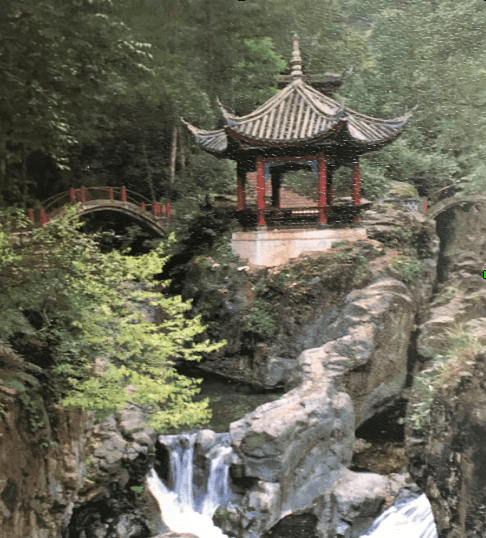
After visiting the temple, it was already early afternoon when I set off on the walk through the foothills to begin my ascent. The next temple was over a covered bridge, and up steps through an arched gateway with a beggar at the entrance, the first I’d seen in China. It was a splendid temple complex with twenty larger-than-life Buddhas and their demon protectors, all brightly painted in primary colours. Continuing up the narrow traffic-free road, I saw two men coming off a track. I followed it up, through fields planted with potatoes, corn and beans, past large, well-built wooden farm houses, with vistas of the plain below, disappearing into the haze. On the way I stopped off at another wayside temple which had primitive but fascinating terra-cotta sculptures, great Buddhas, and a tall bronze roofed pagoda.
Between temples, a mountain stream filled a sun-dappled pool of clear water crossed by a stone arched bridge. Across the stream, terraced fields climbed to deeply ravined rainforest covered hills, the summit of Emei Shan hidden in the clouds. A pleasant afternoon stroll past numerous tea stalls led me to the temple hostel at Chinko, where I spent the first night. There was a large colour television in the otherwise undecorated dining room, and the loud rat-a-tats and explosions of a Chinese war film blasted through the silence as I ate.
Day 2
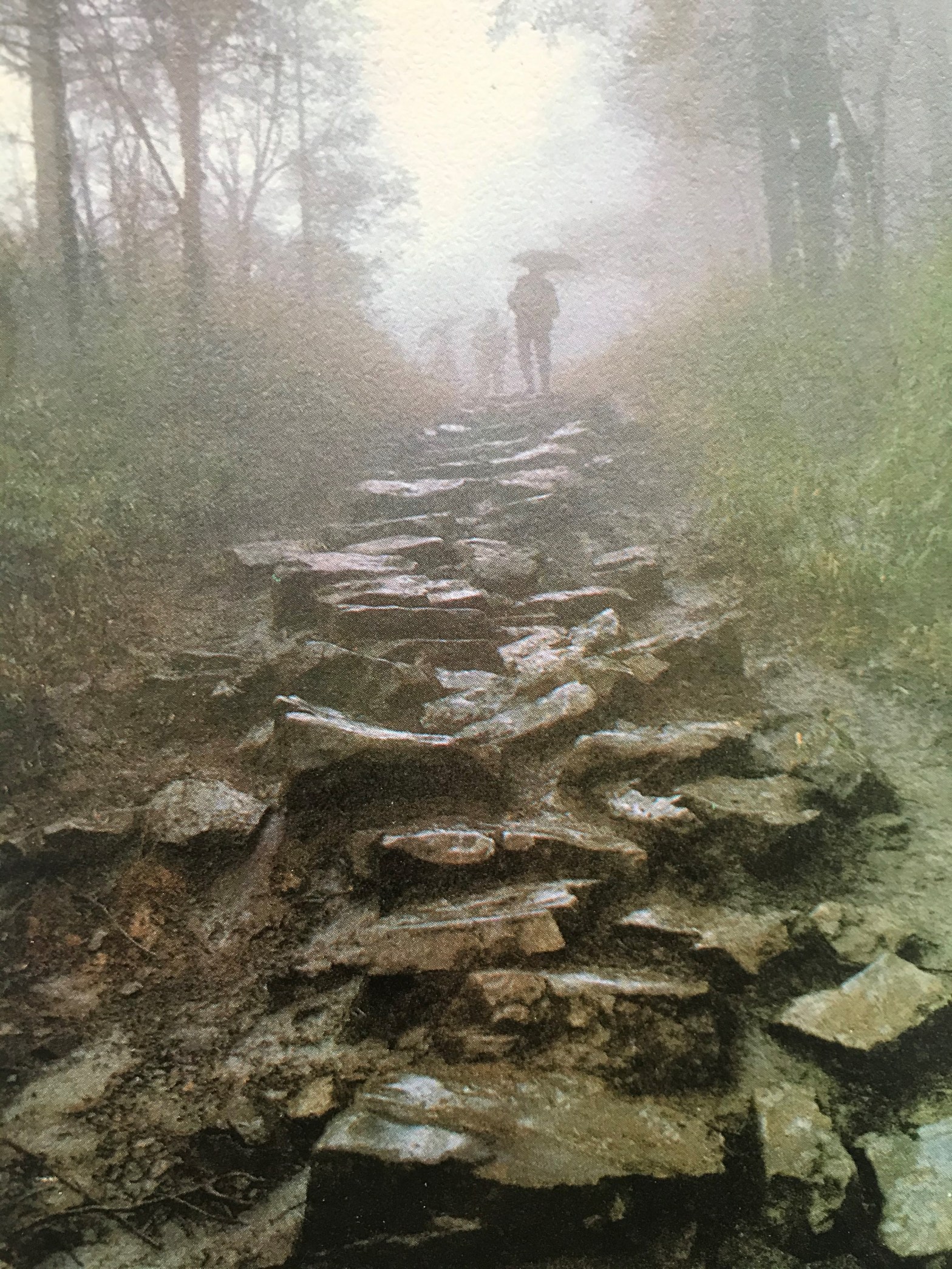
The next morning I walked up a narrow, steep sided valley alongside a tumbling brook. The trail climbed and fell, mostly stepped with large half finished stones. Many of the walkers were coming towards me, returning from Juladung or the summit Jinding. Occasionally, small temples provided noisy stopping places, but there were many more tea stalls which appeared in ones and twos around almost every corner. People of all ages were making the pilgrimage: and among them were several families of Tibetans, the first I’d seen, wearing their traditional clothing, boots with upturned toes, and the women strung with numerous necklaces and bangles. The trail climbed and climbed, leaving the stream and entering subtropical forest, with broad leaved evergreens, conifers and scrub bamboo. The air was damp, and chill when not climbing, but perfect for remaining cool when clambering up the rough trail. I was wearing strong shoes, but many of the other pilgrims were wearing cheap slip-ons or sandals. Children as young as five or six walked uncomplainingly up the steep rough trail. Occasionally a frail elder is carried down in a seat slung between two porters on a bamboo pole. Sharp, loud, bird-song cackled and chirruped in the surrounding forest.
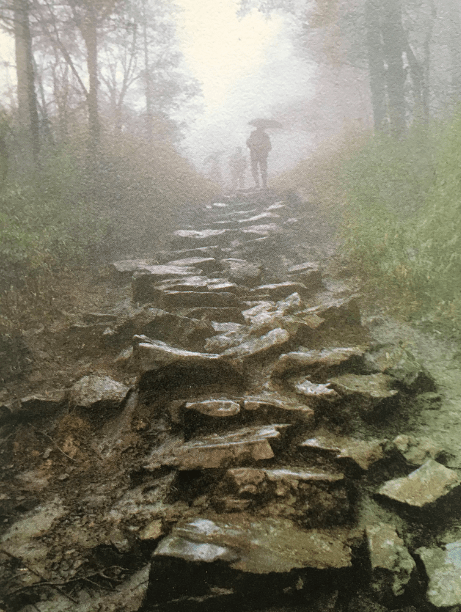
I met and re-met a family of three generations climbing slowly and steadily upwards. I overtook them, but made frequent stops for tea, snacks or temple viewing, and they passed me by, to be met again soon after. The trail passed more temples. Less ornate than the ones I’d seen yesterday, they were none the less interesting stopping places- and a good excuse to take a break from the hard climbing. The tea-houses of yesterday were replaced by small food stalls selling rice porridge, soft drinks, and hundred year eggs. At the temples, restaurants served complete meals. With many stops, I climbed on through the cloudy weather, the vistas hidden. At four I got to Xianasi, where I bargained for a bed. I had a room of three beds to myself. Later (after a snooze) I had supper with the family group I had met on the trail. Two of the men mentioned that I had two empty beds- so I invited them to stay the night. (All this done in Chinese or sign language).
Day3
Next morning, the room boss screamed at my room-mates and locked us all in the room- so they climbed out of the window into the corridor. When he returned to chide or chastise them further, they had gone, and I had paid, so I shrugged my shoulders and politely raised my hands before also leaving to carry on up.
Today feeling better, I pushed up much more quickly, even though the steps were steeper. The way went up through the clouds and along sections being rebuilt where the going was rougher. Along the trail, there was a great spread of flaming red rhododendron. In spite of several stops, I got to Jinding, the 3,099-meter summit (10,167ft) in the early afternoon.
Mount Emei is traditionally regarded as the bodhimaṇḍa, or place of enlightenment, of the bodhisattva Samantabhadra, who is known in Mandarin as Pǔxián Púsà (普賢菩薩).
Jinding was cold and wet with rain. I again met my companions of the trail; a family of grandfather, son and grandchildren. We ate together, conversing without words; laughing and sharing food.
Day 4
The morning brings more rain. There is a special treat called Buddha’s fire, but we will not see it in the rain. I wait the whole morning, from dawn, standing on the viewpoint in drizzle or sipping tea in a small tea stall. At 11, the sky clears to a thin mist and a half-blinding light dazzles as the mist glows in a stunning illumination!
What joy. It lasts just a minute and is gone.
Then as the cloud clears further, I can see to the Tibetan plateau, and decide that the looming peak in the far distance is Gongga Shan (Minya Konka), a gigantic 7,556m (24,790 ft).
Blessed by the light of the Buddha and a sight of Tibet, I leave to descend, happy at my luck.
I am elated with my time in ancient China, away from roads, away from constant control, far from crowded streets. Here, rich or poor, old or young, you must walk, climb, strain, to reach the sacred summit. And to be blessed by Buddha’s light is a wonderful extra delight.
On the way down I wander off the main trail and get delightfully lost in paths through farmers fields and quiet places off the beaten track.
Gongga Shan on the edge of the Tibetan plateau.
Here is a recent blog on climbing Emei Shan. Four travellers walked up, but met the tour buses on top.
From https://blog.goway.com/globetrotting/2018/06/night-emei-shan-one-chinas-4-sacred-mountains/
The Golden Summit sits at the top of one of China’s four most sacred mountains. People come from all over to pray for good fortune or leave a locket symbolizing love. Most come by tour bus – few ever walk. By the time we reached the top, the feeling of intimacy between the four of us almost vanished immediately. Our little group was thrust into the noise of throngs of domestic tourists scrambling for position to take their sunrise photo. Parked side by side were the large motor coaches you see everywhere in China.
As you can see below, I was lucky to get to see Emei Shan before it was swamped by day trippers.
 writesimon
I visited it in 1980 and sure it left a deep impression. And I was one of the few licky ones who saw Buddha`s light. Not sure if you know about this light there.
LikeLike
I loved reading this. I’m fascinated by experiences of other foreigners who were in China during those years of its early opening. Another blogger I follow, Friedrich Zettl, studied art in China during the early 80s. His blog is always interesting, too. https://zettl.blog
I was teaching in China in 1982-83 and had my own Chinese Sacred Mountain experience. Not a successful summit attempt like yours, but… Anyway, your post inspired me to post my story so I could share it with you.
https://marthakennedy.blog/2021/05/07/chinese-sacred-mountains/
LikeLike