Slapstick

A physical comedy

20 minutes

It was the annual Festival of the Glorious Ewe, the patron saint of Mordek, and the capital was thronged with visitors. Kopek, chief spy of the Pimpleknuckle Confederation, surreptitiously mingled with the crowd disguised as a peasant on a jaunt to town, though his monocle and well waxed handlebar moustaches jarred slightly with his shepherds smock and slouch hat. He kept his eye on the guests arriving by coach or litter, climbing the great stone steps of the great Gothik town hall, to the crowded ballroom on the second floor.

Eustace Claricorne, deputy assistant to the Master of the Back Stairs, had dressed carefully for the grand reception and proudly wore the Mordek tricornered hat on his tousled head, and his myriad medals and badges above his ceremonial green and purple sash. He looked out of his turret window, high in the east wing of the town hall, with views of the spires and turrets of the town and of the vast throng filling the square below. It was vital that he do well today not only for Mordek, but for himself. Unfortunately, the day before had not gone well, accompanying the Master on a surreptitious visit to the Hedgehog embassy to promote an alliance against the threats of an invasion by Pimpleknuckle. Carelessly tripping over the embassy carpet, he had knocked over the ambassador’s portly wife. Today Eustace had strict instructions, in a note from the governor, to be on his best behaviour. The guest of honour at the grand reception was to be the irritable ambassador from Mordek’s warlike neighbour Pimpleknuckle himself. Pimpleknuckle claimed the border village of Gok, population 3 persons and 14 sheep, and sought a pretext to invade. It was important that the ambassador was not provoked, as a slight to his august person could be used as excuse for aggression.

As Eustace descended the back stairs from his quarters a trumpet cavalcade sounded from the steps of the Great Hall signalling the arrival of the Pimpleknuckle emissary. Eustace stuck his head into the grand ballroom. The mayor and alder folk were dressed in elegant costumes of lambs wool, with ewes horn hats, to honour the Grand Ewe. Eustace looked down the imposing grand staircase which swept from the ballroom to the mezzanine and down again to the grand entrance hall. Resplendent in his finest court regalia, he hurried to join the Governor by the great front doors. At the top of the grand staircase, he noticed his left shoelace was undone, and stooped to tie it.

A fall from grace

As he bent over, a waiter carrying a tray of empty glasses backed out of the ballroom, colliding with Eustace and knocking him forcefully forward. Eustace landed on his head, and rolled over the top stair. His speed was such that he continued to the second stair, and here (now going faster) over the third. At the bottom of the 26 stairs, as chance would have it, he collided with a large statue which slowed him down considerably. However, this wasn’t enough to stop him bouncing over the top step of the main staircase down to the lobby, again bouncing slightly faster onto the next step. By the time he hit the hall below, his descent had been observed, and a footman ran to close the great door, but too late. Rolling down the hall at a terrific pace, Eustace bowled over Madam the Governor who flew into the air and landed forcefully on top of the newly arrived Pimpleknuckian ambassador. Out the door Eustace shot! Bouncing down the top step at quite a speed, and progressively faster down each of the 12 stone steps, the deputy assistant to the Master of the Back Stairs, medals clashing against his gold braid, rolled into the main square, now gaily decorated for the festivities. He continued to roll across the great square, through the thick crowd, miraculously only bowling over the occasional surprised personages as he passed. Exiting the square, he tumbled at great speed down the steep hill that led to the town gates.

Upstairs in the reception room, there was a wave of incredulity. A half dozen near the door saw the Plenipotentiary, in all his well polished regalia, roll over the edge of the first stairs, and then suddenly reappear, glinting under the great candelabra, as he shot over the top step of the mezzanine. They relayed this astonishing sight to those standing near, and then a cry was heard from the crowd by the windows “Eustace is rolling down the square!” What to do was the question on many lips. The chief of police and the fire chief arrived by the mayor’s side from different directions. The police chief indicated by a small movement of his head that the fire chief should speak first. “I believe it would be opportune to go and investigate,” she said to the mayor. “Perhaps you will join me,” she added to the police chief.

These two officers, resplendent in their ceremonial uniforms, one bright red, the other a deep blue, hurried down the staircase, picking up a couple of members of their respective forces as they went. Unfortunately, though on official business, one of the firemen had over indulged on the delicious sweet wine. He was a large man and he followed tipsily along, slightly behind the others, and when he tripped on the top step he fell against the two policemen a few steps below him. The policemen fell, like well trained skittles, knocking both the fire chief and the chief of police off their feet and into a tumble down the stairs.

The only one not to get knocked off her feet was the second fireman, who bravely grabbed at her colleague’s arm, getting a good grip as he went past. The first fireman being of large proportions, and she of slight build, this did not slow him down. Instead it jerked her into the air, feet straight out behind her, and she joined him in his revolutions. At the bottom of the first flight of stairs these officials bounced, each in their own particular way, as they rolled across the landing, bumping into several footmen who tried to arrest their fall. Instead they all, now including two footmen and a maid, continued at high speed over the top of the first stair of the main staircase. Downwards, a melee of colourful uniforms, they bounced from stair to stair. Onwards they rolled, like giant cheeses, or hogsheads of claret, across the entrance hall and, unfortunately for protocol, over the prostrate Pimpleknuckian ambassador and his retinue. They bounced on through the still-open door and down the great stairs into the main square.

This too of course was seen from above, and a multitude of the guests proclaimed their shock and horror, or went for a strong drink, or sat down stunned, or all three of the above. However, the rush of the more practical to help was a tonic to see. Two dozen guests, including many of the nations leading officials, dashed to the stairs to go down and assist the victims. In their rush out of the ballroom, the crowd swept the first of the aid party brusquely over the top step. As they stumbled, a few managed to regain their footing, but those behind them, shoved in their turn by the surge to help, toppled them again and they joined the others, cartwheeling down the stairs. On the landing they met little resistance, it having been swept almost clear by their predecessors. However, they did add a minor duchess, who had been unmolested by the passing of the emergency personnel. Onward they rolled, a great tumbling mass of dignitaries and lesser members of officialdom, all now united by the wonders of gravitational attraction.

By now the Eustace, the first to fall, had left the square and was rolling with some speed through the town, causing some collateral damage to the occasional latecomer. He first collided with Esmeralda the lady librarian, who most unfortunately had just lifted her front foot when struck, and pivoting on her back foot, she too began to roll with great speed, and given the loveliness of her bright red dress, great effect. The Tardy-Jones family, perennially late, were just entering the road from a side street and got the full effect of the rotating red dress alongside the man spinning in his gold filigree court dress. “Bravo” they cried, impressed with the elegant display. As it was an important festive occasion, extra guards had been deployed, and the town gate was open. Out they rolled, ornate gentleman and brightly dressed lady librarian, past an astonished gate guard who shouted to his friend on the parapet above. The tower guard heard a cry and looked down. “No,” shouted the gatekeeper, “look to the road”. The tower guard turned around to the road outside the gate, and saw the astonishing sight of a man rolling along at high speed accompanied by a lady in a brilliant red dress. “Stop in the name of the Governor”, he called, but to no apparent effect.

By this time, those embodiments of public order, the chiefs of police and fire, and their attendant minions, were rolling expeditiously across the main square. Given their number, and in several cases large mass, they wrought more havoc, or to put it more scientifically, had greater material effect, upon the body of revellers than the passing of the Deputy assistant to the Master of the Back Stairs. With an accuracy that would have greatly improved the towns chances in the recent national 10-pin bowling tournament, they cut a wide swathe across the square. Their inverted V of well aimed blows and clouts upon the assembled personages caused a profusion of response vectors as each individual reacted independently to the strike force imposed upon them. But, marvellously undeterred by any extraneous contact, the mass of officials rolled, and frankly bounced and hurtled, towards the steep hill leading to the town gates. Before the crowd had begun to recover, or even had had a chance to reflect upon their condition, a third wave of personages came streaming down the great steps of the town hall, and added their portion to the general confusion.

This last wave, was made all the more elegant by the presence of a, even if minor, duchess, her diamonds glittering charmingly in the afternoon sun. They too bounced and hurtled, through, over and across the by now largely supine crowd, thwacking one here, thumping another there, and generally clobbering the last of those still standing. Generally, those struck by the passing ‘rollers’ were flattened, but some instead joined the mass descent of the hill below the square. The specific reasons for one response or another is a field of great interest to science, and has been the topic of considerable conjecture. We will leave this inquiry to others and merely report the facts as they are known. Apart from the first two rollers, the second group began with six or seven officials, recruited two footmen and a maid upon the first landing, and lost one member in crossing the great hall. As they crossed the square, however, their numbers were replenished by a balloon seller, a toffee apple man, three brave, if foolish, policemen, and several visitors to the festivities, whose positions in society are as yet unknown (though one was reported to have sported a handlebar moustache and monocle). This large group swept a large swathe of persons off their feet who either collapsed or cascaded into others, so that by the time of the arrival of the third group, by then numbering seventeen officials and dignitaries, and a glittering duchess, their route though the square was largely clear of those still vertical. Of interest to physicists, but unfortunately beyond the scope of this reportage, was the fact that several persons who had been sent hurtling off towards the extremities of the square rebounded and in their turn discombobulated the trajectories of several members of the third, and by far the largest, group to hurtle across the square.

Unknown to Mordek, it was not Pimpleknuckle that was the great threat. The small but efficient army of neighbouring statelet of Grimchek had been dispatched to attack Mordek some weeks earlier. The Grimchek troops were under the leadership of the notorious General Handlebar, the hero of the Great Chicken War. However, due to a misunderstanding of mapcraft in the Grimchek Ministry of War, the map of Mordek had been printed upside down with north at the bottom. By diligently following the wrong directions the Grimchek forces had spent quite several weeks lost in the woods of lower Mordek and were unaware of the recently agreed truce. Now, after their myriad difficulties in the woods, they were finally approaching the town, climbing the long and steep road towards the town gates led by a marching band, featuring tubas, ukuleles and penny whistles, playing martial airs.

As the army of Grimchek climbed the road, they were met by three successive waves of ‘rollers’, now known to the world as the ‘Descent of the Mordek Patriots’. There has been some quibbling in the media, that the physics of gravity would make impossible manoeuvring around the corners on the long descent to the valley below the town. I can only state the facts. In spite of, or perhaps due to, the winding nature of the road that descended into the deep valley below the town, the numerous rollers swerved around the corners and kept to the road. This is of course apart from a few unfortunate exceptions- the navel attaché for example, became stuck in a thorn tree on the first bend.

Eustace and Esmeralda swept majestically down the steep hill, defying the small minded notions of foreign physicists, taking the corners with ease and elegance as they swept ever faster past the magnificent views of the verdant valley below, backed by distant mountains catching the afternoon sun. Eventually they turned a corner and sped down upon the advance guard of the invading army. They arrived so unexpectedly, and with such speed that they were met with no resistance, and swept through the company, elegantly bowling many of them off the roadside cliff. Before they had time to recover from this first pair, the advanced guard was almost immediately struck by a larger body, in both senses. The oversized drunken fireman, wobbling as wildly as he rolled speedily, crashed through the remaining upright soldiers. He was quickly followed by his many companions of the fire service and police during this second assault, who having dispatched the advanced guard, swept on towards the main body of troops.

General Handlebar, riding his great black stallion Coltrane, rode at the head of the main body of his army. Eustace and Esmeralda passed, one each side of the mounted general, each taking out a line of troops. The general, astonished by this hideous new weapon of war, turned to bark an order, but was immediately driven off his horse by the portly fireman, now advancing at a most warlike rotation. The general’s horse, panicked at the sudden loss of his commander, now turned tail and joined the rout caused by the first wave of gyrators and added considerably to the confusion. Dropping their guns, abandoning their cannon, leaving their tambourines and ukuleles scattered across the road, the army fled, though not fast enough to avoid the arrival of the majority of the second wave. There was little left for the third wave to topple, and the diamonds of the duchess shone impressively in the late afternoon light as she hurtled over the now largely prostate figures.

[To be ended shortly]
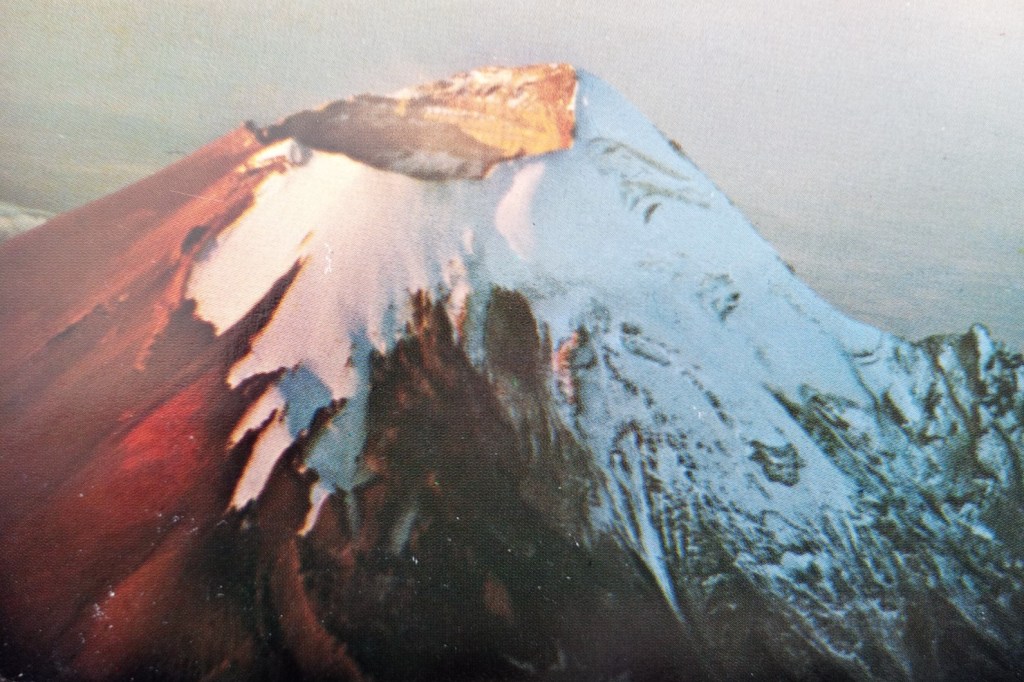
Of Pulque and Popo:

Two climbs on Popocatepetl

The “tourist route” is up the far left slope. Snow conditions vary. The route around to the summit risks a dangerous fall either way.

20 minutes

No man ever steps into the same river twice, for it is not the same river and he is not the same man- Heraclitus.

Twice a day, Pablo’s donkey passed Francisco’s place in San Pedro barrio, Tepoztlan, carrying jerry cans of pulque, Mexico’s cactus beer. Francisco’s shack was right on the edge of Tepoztlan near the last remaining agave field in the town of the god of pulque. Pablo would call out as he passed the shack, and we would often buy a litre or two of the milky liquid. One afternoon Carlos, a traveller from Spain, and I took a couple of litres of pulque up the hill behind Francisco’s shack and sat with a view of the great volcano Popocatepetl (5452m), visible in the distance over the intervening hills. As we drained the last of the pulque, Popo’s summit snowfield glinting in the afternoon light, we concocted a plan to climb Popo a few days later, on New Year’s Eve.

Popocatepetl is high enough, that in spite of being in the tropics, the top can be bitterly cold in the winter. I had a warm sleeping bag, for a night in a hut, and managed to borrow a down jacket, warm mitts and a wool hat from Texican friends who would soon be returning to the freezing US winter. Carlos was less lucky, but found an old leather motorcycling jacket and lined leather gloves. We set off on the 29th December, taking several local buses to Amecameca, where we could hire ice-axes and crampons. The equipment we were offered was old, and dilapidated, but it was only a long slog up volcanic ash and snow after all. The next day, we left Amecameca and hitched the road that climbs steeply up to the Paso des Cortes, (3400m) the saddle between Popo and Iztaccihuatl (5286m) the sleeping woman.

Popocatapetl with Ixtacciuatl behind. Tlamacas hidden behind Popo

From the pass, which Cortez had used to advance on Mexico city, we were lucky to get a ride the three or so miles through the alpine forest to Tlamacas, (3947m); where there is a large climbers chalet, with a canteen and bunkhouse. Popocatepetl is Nahuatl [the language of the Aztecs] for Smoking Mountain; it is the second highest peak in Mexico, after Pico de Orizaba or Citlateptl (5,700m). It looms over Mexico city and it is still intermittently active. We got to Tlamacas early enough to continue to a mountain hut a couple of km further on and about 200m ft higher. The hut was small, without any furniture and crowded with a dozen students from Mexico City, some of whom were passing a bottle of Tequila. We found space for our sleeping bags on the plank floor and ate a cold supper. Just before dark, someone ran into the hut to report that a climber had fallen high on the mountain and was injured, then carried on down to alert the mountain rescue. An hour or so later, a group arrived carrying the injured climber. I learned from his girl-friend that he was an experienced climber from Colorado, and had slipped on the icy summit slopes, tumbled over volcanic rocks and broken his leg. I offered my sleeping bag for him and encouraged his girl friend to get in with him to keep him warm as it was now nearly freezing and he was suffering from shock. When the mountain rescue team arrived with a stretcher, they had brought a cheap, thin kapok sleeping bag, with an all round zip. I worried about the injured climber staying warm on the long carry down in the dark and offered them my sleeping bag to keep him warm, in exchange for the miserable rescue bag.

After the mountain rescue left, the students finished off their bottle of tequila and put out their lantern. I had a long, bitterly cold, and largely sleepless night in spite of my down jacket. Carlos and I woke to our alarms before dawn. The wind was very strong, and buffeting the hut, but we had heard that this was normal, and it usually moderated later in the morning. We set out at first light, the first, and it turned out the only party to attempt the summit that morning. The climb was reasonably easy up 30 degree slopes on hard snow, and soon the wind died down. We felt the altitude, but had the advantage of having spent over a month at about 1700m in Tepoztlan, where we did a lot of walking including, sometimes twice a day, the 2km climb up the steep hill from town to Francisco’s shack in the San Pedro barrio.

We arrived at the craters edge into a blast of freezing wind and were surprised to find four people waking up from a bivouac. Behind them the crater dropped hundreds of metres into a sulphurous pit where mist swirled. The group of four well-equipped Mexican climbers, in full down suits, had come up late the evening before and spent the night bivouacked on the craters lip. They were getting up and kitting up to climb to the summit, on the far side of the crater. The wind was suddenly tremendous, and bitingly cold and they decided that it was too dangerous to climb along the crater edge to the summit. As we talked to them, I began to get very cold. I looked at the slope back down. The wind had turned the snow crust to ice, which glittered in the morning sun, and I was not confident I could climb down safely with crampons, which I hadn’t used since learning to use them ten years earlier. I was also worried about my ability to balance on the steep ice as I was beginning to get really cold and becoming hypothermic. I felt it only too likely I’d trip over my crampons, and start to tumble. I feared I’d end up like the Coloradan climber, or worse.

Thankfully, the Mexican climbers decided to rope down the slope, and offered to tie us on too. So we slowly down-climbed on belay, and then sat with ice-axe wedged waiting for the rest of the party. Carlos was now getting seriously hypothermic with only a motorcycle jacket in the sub-zero temperature and strong wind, and I worried he’d lose the ability to climb. I was bitterly cold too, sitting shivering in the snow, in spite of the down jacket. At one point, I contemplated untying and descending alone to get moving, as I became colder and colder. I sat numbly looking at the fantastic views across Mexico almost to the sea. Eventually, after two or three very slow rope lengths, belaying six people down one by one, the slope eased and we untied. We’d been very lucky to have met up with the Mexicans and thanked them profusely. Then we all ran whooping and hollering down the rest of the snow and plodded back on the volcanic ash path to Tlamacas, and warmed up with hot drinks and food. It is only in writing this piece that I remember how close we were to not making it down safely.

The next day, we returned our rented equipment in Amecameca and I went to find the mountain rescue and my sleeping bag. There I heard the good news that the Coloradan climber was safe in hospital, and swapped their very poor sleeping bag for my own. This was my second time at 5,000 metres, but like the first time in the Himalayas, it was a ridge line not an actual summit. I felt that I’d climbed Popo, as I had looked into the crater, but none the less, I had wanted to go to the summit.

Over the next few years, I climbed half a dozen non-technical volcanoes in Mexico and Guatemala, each one a thrilling experience, some with exciting volcanic activity. I was back in Mexico one winter in the early 90s, again staying in Tepoztlan, but now in a posher house in the flatlands south of el Mercado. Francisco and his Texican friends had purchased the pulque fields to save a small piece of the traditional economy. So, I was treated to some fine pulque for old time’s sake and, inevitably, decided to have another go at Popo.

This time I went alone. I got a bus up to the Paso del Cortes, and was dropped off on the saddle, and walked the three gently climbing miles to Tlamacas, with lovely views of pines and other alpine plants. It was a sunny winters afternoon, and I had time to wander into the meadows to look at the wild flowers, and sit under a pine listening to the mountain birdsong.

I spent the night in the climbers hostel, and got up at 4 am with the first group heading off for the summit. We walked along with headlamps lighting a black sand path in the mist. I chatted to various groups as we stopped for breathers in the cold, windless air, but it didn’t take long for the majority of the other climbers to overtake me. Most of them were college students from Mexico City, over 2200m, and even the Americans studying there for a few months had had a good acclimatisation. I was fairly fresh from Vancouver, at sea level, and I was also over 40, and not particularly fit.

It got light as we arrived at the snow, a steep and rather icy slope leading to the summit, and I was back with the slow coaches. A dozen or so people were visible a hundred or two metres above us, going up the long snow slope to the summit. Many of the slower hikers looked at the steep snow slope and gave up. I kicked steps about 50 metres up the snow, and sat on a flat rock to put on my crampons and to get back my breath. The altitude was making breathing painful and I felt terrible. I was joined on the rock by a Mexican woman of about my age.

After about 10 minutes, I realised I was beat and gave up on my ambition to get to the top. Instead, I descended and showed six or eight people who had stopped below the snow how to use their ice-axe and to walk up and (importantly, from my own experience) back down the slope in crampons. I spent an hour doing this, and one by one my students picked up the technique, took heart, and went on up the slope towards the skyline. I then returned to the rock for my pack. The Mexican woman was still resting, but she now decided to carry on up. I went up with her, but it wasn’t long before she was going faster than me, and disappeared into the distance. I was left to puff up, last and alone. When I got to the craters edge, about twenty people were lying in the sunshine, nibbling on snacks or taking pictures. I lay down for twenty minutes, to recover my breath, and soon afterwards they all left, moving off along the rim to the left for an easier snow-free descent. After my rest, I decided I should go for the top, and was surprised to discover it was several hundred metres around the rim. Feeling lonelier and lonelier, I walked through a swirling mist of sulphurous fumes with views to the vast crater floor hundreds of metres below, and with a stiff climb at the end to the actual summit. Whoopee, I’d finally made a 5,000 metre summit. The views from the summit were extraordinary, from Mexico city to the east, past Puebla in the west, to the distant cone of Citlateptl, more than a 100 km away. But I was alone, and nervous of the swirling fumes, so I didn’t stay long and descended past our resting place and around to the descent. I plunged down, ploughing through deep black ash and sand, though it was quickly more tiring than I’d expected, and I was soon exhausted. I carried on straight down, rather than angling back towards the ascent route, as I should have, so at the end of the descent I had a several hour walk back around the mountain. There was terrific heat off the black volcanic sand, in the noonday sun and I had to take numerous rests, dehydrated and breathing painfully at over 4,000 metres. It took me several hours to get to the trail down to Tlamacas. I arrived exhausted, and decided to spend another night.

Man is most nearly himself when he achieves the seriousness of a child at play -Heraclitus

After a siesta and a good meal in the cafeteria, I spent the evening chatting to the arrivals for the next day’s attempts. Again, most were Mexican students but many of them were Americans studying in Mexico City. There were also a few climbers: two thirty something Brits and three fifty something Americans who had recently climbed Denali, North America’s highest peak. I was woken by everyone leaving between four and five am but went contentedly back to sleep. Around eight, the Americans returned having failed on their attempts due to altitude sickness. Later, the two Brits came back also unsuccessful. I thought it ironic that more or less any half motivated student could get up the mountain, but that it had defeated five good but unacclimatised climbers. I was lucky I’d stopped and helped the stragglers the day before, or I too would have given up. It was a lesson in the value of resting when suffering from the altitude.

No one ever climbs the same mountain twice, for it is not the same mountain, and you are not the same person. If something as solid and unchanging as a mountain is never the same, due to ever changing conditions, how much more so is it with life. Each of us faces the same, so different world.

Recently, Popo is off limits due to volcanic activity.

Some pictures of the 2019 eruptions

https://www.volcanoadventures.com/tours/volcano-eruption-special/popo.html

https://www.youtube.com/watch?v=fshQ_q7k9h4 a YouTube video of recent skiing action that shows there are a number of serious hazards on Popo.

Is a good guide to the three big volcanoes

http://www.peakbagger.com/climber/ascent.aspx?aid=1228

Is an interesting traveller’s tale of a climb on Popo

As you can see you need to take the risks seriously. I was very lucky, don’t count on being so fortunate.

First Knock Door

Doting your flower: Paying the bride-price among the Ewondo in Central Cameroon.

15 minutes

Cameroon 1999

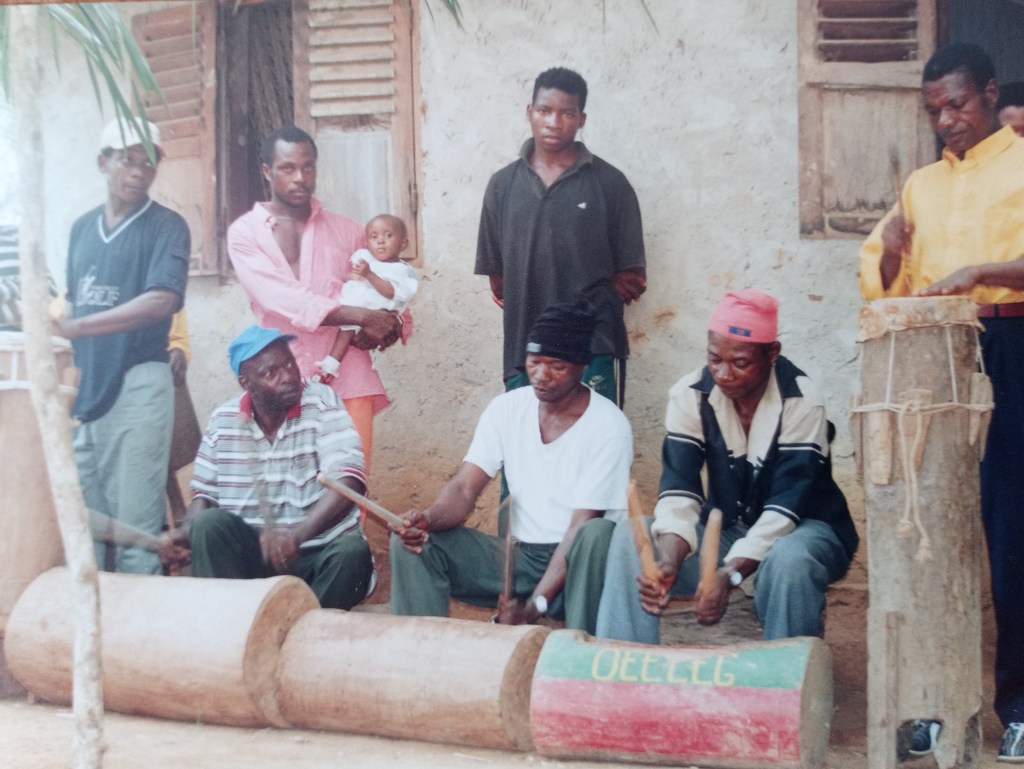
A village balafon orchestra, playing all night at a dote

Buea, the capital of Cameroon’s English speaking South West Province, is perched on the side of Mount Cameroon, a volcano and the largest mountain in West Africa. I had come to see the volcano erupting. But, apart from a red glow above the up-hill horizon, when the clouds cleared late in the evening, the eruption was not visible from town. So, I went and had a beer in a local bar and got talking to Victor and his friend Albert.

Are you a serious man?

When Victor found I had an Ewondo girlfriend from the Centre Province, he asked me if I was a serious man.

“If you are a serious man, you need to know how to dote your love,” he said. “I will tell you how to go see her father.”

The Ewondo live in the French speaking Centre province, so I asked, “How do you know about the Ewondo?”

“I had a love from there,” he told me. “You must be ready for what will happen. It is called the First Knock Door. When you go to see the father to ask for his daughter, you will say to the father, ‘You have a nice flower in the family that I love’.”

“The father will say: ‘I have so many girls here, I don’t know the one you really want’.

They will present you so many girls. And, the one you are looking for will not be among those they are presenting. And, they will start to show you one after the other. And, when all the girls are passed, you will tell the father that, ‘Among all the girls, I have not seen my love- the one I want’. And the father will say, ‘I don’t have any other daughters, I don’t know why you are disturbing me. You can go back to your country. You think I am a child, you can play with me!’ ”

“Then the mother will say, ‘There is another one child somewhere, I will go look for her. If that one is not the one you are looking for, I don’t think I have any other one in my compound’.”

“They will tell you that the roads leading to where that one is, is a very long distance and they need transport to go and bring their daughter. You issue them money to go where the daughter is, and when you give the mother the money to go look for that daughter she will tell you that her legs are bad, ‘I need some treatment before going’. You will give more money for the treatment. And they will go bring you a different girl- not the one you want.

Then you will be very angry.”

“The mother will say: ‘There is one other one- that is the final one’ and that they need another transport again. So now you will give them another money. Then they will go and bring you your wife. The face of the wife will be so covered and they will ask you, ‘is this the one you are looking for?’ ”

“You will say, ‘I want to open it’. You know her appearance, you know her structure very well.”

“You say, ‘That is my wife- I will just go and grip her’.”

“Then the father will sit down, and the father will be very angry. He will ask you, ‘Mr Man, this is the only daughter I have, now you want to take her away, I am dead’. He will pretend to fall fits- and they will give him some drinks- red wine- what you call in French ‘vin rouge’ 20 litres.”

“Gandia,” says Albert, naming the preferred brand.

“The girl will sit beside you and then you will call family heads and discuss the palaver and they will arrange a day that you people will come again. That is the first part, which is called ‘Knock door’. That is the first part- we have not yet finished.”

Victor told me, “This is how they do it for the Centre province, the Eton, the Ewondo, the Bulu.”

We ordered more beer, and Victor continued.

You will give Green,” the second phase of it.

“Now you are going back to your father-in-law, with your wife. Arriving there the girl is no more your wife, she is now a child in that house, and no more your wife. The father will ask his daughter that, ‘We have never seen a white man in our country in our village- you refuse to marry a black man because you want a white man’. ”

“This will not happen to you,” I said.

“But I just want to let you know what will happen to you, to be alert.”

“The father will call the girl. He will ask the girl openly, in front of you, with those drinks that you brought the first time, ‘This is the food that this man has bring- and wine,’ and the father will say:

‘Let me eat and drink this wine because I don’t want something that if I eat the food of this man and drink his wine then tomorrow he will escape from marriage. And tell me really if you really love this man, because we are now in serious business. If you want him- this is the food and the wine. We have prepared it, go and give it to your husband.’

“Then the girl will take some food in a plate, bring it in front of you, put the food in your mouth; then you will also take some of the food, put it too in her mouth. Then there will be clapping on you, there will be cheering. Then she will take the wine and give it to you. Then you drink, (you drink small), and you will take it too and give it to her and she will drink too.”

The bar owner brought the new beers and asked, “I will just open it, eh?”

We still had some beer in our bottles, so Victor said, “Allow it, allow it” (leave it).

Victor returned to his description, “And then you will embrace your wife. The family will very happy about the whole show now- they will have confidence that you will have decided to get marriage. That is the second part of it.”

The list- part three

“We are now coming to the final phase- the dote. And this is what we call the third part

They will ask you so many things to bring. Now they will give you a list for what they want from you to buy and bring for that girl.” (That is the bride price).

“And then you will bring them. It will be a very big festival. People will eat and drink hard and dance. Before the dancing they will tell you to open the floor with your wife- you and your fiancée til dawn.”

Victor gave me an idea of what would be on the list:

5 bags of rice 4 big hens 5m of materials (cloth)

10 machetes 20 files (for the machetes) 5 jugs of vin rouge

“It costs one million,” he said. (Over a thousand pounds).

I asked, “If you don’t have the money to pay for these things, what can you do?” “You will not bring according to this list. You will not bring them according to what they ask you, but according to what you can afford.”

Albert added something on how to avoid the bride price: “You can bullet that girl, make her pregnant. Then you bullet her again.” Her father will ask, “Who pregnant you?”

The daughter will say, “It’s the one.”

“And you don’t have much problem.”

As we drank more beers, the conversation moved on from marriage. Victor is built like Sonny Liston and Eric says that he has many girl friends.

“I am annoyed of him. He told me he can’t change. He has more than twenty girlfriend. We went to the hotel, he has a girlfriend. We went to the house, he has a girlfriend. Now he goes to another girlfriend. That is not right.”

“I love so many,” said Victor.

“You don’t love, you like.”

“You can go out with so many girls”

Eric said, “To me it is not easy it is bad.”

“Get up early you will see.”

“He must tell the truth,” said Eric, “but it is bitter”

A record of a conversation in the Apollo bar in Buea on March 1999. I had been keeping notes of this conversation, but by now my wrist was sore, and I stopped writing.

Appendix

The list for my dote (translated from the French)

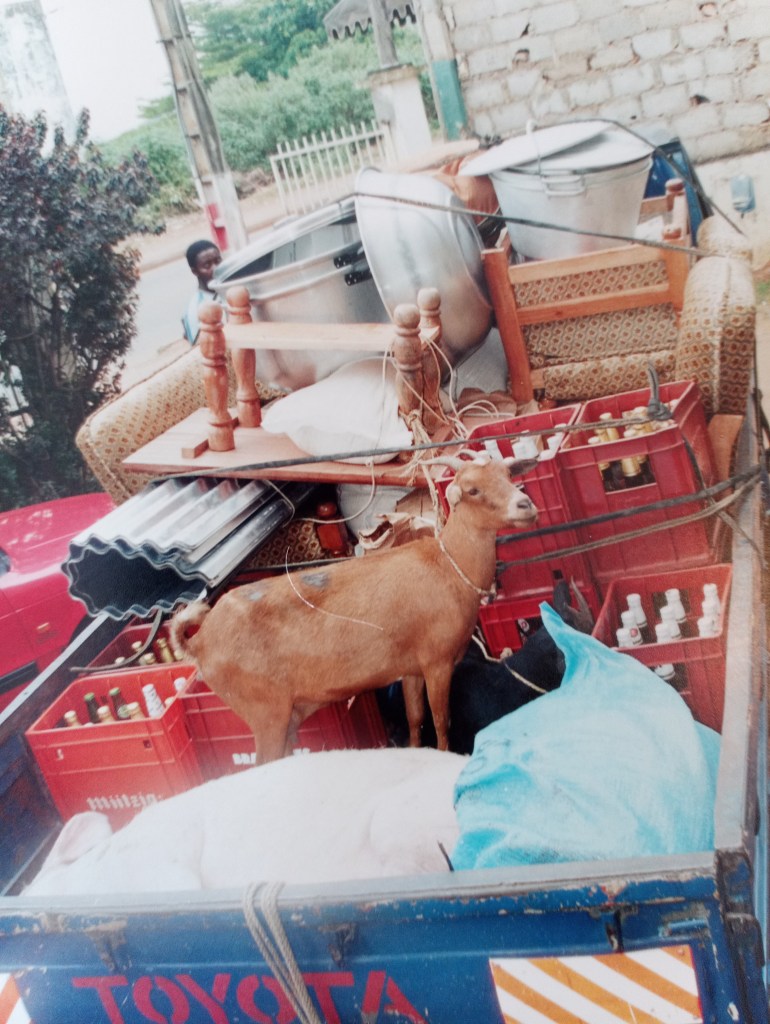
2 fat pigs 2 fat goats 100 kg rice 2 cartons tomatoes I bag of onions

4 bags of Maggi cubes 2 sacks of salt 20 litres of oil 5 palettes of fish

2 20 litre demijohns of red wine 12 cases of beer 10 litres of spirits

40 litres of palm wine 6 cases of soft drinks 1 bottle of rum

5 bottles of whiskey 5 cartons of Baron de Vallee wine 12 glasses

1 cork screw

For my father in law: A sofa set A dark suit and shoes

For my mothers in law: 40 sheets of corrugated iron roofing 2 large pots

1 double sided wool blanket 6 bolts of wax cloth

For Judith’s brothers: 5 machettes 5 files 1 radio for Balla 1 TV for Sidoine

This was the first list. A number of items for the bride’s sisters followed.

Some of the Dote on the lorry for the village

Getting Lucky (fiction)

A short story written about 1990. 15 minutes reading time.

[I wrote this story in a single sitting, on the bus back from the Seattle opera following a performance of Wagner’s Percival. I thought that, for most of us, relationships are far less dramatic than Wagner’s operas, and yet they are still consequential. This was my attempt to write a story of an ordinary emotional dilemma.]

Piter walked into the small kitchen and put his coffee cup besides the dishes from last night’s meal. The porcelain sink was chipped and a thin crack above the greasy water was etched black. Piter, pulled out the plug and grimaced at his greasy hand, ‘shit.’ He crossed the worn wood floor to the bathroom and washed his hands, then noticed there was no towel. He wiped his hands on his blue jeans, put on his coat, slammed the apartment door and ran down the stairs to the street.

An old Ford pulling into the intersection was blared at by an approaching van. Under a papier mache sky a sporadic wind shook the now leafless trees, which rained onto their sodden leaves. Across the street an old woman in a grey coat raked her lawn. An old man with an umbrella stopped to speak with her. Piter knew none of his neighbours. His coat flapping in the wind gusts and splattered by the tree’s rain, he walked to the corner and crossed against the light.

When Agnes came home through the dark afternoon she carried a large bag of groceries. The street lights glistened on her bright yellow Mac as her tired feet trod carefully between the sidewalk puddles. At the house door she held open her purse with one hand, manipulating the door without putting down the groceries. As she went into the kitchen she said, ‘damn,’ put the groceries on the floor by the fridge, went into the front room and turned on the TV news.

An hour later, Piter hesitated before opening the door. ‘Hi.’

Angie didn’t look up, ‘You could’ve done the dishes.’

‘I’ll do them now.’

‘It’s so disheartening coming home to this mess.’ She looked up but Piter’s back was to her.

‘Piter?’

‘Yes?’ He turned around.

‘Let’s be nice to each other tonight.’

Piter looked at Agnes, her face wan below short, almost black hair, her nose a little to the left, her slightly overweight body and her red rubber boots.

‘OK, I’m sorry’, he flashed a wan smile, ‘I’ve been a bit depressed with nothing to do all day.’

‘Come sit by me.’

‘Just let me clean up first.’ He touched her shoulder lightly and went into the kitchen.

Agnes sighed, and slipped off her boots, carrying them to the door. She picked up her bright yellow Mac from the floor and hung it above the boots. She looked out of the window at the diagonal rain.

With much clattering, and one broken glass, Piter got the dishes done quickly. Picking up a stained cloth he stood at the kitchen door.

‘What should I do about this cloth; it looks like time to throw it out.’

‘You’re in charge of the kitchen Piter, don’t ask me.’

‘But I don’t know that kind of thing.’

‘I don’t want to come home from work and talk about rags.’

Piter went back into the kitchen and wiped down the stove and counter with the cloth and put on the kettle.

‘Do you want a coffee?’ he called.

‘I want a special coffee.’

Piter came to the kitchen door as Agnes lifted a small bottle out of her purse. ‘Amaretto!’

Piter crossed the room, leaned down and gave Agnes a hug, kissing her on the lips, cheek, nose, forehead and hair. ‘Thank you, sweet love,’ he said. ‘Being in the house all day doesn’t give much reason to be joyful. I’m glad it’s you that comes home to me each night.’

‘More kisses,’ said Agnes.

Piter got up and made Agnes breakfast. After scraping it off, he kept the burnt toast for himself. When Agnes left for work at 8.15, he did the dishes and swept the front room. When he went into the bedroom he saw that Agnes had fixed the bed and set the two cushions she’d made against the headboard. He went out into the rain at 9am.

Agnes phoned at lunchtime but got no answer.

Piter ate his sandwiches at the back of the library where he couldn’t be seen. The papers had no jobs he could apply for. He had looked at Maclean’s, Beautiful BC, and a skiing magazine, but finished none of the articles. As he folded his sandwich bag, a pretty young woman pushed a cart of books around the nearest stack. Piter self consciously cleared the crumbs off the table as she began to stack the books. He wished he had shaved that morning.

‘I come here most days to look at the job ads,’ he said.

‘I was doing that until last week,’ she said.

‘Oh.’

She paused from stacking the books, ‘I know how hard it is to get a job,’ she said sympathetically.

‘There’s nothing,’ said Piter

‘I finished library school three years ago and I’ve only worked a year since. This job’s only temporary’.

‘Well I hope for your sake it lasts.’

‘Thanks.’

Piter had been a sporadic searcher for work, but for the next two weeks he went to the library daily- at about the same time and carefully shaven.

Piter arrived at Sally’s with a bottle of wine. Agnes was at her weekly woman’s meeting.

‘Ah, you’re early. I was just putting dinner in the oven.’

Piter sat in the kitchen watching Sally’s hips moving beneath her tight wool dress.

‘I’ve got some wine.’ He gave Sally the bottle.

‘It looks very expensive; you shouldn’t have spent all your money.’

‘Well I didn’t bring anything last time and you went to so much trouble.’

‘That was my one sure-fire dish; now I’m afraid you’ll be getting something more typical of my hit and miss style,’ she smiled.

‘I should have brought the wine last time.’

Sally laughed, and gently touched his arm.

After eating a slightly burned risotto, they moved onto the couch with the remains of the wine. Sally slipped off her shoes and sat with her stockinged legs on the couch. Piter touched her knee. They both put down their glasses.

Occasional clouds drifted past the waxing moon as Piter stood on the corner of Sally’s street. He was already twenty minutes late. Tonight he was sure Sally would let him sleep with her- but he hadn’t told her that he lived with Agnes. His chest was painful. He wanted Sally’s soft breasts, which he had felt through her wool dress. He imagined them mohair soft.

‘You’re late.’

‘I missed the bus,’ he put a cheaper bottle of wine on the table.

‘You look a little depressed.’

‘I’m going to lose my unemployment money.’

‘What will you do?’

‘I might have to get a job,’ he tried to make more than a thin laugh.

‘Poor you,’ Sally said tenderly.

Piter lowered his eyes.

Later he lay next to Sally in her small bed. Their love making had been ineffectual. He had come unexpectedly; she had not had an orgasm. Sally’s hand slowly and repetitively stroked his thigh. It was becoming aggravating. He put his hand on hers.

‘I’m sorry I wasn’t very good.’

‘It’s alright. It’s like that sometimes the first time.’ They both lay still.

Piter knew he must do something. He nuzzled her soft breasts with his closed lips.

This time they worked better together and afterwards lay bathed in sweet body smells.

Later, he said, ‘I’m glad you had an orgasm too.’

Sally squeezed him, ‘mmm, it was really nice.’

Piter, knowing he had to go soon, luxuriated in the touch and quiver of Sally’s down-soft skin.

‘You’re tickling me.’

‘I’ve got to go.’

‘Oh.’

Piter dressed quickly and then said, ‘I’ll call you tomorrow, sweet Sally.’

When he got home at 11.30, Agnes was in bed reading. He stooped to kiss her.

‘You smell funny.’

‘They put a free sample of deodorant in the mailbox.’

‘Oh.’ She closed her book, and turned off the bedside light.

Piter went into the bathroom and had a shower.

Agnes climbed the steep stairs carrying a bag of groceries and a large parcel covered with stylish Christmas trees coloured rainbow, silver and gold. She put the parcel down to open the apartment door, walking through the unlit front room to the kitchen. Wearily, she put the groceries in the fridge and filled the kettle, pushing aside a stack of dirty dishes to plug it in. She took a cup from the cupboard and coffee from the freezer.

Bringing the parcel in from the door, Agnes noticed Piter laying on the sofa, his lower back bare. A blanket had slipped down and lay bundled around his legs. One shoe lay upside down on the floor, the other beside it.

Agnes closed the door behind her, put down the parcel and went into the kitchen. As she stood she heard the kettles quiet fury next to the single cup. Brushing aside a lone tear, she reached into the cupboard and put another cup beside it.

A short walk in the Cameroon rainforest

(Summer 2014)

Simon Waters; 15 minutes

As we left Assok, morning light streamed down through the rainforest tree tops. Soon the trail crossed a wide mud-brown river on a fallen tree trunk and Etienne strolled unconcernedly across. Although my pack was lighter than Etienne’s, I needed to protect my iPhone, and digital camera, so I half crawled across the log, which made Etienne laugh.

Soon after, we stopped in a small clearing where Martin, another Baka from Assok, had brought a plastic jerry of palm wine out of the forest to lubricate our journey. Joseph, who had left the village before us carrying a regime of plantain, was also waiting, and we four drank the fresh, sweet palm wine, after clearing off the floating ants and palm chips. After a couple of cupfuls, I set off along the trail first, to get a head start and gain a respite from the relentless ease with which my Baka companions walked through the forest. The path was frequently hidden by undergrowth at ankle and knee height, through which rattan snaked, and so a real trip hazards for the unwary. The three others soon caught up.

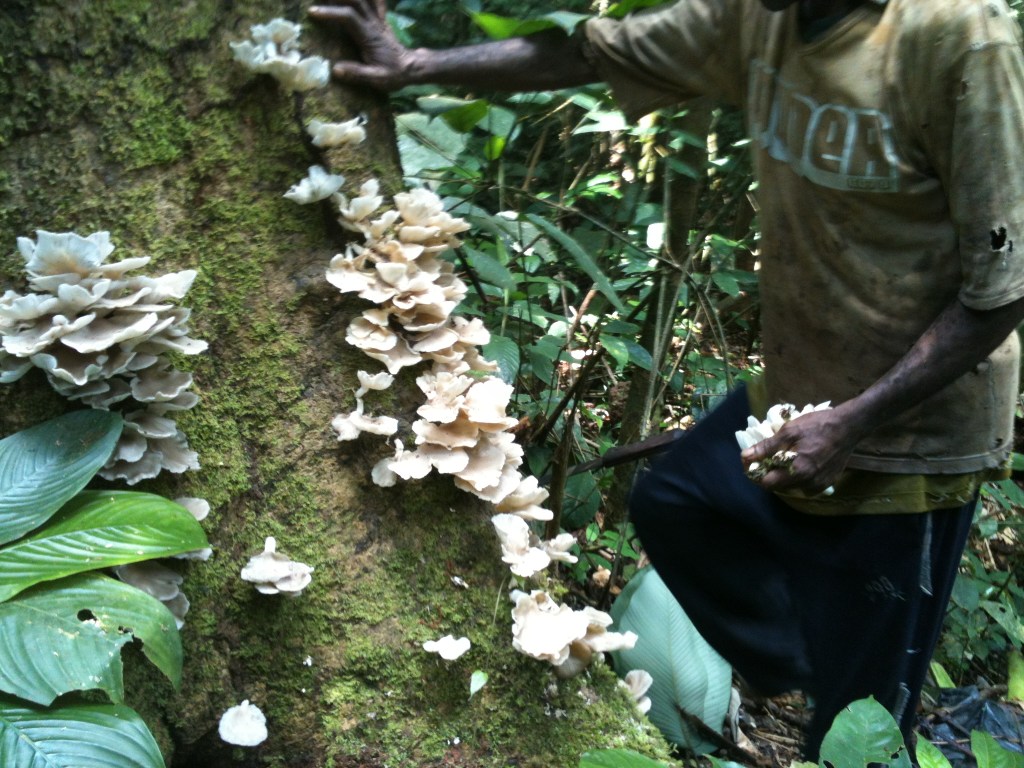
We stopped after a while and Joseph picked handfuls of mushrooms which resembled Chanterelles from a trail side tree, and Etienne wrapped them in leaves from a nearby shrub and tied them to his rattan backpack. After an hour or so we had another break, this time so that Etienne, Martin and Joseph could each swig a small plastic sachet of Cameroonian “whiskey”. And so the walk continued at a fast pace, me often stumbling on hidden roots, or snagging low hanging vines, between hourly pit stops so my three Baka companions could swig another whiskey.

Returning to Cameroon after ten years, I had wanted to visit my Pygmy friend, Etienne Mopolo, a Baka who lived in the east province. I had first met Etienne in 2000 when he had guided me into a village-run gorilla habituation project. In 2002 I had visited him in his village in the UNESCO World Heritage Dja Reserve. In the Dja, Djengi the spirit of the forest had danced in the moonlight as Baka women sang their intricate polyphonic songs. I hoped Etienne would again take me into the rainforest to stay in a Baka camp and further explore the Dja reserve.

I showed Etienne’s picture to my host Samuel Nnah in Yaounde. Samuel has worked with Baka, Bagyeli, Twa and other forest people across central Africa for fifteen years and he recognised Etienne. After a few calls to colleagues, Samuel found he was now living in the village of Assok, in the south region, and got a message through that I was coming to visit.

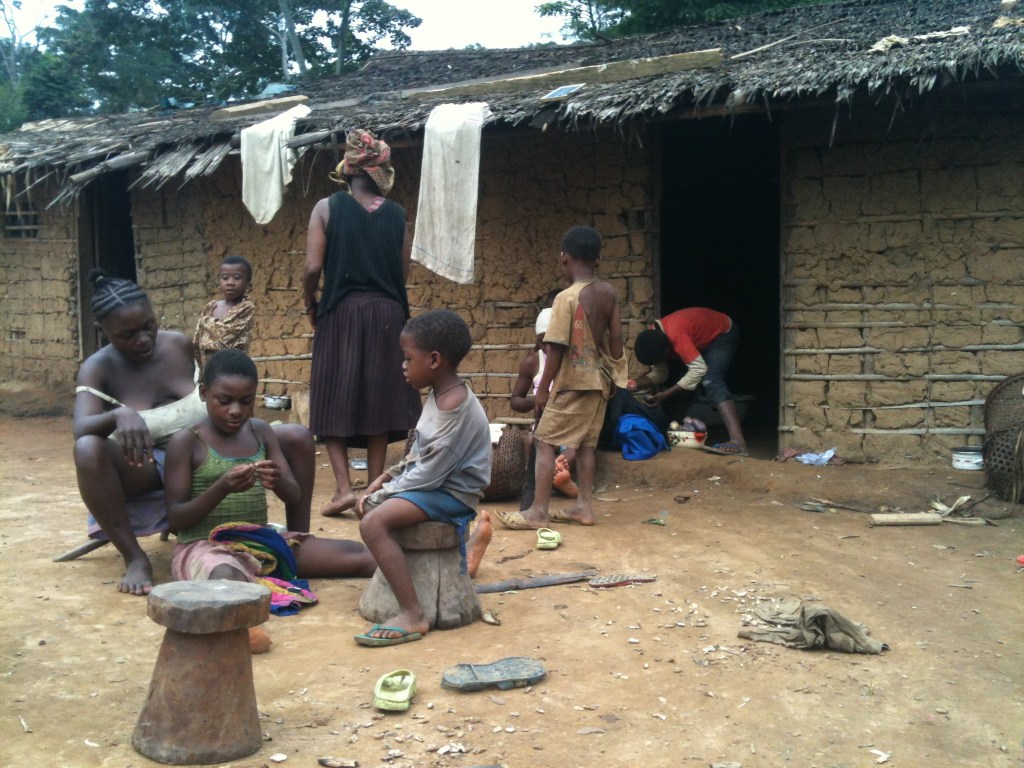
Assok is a small village that stretches along the road to the Congo 100 km past Djoum, the last town of any size. Assok is in two parts: a Baka village a couple of hundred metres before the river, and a Bantu village five hundred metres past it. Both parts of the village use the river to wash themselves and their clothes and to get their water. The Baka are hunter gatherers, one of a number of Pygmy peoples who live a semi-nomadic life in the rainforests of central Africa. The Cameroon government has relocated the Baka along the roads, where most now live near Bantu villages. They are often seen as ‘possessions’ by the Bantu, who consider them inferior, and primitive. Racism against Pygmies in central Africa is substantial and most Bantu will not eat food cooked by a Pygmy. As long as the Baka live a large part of the time in the forest, and can hunt game to exchange for village goods, they can maintain a reasonable amount of independence. But once the rainforests are degraded, and most of the game hunted out to feed logging camps or mines, the Baka often live an impoverished life working as agricultural labourers for tiny wages, often in permanent debt to a villager who considers them ‘my Baka’.

After a day and a half’s journey from Yaounde, I arrived at Etienne’s house, a typical rainforest roadside construction of a wood frame covered in mud daub, but larger than any other house in the Baka village. I was never quite sure who lived there, but there were at least twelve, including his wife Salome, their five children, his wife’s sister and her baby, his father in law, and several other adults.

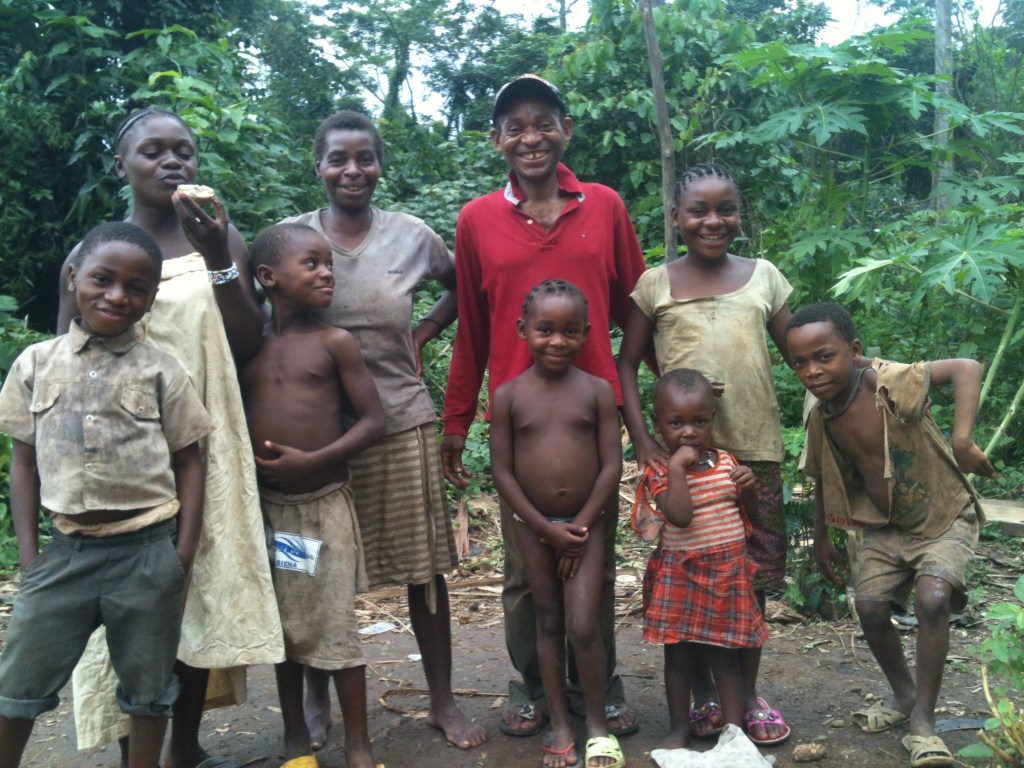
Etienne, his wife Salome, their children and her sister

In front of Etienne’s house, Assok

As dark fell, people arrived from the rest of the village. Etienne took out his guitar and sang an upbeat hymn, accompanied by several of the older children on an upturned pot or wooden block. The lively chatter, the music’s changes of pace and rhythm, combined with plenty of palm wine, and the light from a full moon and open fire, made for an engaging evening. I went to bed under a mosquito net in a windowless room on a sagging rattan bed covered in several small pieces of thin foam and the sheet I’d brought. The room had no ceiling, as the walls did not reach the roof, and so sound travelled well between rooms. Conversation in the hut continued for over an hour as people called, jested, laughed and shouted between the rooms. The two babies occasionally cried, and were nursed and sung lullabies, and the kids played outside in the moonlight until late. Slowly it grew quiet. But throughout the night there were moments of conversation, lullabies sung to one or other of the babies and occasional laughter.

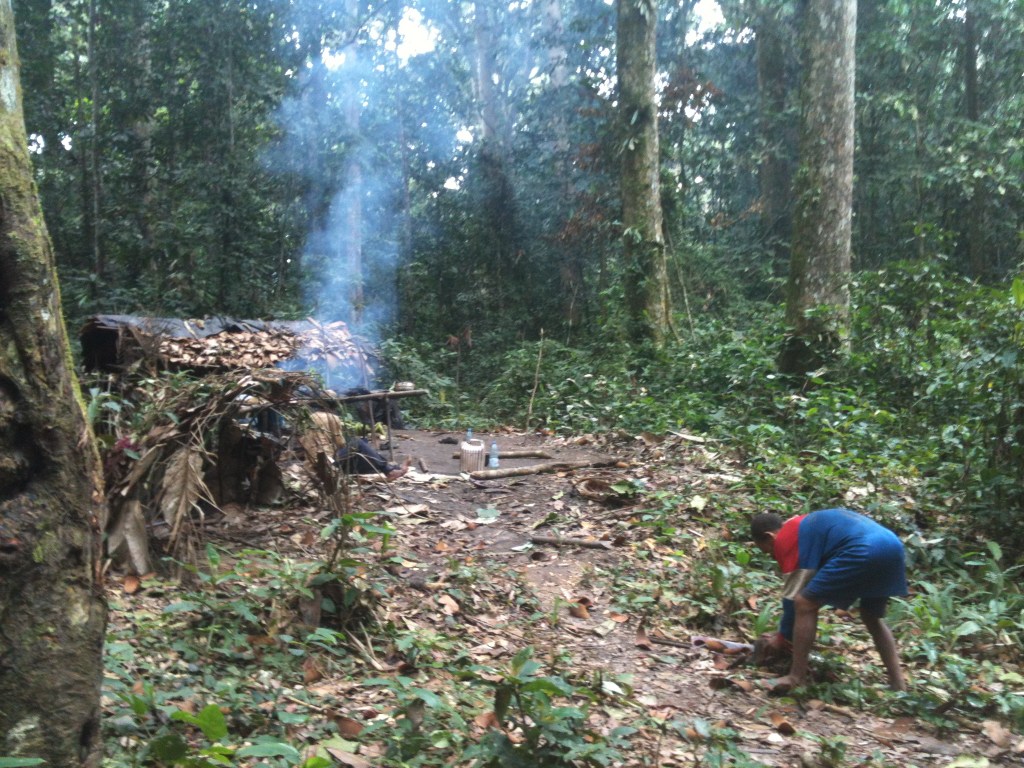
Back on the hike, the path continued through twenty or thirty metre high forest and crossed occasional small streams, some surrounded by wide areas of wet ground. I tried to keep my boots dry, following Etienne as he detoured or hopped across the puddles, but the flooded areas increased in size and there were a few wide areas flooded about a foot deep. Soon I stopped bothering and waded through the water. Etienne had a pair of plastic shoes, and both Martin and Joseph had bare feet, but my light goretex hiking shoes were soon sodden, and heavy. The forest was dense, but where trees had fallen, small patches of light filtered down from a cloudy sky. After about four hours, we arrived at a forest camp, where half a dozen mongolou (round leaf-covered huts) stood in a small clearing surrounded by avocado and papaya trees. Here we had a break, and Etienne collected some avocados, and drank another sachet. After more walking, much of it wading through foot deep water, we arrived at Etienne’s trapping camp, a small clearing with a low flat roofed shelter and two mongolou with most of their leaves missing. I was exhausted from the pace and lay down in the shelter, while Etienne and Martin went off to check their snares, and Joseph got a fire going and boiled some of the plantain he’d carried from the village.

The camp was set in a clearing under a particularly unpleasant tree. Large seed pods whistled to the ground and landed with a violent whoomf! Joseph told me that they were dangerous if they hit you on the head, but sat untroubled by the fire. I crept into the shelter when not needing to be outside, and listened to the loud crack when they landed on the roof.

Etienne at the forest camp

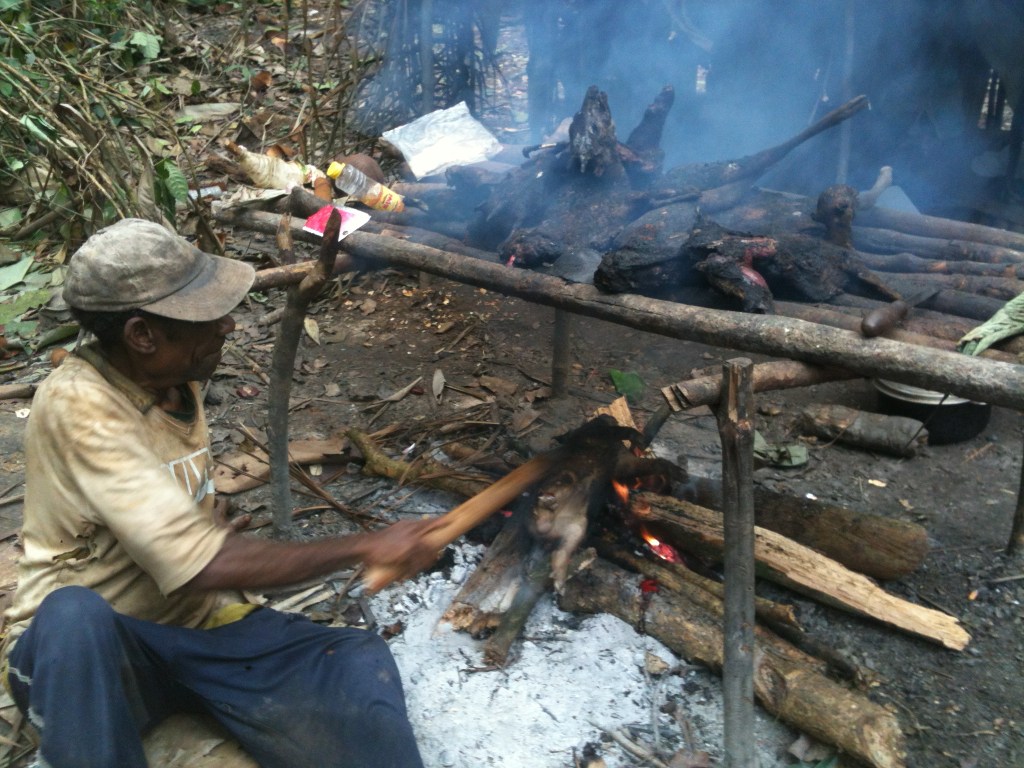
Etienne returned in the dusk with three Lièvre, small forest deer, and told us he’d seen a leopard very close. He skinned and cut up one of the Lièvre, and Joseph cooked it in a sauce with some of the mushrooms we’d collected. The other two he skinned and halved and set above the fire on the smoking rack. Martin returned in the dark. He’d found nothing in his snares. Sitting around the small fire in the dark, we ate a delicious dinner of Lièvre, mushroom and plantain, before going to bed.

smoking wild game

I shared the small shelter with Etienne and Martin, lying on the too-short bed made of split wooden slats. Joseph slept by the fire on a few large leaves. I had forgotten to bring a sleeping mat or cover, and so slept directly on the slats like the others, and spent a cold and uncomfortable night, but enjoyed the forest sounds. For breakfast we reheated the rest of the Lièvre with more boiled plantain, and after a wash in the nearby stream, set off to check the rest of Etienne’s triplane. We visited more than a dozen snares, passing a gorilla’s tracks, and finding several edible fruits, including a Moabi, which is like starchy sweet custard.

Etienne had snared many more Lièvre, a Biche (a larger and very tasty antelope), and a small wild pig. For lunch we cooked the pig, while Etienne finished off the Lièvre. During the day, Etienne, Martin and Joseph checked their snares, peeled plantain, gathered firewood, cooked, ate and fed the fire. Twice I saw Joseph make a tool, once cutting a piece off the bed slats to make a knife to peel plantain, and once turning a piece of firewood into a pestle to pound the plantain into fou-fou. I spent my time eating, sleeping, taking pictures, recording forest sounds and Baka conversation, and following Etienne around to his snares. That evening Etienne caught four more Lièvre and a porcupine.

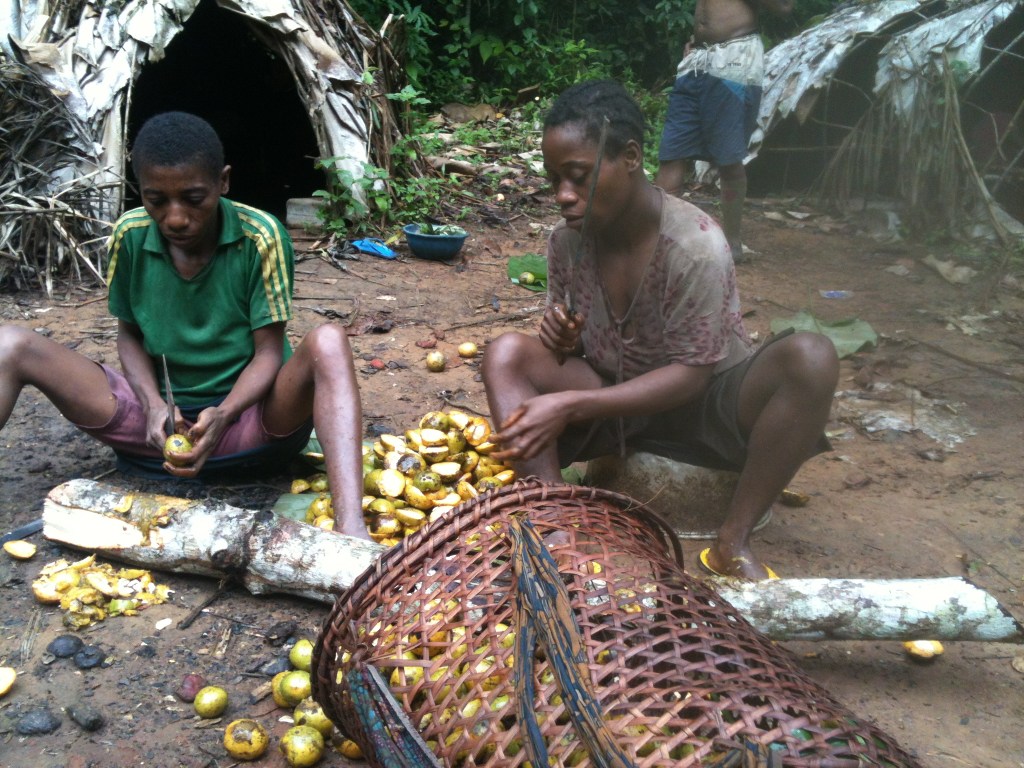
The next morning was chill and grey. After another tour of Etienne’s snares, we set off for the village, ploughing on as a light rain increased, finally descending in a deluge that soaked us to the skin. I stopped to break off some wide leaves as an umbrella, but we were almost at the mongolou camp. Here we cowered in one of the shelters, which had most of its roof intact. A fire was started, and Etienne began to dismantle the drying rack and feed it into the fire- another could easily be made when needed. Soon after, two women, a young girl and a baby arrived and joined us by the fire. When the rain stopped, the women went off to collect wild mangos, and then sat and split them to extract the seed, which make a delicious sauce.

Splitting wild mangos to extract the seed which makes an excellent sauce

When we returned to Assok, Etienne’s wife Salome told him their toddler “little Salome” was very ill. She began daily visits to the local health centre in Mintom where she was treated with injections for malaria.

Little Salome before her treatment. She was so weak she couldn’t walk.

After three days I left to return to Yaounde. I stopped at Djoum, and bought a mobile phone for Etienne as he’d asked, and sent it back in the car I’d come in. That night I phoned Etienne, to make sure he’d got the phone and to ask how little Salome was. She was still lethargic and still unable to stand. I phoned Yaounde and asked my host Samuel if he could send me some money to be repaid when I got back. Next morning I called Etienne again and asked him to bring little Salome to Djoum. The next day we went to the Military hospital where she was diagnosed with not only malaria, but also intestinal problems and malnutrition. I spent a few days with the family in Djoum, making sure they, and especially little Salome, were well fed and receiving treatment. I spent both afternoons and nights visiting the Baka village where they were staying with relatives. The cost of Salome’s treatment which I paid for (including the family’s travel costs and the expense of staying away from home) was about £80, more than Etienne made in three months, even though he is an excellent hunter. Because healthcare is so unaffordable, most Baka children don’t get proper treatment, or any treatment, when they are sick, and many die of easily curable diseases such as malaria. Two years earlier, I had carried out research in the DRC on Twa Pygmies access to healthcare. I had come across numerous cases where children died unnecessarily of diseases when the treatment was available, due to the inability to pay and discrimination in provision. Fortunately, a call to Etienne’s new phone a few days later gave me the good news she’d made a full recovery. Salome was toddling around with the other children, as right as rain.

The mango gatherers arrive in the rain
Two Baka women splitting wild mangoes in the forest camp
Walking through flooded rainforest

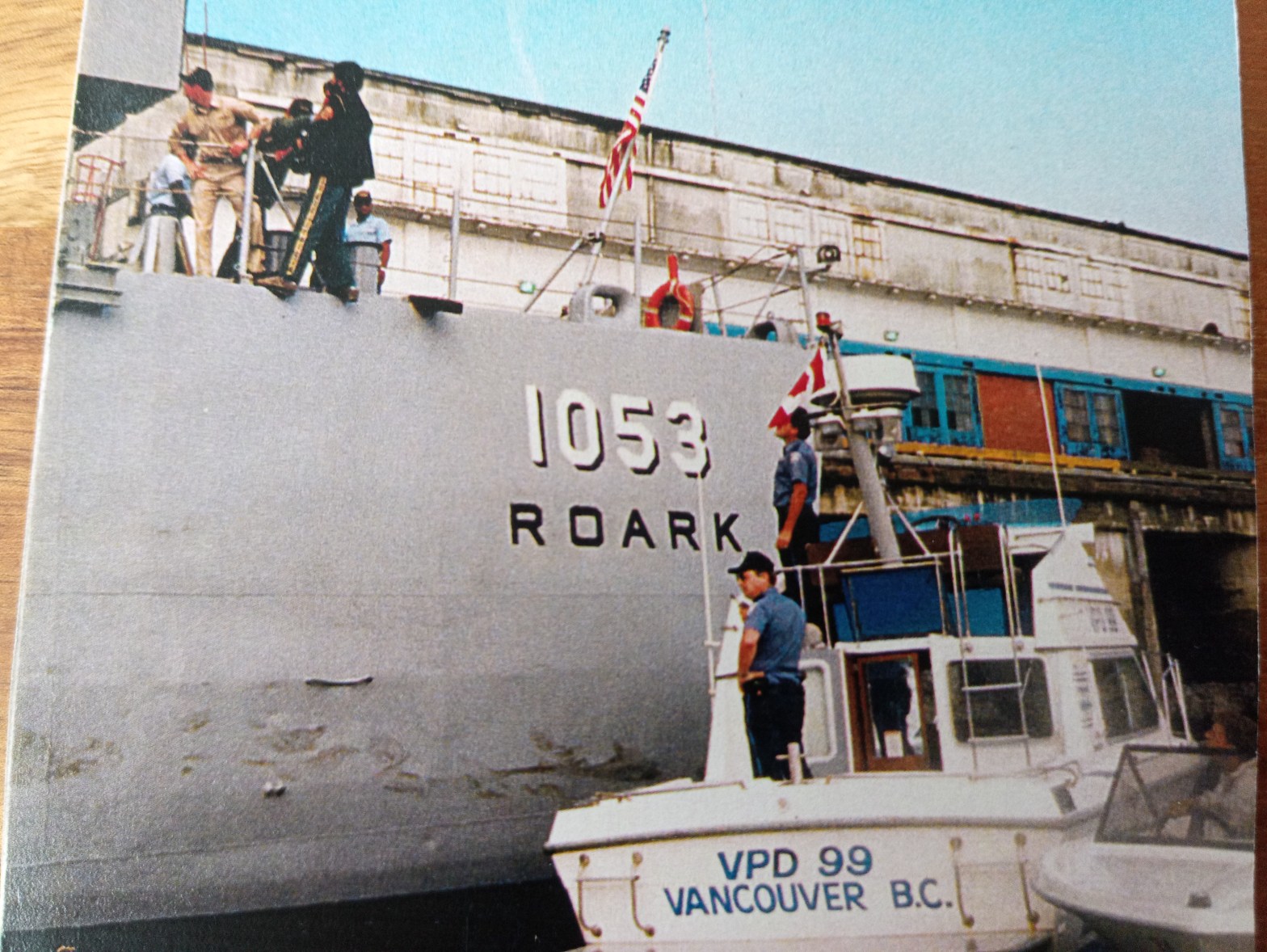
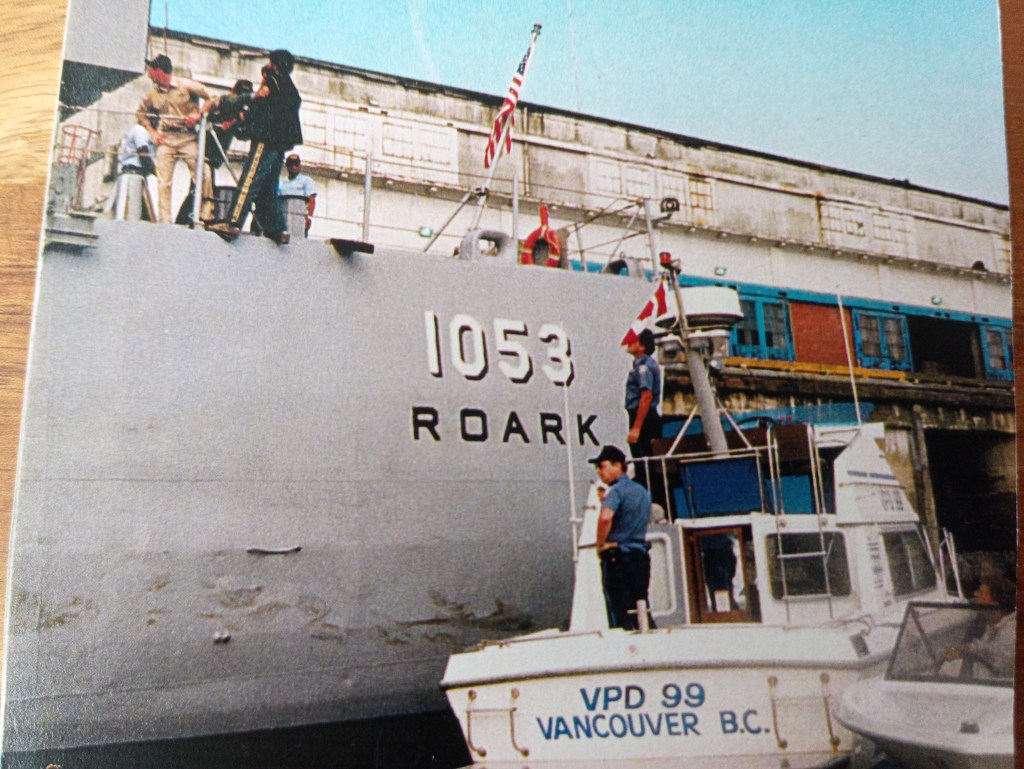
Canadian Customs boards US warship

USS Roark, Vancouver

1000 words/10 minutes

The tiny Greenpeace sailing boat motored quietly towards the USS Roark, a nuclear armed warship, tied up to a dock in Vancouver, B.C., I felt sick. Nobody, as far as I was aware, had ever tried to board a US warship, and I was to be the guinea pig. I didn’t want to be shot by the US marines as I climbed up the side of the American frigate. I knew there would be a scandal if they did shoot me, but I might not be alive to enjoy the US Navy’s discomfort if the captain ordered me shot, or a trigger happy marine shot me by accident. And, I wasn’t convinced their protocol would ensure they didn’t shoot me.

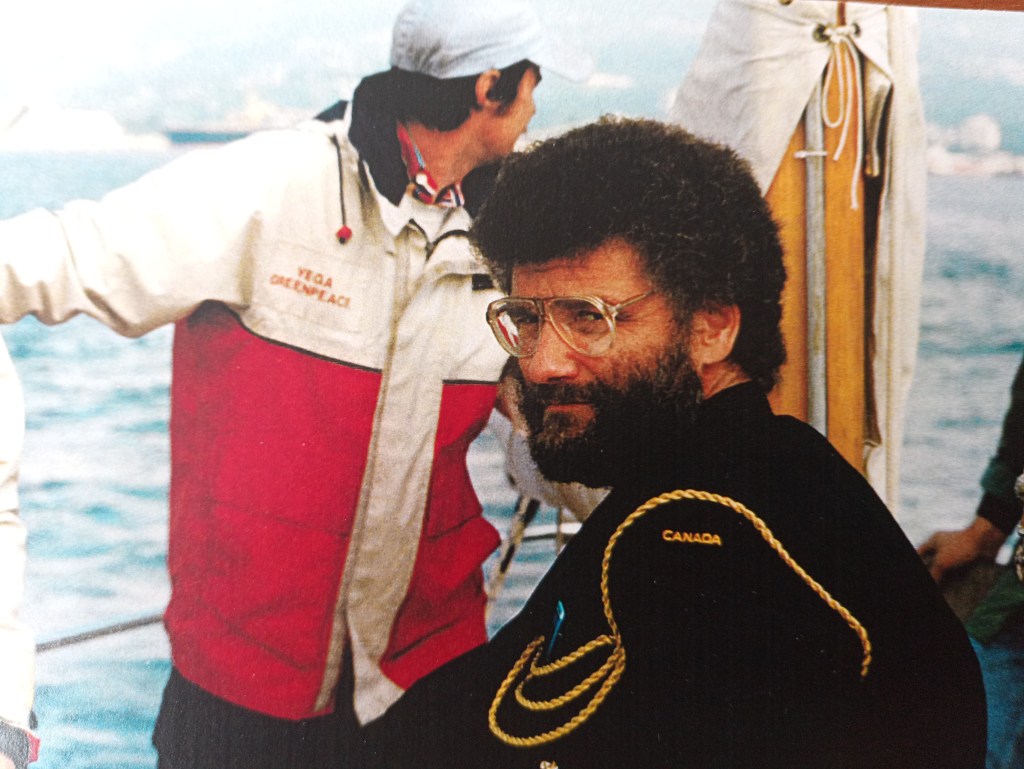
Wondering if I’d get shot. Not feeling happy at all.

It was a mixed blessing that Steve Shallhorn, Greenpeace Canada’s Nuclear Free Seas campaigner had complete confidence in me. When he’d come up with the idea he’d chatted with me at the office. “Simon, with your gift of the gab, you are the only one that can pull it off”. It was broad day-light and our boat was followed by another boat carrying Canadian print and television media. But the US navy was bound to be touchy about anyone boarding their ship uninvited.

I was on board the Vega, the iconic Greenpeace sailing boat that had twice ventured into the waters around Mururoa atoll in 1972/3 skippered by David McTaggert, a Canadian who later founded Greenpeace International. McTaggert had been assaulted by French marines, who had boarded the Vega and beaten him badly, causing him to lose the sight of one eye. The French had later blown up the Rainbow Warrior killing Greenpeace photographer Fernando Pereira in 1985. I had no confidence the Americans would be any less protective of their nuclear fleet. The Roark was berthed in Vancouver, a self declared Nuclear Free City. But the waters around the city were a federal government jurisdiction and the city of Vancouver had no control over what ships came to visit. As the Vega approached the Roark my pulse raced and my stomach felt sour.

The Vega had a high powered crew: Twilly Cannon (who later became Greenpeace US action coordinator) was skippering, while John Sprange the Greenpeace International Action Coordinator, and Pat Herron the Greenpeace US zodiac legend, both hefty blokes, were there to hold the ladder I was to use to climb aboard. In order to avoid possible legal complications for Greenpeace (!), I wasn’t dressed as a Canada Customs officer (the official designation). Instead I was dressed as a Canadian Customs officer: wearing an official looking jacket found in a charity shop with added gold braid and brass buttons, and a pair of green cord trousers with stripes down each leg, all laboriously sewn on by me.

Before boarding, I read out a statement: “I represent Canadian Customs, and it is a Canadian custom to be nuclear free. I will be boarding your vessel to confirm whether you are carrying nuclear weapons.” The ship then went aside the USS Roark and the ladder was hooked over the ships rail. “I am coming aboard”, I called. “Negatory” responded a burly seaman and he and two other sailors quickly tipped the ladder off. John and Pat hooked it back on again and John shouted “Go, go” and I scurried up the ladder like a rat fleeing the wrong ship. At the top of the ladder the three sailors grabbed and shoved me and tried to throw off the ship. I feared that if I was tossed back onto the deck of the Vega, I would possibly crack my skull or break my back, so I shouted to the Vega to cast off. This took what seemed like an age, as I clung on in panic until I saw that they had got out from under me. One of the three sailors was painfully forcing my fingers off the cable of the ships rail. I clutched the cable frantically, while the other two sailors pushed and shoved at me from the other side of the rail.

Once I was sure that the Vega was away, I considered letting go. Being tossed into the sea by American sailors would show their disrespect for Canadian Customs! But with a strength born of desperation, and too much experience rock climbing of having to hang on when a slip could mean a serious injury, I managed to hold on. After a few minutes of tussling, the three sailors stopped trying to throw me into the sea. I stood with each arm held by a sailor, loudly demanding the right to board and make a search to discover if they were carrying nuclear weapons.

I carried on with my demands to inspect the ship for nuclear weapons. I demanded the captain call off his sailors and show respect for Canadian Customs. “You are guests in our country. We have a right to know if you are bringing nuclear weapons into the middle of our city!” After a while, the sailors relaxed, and just held me without trying to throw me into the cold water. Ten minutes later, two Vancouver Harbour police boarded the ship, from the dockside, crossed the deck and escorted me off. I was taken to the Harbour Police station on a quiet back street behind the docks, and after being booked I was let go. After all the tension and high level of adrenalin, I got out of the police station feeling a little flat. It was still early in the day, Steve Shallhorn and the press people were dealing with media, and the Vega crew were taking the boat back to its dock. I am not even sure that I got a free beer out of my frightening mornings work. But at least I hadn’t been shot.

video

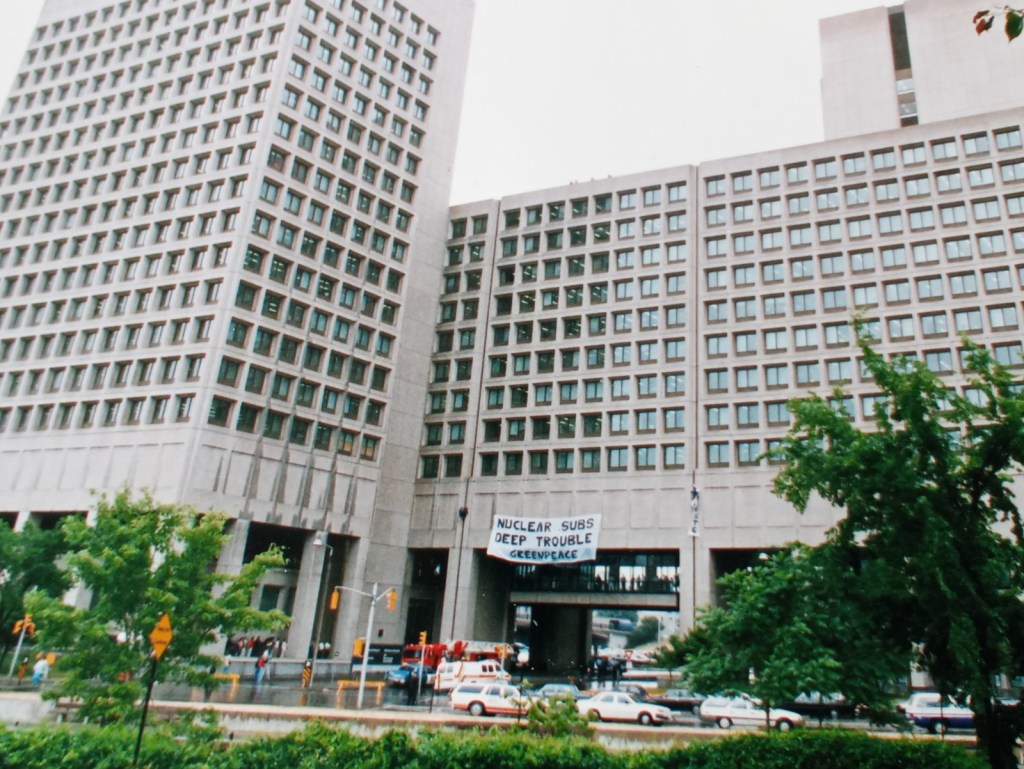
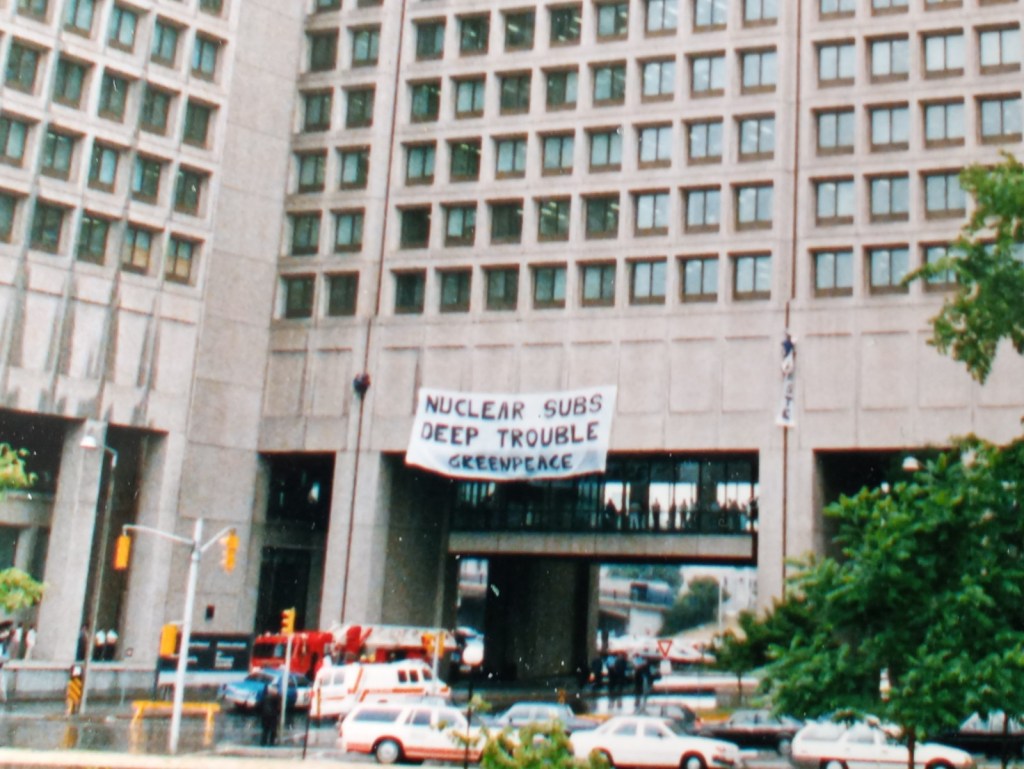
Nuclear Subs Deep Trouble

Nuclear Subs Deep Trouble- on Canada’s Department of National Defence HQ in Ottawa

Stopping Canada buying nuclear submarines

In the middle of the summer of 1988, I got an urgent call to go to the Greenpeace Toronto office to meet with Steve Shallhorn Canada’s Nuclear Free Seas campaigner. Steve got straight to the point: he wanted me to plan an action in Ottawa in a few weeks. I told him that I was extremely busy, and didn’t have a moment to spare. Steve asked for ten minutes to lay out the case.

Canada’s Conservative government was proposing to buy 10-12 nuclear-powered submarines for what they said would be eight billion dollars, though it was widely believed it would actually cost over 30 billion dollars. There was opposition in parliament and from unions, the peace, women’s, and environmental movements. A majority of Canadians were against the plan, but the Conservatives had a large majority and could get the legislation through easily. Steve believed that the Conservatives would announce whether they would buy British or French submarines in the next few weeks. Discussion of the issue had disappeared from the media. Once the decision was announced, protest would be too late. Steve wanted to embarrass the government just before they announced their choice of which submarine by hanging a banner on Canada’s Department of National Defence (DND) in Ottawa. This would bring the issue back onto the front pages while there was still a chance to change the outcome. Steve had visited the DND, and spotted a pair of wide tracks going up the building. He asked me to go and see if they were climbable. The issue was so important that I had to say “Yes.”

A few days later, I drove to Ottawa to look at the DND. There was a tall concrete tower on one side of a busy road and a shorter block on the other side. They were connected so that the road went underneath the middle of the building. On either side of the road, a shallow but wide crack climbed up the side of the building. If we could climb these cracks, we could hang a banner across the road. I measured both cracks, they were 8 inches wide and about 4 inches deep. I had never seen any climbing equipment big enough to fit, but there are pieces of equipment used by rock climbers called cams that fit into cracks and expand on a spring. They are strong enough to hold a falling climber, and would surely work here. However, as far as I knew, they were only made to fit cracks up to three or four inches wide. If we could get a manufacturer to make us cams for these much larger cracks it should be possible to climb the building. Cams are strongest when compressed under tension, so we would need about 10 inch cams- which would be enormous and quite heavy.

I would have to be one of the two climbers, as we were short of trained volunteers. The second climber also had to be a Canadian as it wouldn’t be appropriate to have an American protesting Canada getting nuclear submarines. The only Canadian climber available was Spider, who was a great guy, but a beginner. This climb was tricky and going to need the focus and skill of an experienced climber. A lot had to be done in a couple of weeks, and I was already working flat out.

A Greenpeace climber from the US offered to help by ordering the six bespoke camming devices from a company in Oregon, I thanked him and gave him the measurements of the crack. I discovered that another piece of large equipment (the Big Bro) already existed . I hoped they would be effective to hang the banner on, and though I’d never seen one, I ordered four from the Mountain Equipment Coop in Vancouver by mail order. However, there was still a real difficulty as I hadn’t found a climber to accompany me on the climb. Then I remembered a Quebecois climber I had met a month earlier on a day off at Mt Tremblant, a climbing area north of Montreal. He’d asked me what I was up to as I trained Spider in the basics of climbing a rope and I explained we were about to start a full summer of actions in Quebec and Ontario. Nelson had said casually that he’d be interested in doing something sometime with Greenpeace, and I’d taken his number. He was my only hope, so I called him:

‘Hi, Nelson, it’s Simon. Remember we met last month at Mt Tremblant?” Fortunately, he did.

“I have something coming up and need a climber. Are you free next week?” Fortunately, he was.

“It’ll take a few days to train and prepare, are you free for four days?”

“What is it for?”

“I can’t tell you over the phone”.

Nelson agreed provisionally, and we planned to meet in Ottawa in a week.

I carried on with my day job of organizing a series of actions around the Greenpeace ship Beluga boat tour and then spent every spare moment planning for this action. As I was on the road, I couldn’t use a Greenpeace office credit card to pay for expenses, so everything went onto my personal card. I had to order the banners, arrange for them to be lettered, sort out delivery to the Ottawa office, and talk to the canvass coordinator to request help from the canvassers as a local support team. The Ottawa office also arranged van hire, ladder hire, and other equipment. Steve sorted our hotels, and took up a lot of slack. I heard no news from the Greenpeace climber about the critical giant cams and began to get worried. I tried to track him down, but couldn’t contact him. This got serious as the action was approaching, and I didn’t have the necessary equipment. I called the company making the cams, but it took a number of calls to find anyone who had heard of the order. I was on the road, so no one could call me back, and I had to make many of the phone calls from coin boxes in gas stations. By the time I got to my motel at night, offices and factories were shut. When I did get through to someone who knew about the cams, they had not been told how urgent they were. They said they’d try to get them ready on time. I told him I was from Greenpeace, and that “something important” depended on them being with me in five days. He said he’d see what he could do. There was also a hold-up in the delivery of the Big Bros. I needed all these things. It was touch and go. If one of the key components was missing, we’d have to call off the action.

When Nelson got to Ottawa and I told him the plan was to climb the Department of National Defence. He was shocked. Not surprisingly, he thought we’d get into serious trouble. This was an enormous step for him from making a general offer to help us sometime, to climbing the belly of the beast. For a while, it seemed as if I might need to scramble for another climber or call the action off, but after some thought, Nelson very bravely agreed to join me as the second climber. We spent half a day together going over the details of the climb, and how to deploy the banner. As he was a lot younger than me, and very fit, I got him to carry the banner on the day. In case we couldn’t get that large banner out for some reason, I had another, smaller banner in my backpack. Neither the cams nor the Big Bros had arrived and I spent some time on the phone chivvying my suppliers and getting them air freighted. There were now a number of things that could go wrong. After getting assurances that the two kinds of specialist climbing equipment would be airfreighted, I had to make sure that everything else would work.

Fortunately, Ottawa had a full-time door-to-door canvass operation. When I arrived in Ottawa, I had met the canvassers in the afternoon before they went out canvassing, and recruited most of them as volunteers. The next morning we had a thorough briefing. I had asked the Ottawa office to rent two 26 foot extension ladders. If we started climbing from road level, it would take several minutes to get above the reach of security, and that was too long to risk. I explained to the ladder team their key role. The most critical time in the whole action was going to be getting very quickly off the ground and too high to grab. The height you need to get to be safe is more than you might think as they might have a step ladder- or certainly a chair close by. Even when we climbers were out of reach, the rope we needed to connect us- which we’d use to pull the banner across, would inevitably sag lower. I felt we had to get 20 feet off the ground very quickly to be safe. The ladder crew’s speed and efficiency would be key to the success of the action.

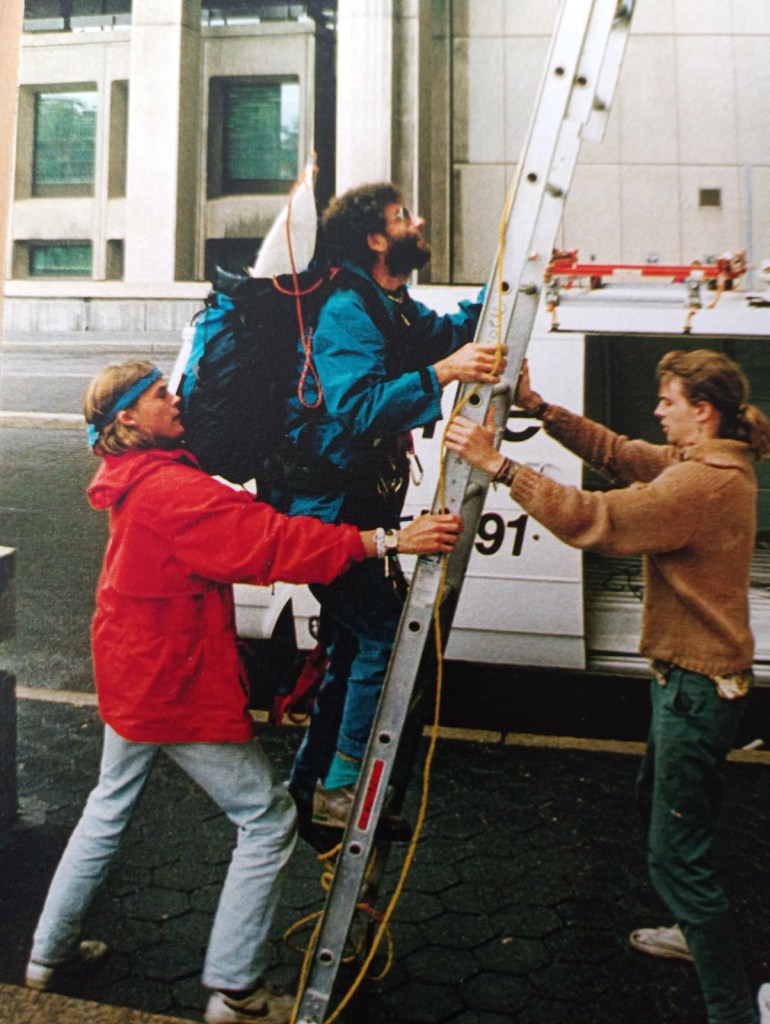
The plan was to drive up in a van, stop just before the tunnel, block the road, and run a rope across to join me to Nelson. At the same time, two teams would each pull a ladder off the roof of the van and set it up by a crack. With the ladders held securely, Nelson and I would climb up, stick our camming devices into the cracks, and clip in (connect ourselves to the camming devices). Once we got our weight off the ladder and onto the cams, the ladders could be removed, collapsed, and put onto the roof of the van, and the van would drive off leaving us unreachable. Until the ladders had been driven away, they could be used to come after us. It was critical how quickly we could get from stopping the van, to deploying the ladders, to getting up the ladders and attached to the building, to getting the ladders out of there.

Two nights before the action, after the canvass had finished working for the night, the two ladder crews of three people each, with their ladders, the road crew, Nelson, and I set off in a canvass van with the seats taken out. We drove around the outskirts of Ottawa looking for a place to practice and settled on a large, blank, thirty-foot high wall in a housing development. We swung into action. The van pulled up to a stop, and the two ladder crews jumped out, dragged out the ladders, and set them up twenty feet apart. Two of the road crew role-played blocking the road, and the third connected a thin cord- the banner pull line, to me and ran across to Nelson and clipped it onto him too. Nelson and I clambered up to the top of the ladders wearing our packs stuffed with various heavy items. This took far too long. We returned to the van for a discussion on what had to be done more quickly, and after circling the block, we tried again and cut the time in half. Another chat to see how we could make it really smooth and we did a third and very efficient deployment. Our late-night ladder antics caused surprise to several people coming out of the building.

The cams arrived the day before the action was planned to take place. It was very worrying that they weren’t big enough. They were barely 8 ¼ inches which was an insufficient margin for an 8-inch crack. This was a real blow. The one piece of equipment we had to fix ourselves to the building was borderline, and could potentially pull out, dumping us on the concrete below. I really hoped they’d work. We also had the Big Bros, they expanded to 10-12 inches and seemed they’d do a good job holding the banner. Nelson and I played around with the equipment in the hotel room, but we didn’t have the time to find somewhere to test them.

On the morning of the action, there was a delay as there appeared to be an increased security presence at the DND, and Nelson and I sat in our hotel room, all kitted up with harnesses on, waiting for a ‘go’ from the scouts near the DND. Not having a set start time adds to the nerve-wracking nature of an action. We were doing a really important action, with a climber brand new to Greenpeace, a new crew, equipment we had not had a chance to practice with, and a very low tolerance for the critical cams which would hold us as we climbed high above a concrete pavement. There was too much to go wrong, and no time to make things safer. On principle, I should have called the action off. But the issue was too important, and we would have to deal with any problems as they came up.

Getting on the ladder

Eventually, we got the word and drove in the van to the DND and stopped just before the tunnel. As Nelson and I jumped out and put on our backpacks, a helper connected a rope between us and Nelson crossed in front of the stopped traffic to his place below the far crack. The two ladder crews were brilliant. They had the ladders up in seconds and both Nelson and I were climbing up towards the top of the extended ladders, carrying large backpacks, with three vast cams, and two Big Bros swinging from our harnesses. Behind us, a GP helper in an orange high-viz jacket and safety helmet held up the traffic with a stop sign. A second canvasser in the traffic crew walked down the row of stopped cars and reassured the motorists: ‘We’ll just be a few minutes. One of the stopped cars was being driven by an army captain on his way to a meeting at the DND. ‘We’ll have the traffic moving in a minute or so, sir’, the canvasser told the captain.

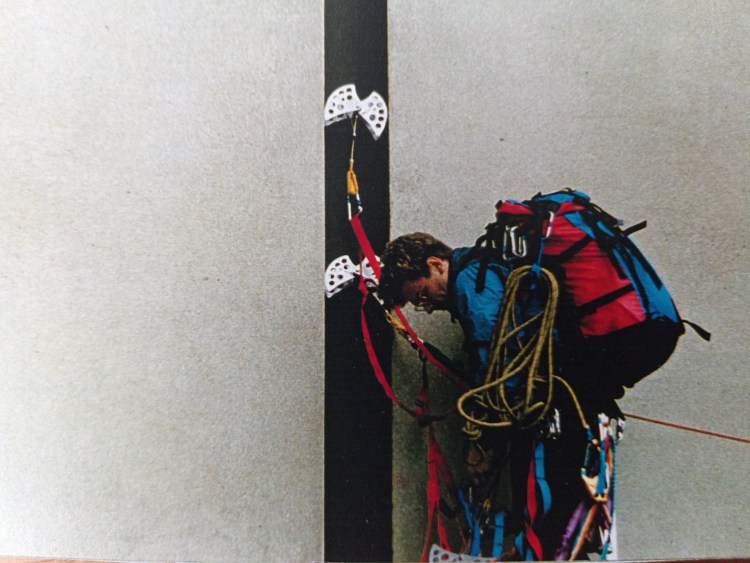
I scurried up my ladder until I had my hands on the top rung and reached for the camming devices attached to my harness. I placed two devices into the crack, to discover that they were not only just barely big enough to fit the width of the crack, as I already knew, they were also too deep for the crack and half the nearside edge of the cam stuck out from the wall. With some fiddling, the cams barely caught on the sides of the crack. I now had to put my weight onto the camming devices 20 feet off the ground, a difficult moment given the poor tolerances, and my uncertainty the devices would hold. As the more experienced, and the person ultimately responsible, I had to test the equipment and make sure it would hold before expecting Nelson to put his safety on the line. I didn’t have time to think about what he must be going through.

I weighted one foot, the other still on the ladder, the cam held. I reluctantly bounced gently up and down, the cam still held. I weighted the other cam and when I was reasonably sure it would hold (I had to move fast and take the risk) I put my weight onto both cams and let go of the ladder and shouted down for it to be taken away. Across the road, Nelson was also having difficulty with his devices and was still on the ladder. I placed the third cam and moved the top cam up and weighted it. What seemed like an age later (but was probably just another minute or so), Nelson left the ladder and it too was taken down. The ladder crews slid the ladders down, loaded them onto the top of the van, and took off with an unnecessary, but dramatic, squeal of tires leaving us safe and unreachable above. Traffic began to flow underneath us as we began to methodically climb the crack. I looked over at Nelson, who was understandably moving carefully, and after a long pause, I saw a security guard come out of the building. The Greenpeace ground support and campaigner assured him all was well, and he stood around looking bemused, speaking into his radio. Another person, this time wearing a military uniform, came out of the building looked at the scene, and rushed off back into the building. I continued up the wall with a few delicate moments where some variations in the depths of the crack meant that cams stuck further out, and the front part of the cam barely touched the side of the crack. This meant only half the cam was operating as designed, and the cam was liable to pivot, potentially pulling out. After about ten minutes of tentatively sliding the cams up the crack and changing our weight from cam to cam, I was still a little fearful we might be dragged off by the wind, and plunge onto the concrete below.

Nelson on the left, me on the right beginning to deploy the second banner

I chatted to Steve by walkie-talkie and we agreed there was no need in going further up the building for a more dramatic effect. I stopped at about sixty feet up, already too high for a fall, and we were ready to deploy the banner. By now, the media, who had been informed we were up to something- but kept in a staging area a short distance away, were in place, cameras at the ready. I set my second device, a Big Bro just above my head to hold the top of the banner. This was a piece of equipment unlike anything either Nelson or I had ever used, that utilized a sprung tube to put pressure on both sides of the crack. It was important that the banner was held by something separate from our cams. As, if the banner caught the wind, there would be forces on the Big Bros for which they had not been designed. If they failed and the banner tore out of the wall, we could let it go. We didn’t want it to be attached to us, if it blew to the ground.

Nelson and I were communicating with cheap walkie-talkie headsets. He was dealing with the situation with aplomb, though we were very much in the hands of unknown gods. I don’t think the calculation had been made as to how big a banner, or in what wind conditions a Big Bro would hold. Once you realize that there is nothing you can do about a problem, it is pointless to worry further. However, it was important to remain vigilant. Every move of the cams had to be done with attention to get the most surface in contact with the crack side.

I set a prussic (a knot that attaches a rope to another easily) on the cord connecting me to Nelson, to hold the cord in case I lost control of it in the wind. He tied his end of the banner to the Big Bro above his head and my end to the cord that connected us. I looked again at the Big Bro to see if it was well seated, and would take the strain of pulling over the banner. I had fiddled with it as I put it in, the first time I’d ever used one. I hoped I’d put it in the right way… I had never done an action with so many imponderables and it did not feel good. I gave the go-ahead to Nelson and pulled the banner and it came slowly across, catching the wind. I felt the entire system lurch. Fortunately, it held, and the banner filled, displaying the message “Nuclear Subs, Deep Trouble, Greenpeace”. When the banner was all the way across and tied off, Nelson and I descended the crack to set the lower corners of the banner about forty feet off the ground. With the banner successfully in place, we hung in our harnesses just below the banner and awaited developments.

Nelson coming off the ladder– notice the cams are at extreme extension and barely holding

Soon, a fire service ladder truck arrived. After a little discussion on the ground their ladder was extended and a fireman brought his platform close to Nelson. We had decided that we wanted to climb back down the crack, for safety reasons and to display that we were in control. I presume Nelson declined a ride down, and the fireman’s ladder moved across to the banner and the fireman on the top of the ladder cut the banner down. With the banner gone, Nelson began to slowly descend the crack towards the distant ground. This took him longer than climbing up, as descending is slower than ascending, and he had an extra twenty feet to go. As Nelson descended, I attached the top of the second banner to a Big Bro and pulled the banner out of my backpack. I didn’t have much time with a ladder already deployed. The new banner was weighted with a aluminium spreader at the bottom and I lowered it to its full length of twenty-five feet. There it began to swing in the wind and disappeared under the bridge between the two buildings. I heard it bang against a set of windows lining a corridor underneath the tunnel. This corridor was filled with DND staff watching the action in their lunch hour. It would not be good if the windows broke, hurling broken glass over the DND staff, but I left the banner out for a short while so that it could be photographed, before a fireman grabbed the rope trailing off the banner bottom. This controlled the banner, and for a while the fireman unwittingly (?) helped display the banner to full effect, and the slogan “SUBstantial Waste” was clearly legible.

Soon afterwards, I began to climb down too. I was met at the bottom by a couple of Ottawa police officers who escorted me to a police car and off to the police station. As Nelson and I were being booked, the television behind the booking sergeant was showing the action as the top story on the 4 o’clock news. The booking sergeant kindly put up the volume and we all, arrestees and arresting officers stopped and watched the news together. Everyone was polite and friendly.

Afterwards, Nelson and I were put into a cell for an hour or so, before being escorted to a room where we were asked by two detectives to sign for the equipment they were returning to us. I insisted on a thorough inventory, both of the equipment confiscated by the police, and that returned to Nelson and me. Then I insisted on making a copy for me to take away. This took an hour or so, to the irritation of the detectives, who wanted to get home, but it was essential to me that I had a record for my inventory control and to make sure we got back the goods confiscated.

When we got out, around six o’clock, we went back to the hotel and out for a celebratory meal and a few drinks. Everyone was on a high. We’d pulled off an action on the Department of National Defence, in the nation’s capital, and gotten both banners up and properly deployed. The coverage was staggering, as the story was at the top of the news on every channel and included several segments: the banner beautifully displayed on the DND, interviews with the campaigner Steve Shallhorn, (or a French campaigner on CBC francais), questions to the Minister of Defence caught in the corridors of parliament (who said wittily that “I am glad to see that Greenpeace has become attached to the DND”). On several stations, vast ugly nuclear submarines were shown, and the question of whether Canada needed them was asked again. The news reporters took a rather ironic tone, lauding Greenpeace for pulling off a bold action on the DND. It was the cause celebre and nuclear submarines were back in the news, with a review of whether they were a good idea. The government looked appropriately foolish and unprepared. We couldn’t have asked for more.

The Ottawa canvassers who had provided most of the volunteer help as ladder crew and traffic control were over the moon. There were not a lot of actions in Ottawa, and nothing before on this scale. They’d had a critical part in the success of the action so they were in a great mood. I felt an enormous relief. All actions have risks; risks of accident and risks of being stopped. Carrying out an action in broad daylight, on a busy road, on a high-security building, with a largely new crew and an untrained climber new to Greenpeace, and untried faulty equipment offered many opportunities for failure. Everyone was brilliant, and I had to hand it to Nelson, the real star of the show, for taking on a high profile, potentially, and to be realistic actually, dangerous action, with possibly serious legal consequences for the climbers. He’d had no warning, or opportunity to prepare himself psychologically for the stress and had come through with flying colours. He’d even made a good sound bite to the cameras as he got down to the ground.

The action continued as top of every news show that night, on all the TV channels, and was front page the next day in the Ottawa papers. Questions were asked in parliament as to why the DND should be trusted with nuclear submarines when it couldn’t even defend its own HQ. The Tories were deeply embarrassed and to avoid further humiliation, they canceled the planned announcement of the choice of submarines.

Several weeks later the Conservatives called a general election. During the election campaign, they promised two billion for universal free childcare. After winning re-election, they pulled off an astonishing political trick by claiming that they had not realized the state of the government’s finances. This might be reasonable for a new government coming in, but stunning for one returning to office. Due to this sudden hole in the nation’s finances, they announced they couldn’t afford the cost of the promised universal childcare. Having announced they couldn’t afford two billion for childcare, they were unable to announce new spending of eight billion on submarines, and the plan was quietly dropped. The timing of the Greenpeace action had been critical. Had the submarines been announced before the election as the government had planned, they could have continued with the programme as previously agreed spending. As it had not been announced, they could hardly announce such a vast new programme given the ‘new’ budgetary situation. Following a long and widely supported campaign by numerous players, the submarines were an unpopular idea. The DND action blocked a decision on the submarines before the election and turned out to be the final nail in the coffin. This was perhaps the most successful action I ever did. More than 30 years later, Canada still hasn’t created the risk and waste of a nuclear-powered navy. Actions play an important role in Greenpeace campaigns. This action though may well have been the deciding factor in stopping Canada become the world’s 6th nuclear navy, and saved the taxpayers 30 billion dollars.

END

A Princess or an ice-axe?

The Himalayan Institute of Mountaineering, Manali Part 1

Simon Waters

I was sitting looking into the beautiful brown eyes of a stunning, sari-clad princess, at a party in Dehli, when my father came up. “There is someone over here I think you ought to meet”.

“I’ll just be a few minutes Jake”, I replied, and turned back to the princess.

I had a good relationship with Jake, and respected his judgement, so I soon reluctantly left the princess and joined him. “This is Mr Govind; he is Chief Secretary at the Ministry of Defence Production”. Mr Govind looked at me affably and said, “I hear you want to go to the Himalayan Institute of Mountaineering?” He asked me a few questions about my interest in climbing, and then turned back to Jake, “I think we can get Simon into the institute, Mr Waters. Just give me a call at the ministry next week.”

I had been given a copy of Hunt’s book on the conquest of Everest for my tenth birthday, and had dreamed of climbing Everest ever since. I had heard about the Himalayan Institute of Mountaineering in Darjeeling, which was run by Tenzing Norgay, who with Hillary had been the first to the top of Everest. Since the trouble with China, I believed that the institute was used exclusively to train India’s mountain troops, and I worried that I’d be seriously out of my league. On my application form, I exaggerated my day trip to Harrison’s Rocks and two or three weekends in the Llanberis pass, into a more substantial climbing portfolio.

A few weeks later, back in Hyderabad, Deccan, I heard that I had a place on the 28th basic course in mountaineering in Manali, Punjab, the newer, satellite branch of the main Institute in Darjeeling. The course was due to start in May (1965). The course itself was free, but we had to pay for the special low weight and preserved foods we would need for the time above the snow line. So I began a six week training programme of runs, push-ups, pull-ups and sit-ups, and substantially reduced my drinking. As the course got closer, I got out my rucksack and filled it with restaurant sized tins of chop-suey (a mistake on the order from our food shipper) and ran up and down the Banjara Hills. In the last week of training, I was running with 80 pounds of canned food in the back-pack.

I took a train to Dehli and then up to the railhead. It didn’t occur to me to find out if there was a bus, and I hitch-hiked the rest of the way. I got a lift from a local Maharani, and put up for the night in her luxurious apartments in the capital of her kingdom. She interviewed me politely, in her drawing room, overlooking the town, and the mountains behind. “What is the purpose of your visit?” For once, I had a simple answer. I arrived in Manali a day early, but was kindly let stay in the student’s hostel. The institute was a large building on the edge of a town of about five thousand in a stunning mountain valley at 6400 feet and surrounded by towering peaks.

When the other trainees arrived, I was relieved to find that this course was made up of university students from the Officer Training Corp (OTC), not full time hardened soldiers. Most of the trainees were twenty or so, though there were a couple who were mature students or doing their MA. I was the youngest at seventeen, but I didn’t feel younger, as the majority of my class-mates still lived at home, or in a university dorm, and I had left home to work at fifteen and had hitch-hiked to India alone at sixteen. Most of them had never seen snow, many had never seen a mountain, few had previously climbed, and several had been “volunteered” by their superior, and didn’t want to be there in the first place. But there was a core of very enthusiastic and very fit students, and we soon formed a group. We knew that if we passed the basic course with an A, we would be invited back to do an advance course. Success in the advanced course could lead to an invitation for an instructor’s course in Darjeeling. The instructor’s course was run by Tenzing himself. My goal was set.

In the morning we were woken at six, with hot chai delivered to our dorms. Then we went out into the cold morning air and did group exercises for half an hour, including 10 minutes of running on the spot, with knees lifted high. I was thankful for my six week training, and could keep up with the fittest. On some mornings, several of us ran the two miles up the hill to the hot spring, and soaked in the pool before running down for breakfast at eight.

Lessons on rope management, mountain craft, mountain weather etc were given in Hindi by the school staff; two Sherpas and two members of the Punjabi Border Police. I sat listening to a stream of words I didn’t understand, and a very few I did (utcha, tik-hair, hai, the numbers from 1-10) dotted with technical terms in English. These were spelt out, “crampon c-r-e-m p u n”, “avalanche, a-v-e-l-u-n-g-e”, “crevasse, c-r-i-v-a-s-s”. (How good’s your spelling in Hindi?). But I remember distinctly my surprise at “benightment, b-e-n-i-g-h-t-m-e-n-t”. In the breaks, and after lessons, I would cram with a couple of my new friends, especially my roommate Chopra; they would tell me the gist of the lesson, and I would correct the spelling of the vocabulary. We also learned knots, including the endman, to tie onto the end of the rope, and the middleman to tie into the middle. We were introduced to one hundred foot hemp ropes, and wooden ice-axes over 4 feet long.

We were taken rock climbing at a local crag. Here the boasts on my application form (“It doesn’t matter what you say, once you’re in nobody will read it”, said Jake) led to me being considered some kind of an expert in rock-climbing. Neither of the two instructors assigned to our course (Purshotum of the North West Frontier Police and the Sherpa Dan Kumar) was any good at rock climbing, so they asked me to lead on rock-climbing training. Seventeen, and already a climbing trainer at the Himalayan Institute of Mountaineering! I remembered much of what Tom had taught me in Wales, on those few weekends, and got people standing above their nailed boots, and picking their way up easy climbs. I was a bit reckless myself, and was soon soloing the small rockface alongside my “students” and passing on tips to the hapless. At lunch, I invented a game of running up a short steep face without using our hands. I had my come-uppance in the afternoon; when body rappelling with too much gusto, I tipped over and the rope wrapped around my neck. Fortunately, I was close enough to the ground for one of the instructors to take my weight and for me to untangle before I choked.

We had long hikes in the local well-wooded hills, where our four foot ice axes made excellent walking sticks on easy slopes, and lectures in the evening from the director. As Indians wash twice a day, and we wouldn’t be able to wash when we went to climb our peak, the director gave us a lecture on cleanliness. “A climber must enjoy being dirty, and if you don’t enjoy being dirty, you can’t be a climber” he said. Coming from a culture of the weekly bath (whether you needed it or not), I had no difficulty with the idea of not washing while we climbed. But, many of my classmates were truly horrified.

One morning, after about ten days, we were issued kit. “Don’t just take what you are given”, we were told, by the director, “make sure everything fits and is in good condition. Your kit will be vital when you get out into the mountains”. Chopra and I and a few other enthusiasts spent several hours trying things on and returning dud items for something better. I took back a kapok sleeping bag and got a thick down bag. I also changed my crampon straps, got a warmer down jacket and sweater, and got an extra sweater. Chopra and I went through the tents carefully and got the best we could find, and then poached better tent pegs from another tent. I noticed that several students just tucked their kit under their bed, sight unseen, and went back to playing cards.

There was a problem though as I had size 11 feet, but the institute had no boots bigger than 10. However, Hillary (the Hillary) had been hill-walking near Darjeeling the previous year and had donated his walking shoes to the Himalayan Institute in Darjeeling, run by his friend and climbing partner on Everest, Tenzing. The Darjeeling institute, being well funded, and properly supplied, had passed the shoes on to Manali, its poorer relative. The shoes were size 13, far too big, but the only shoes I could get into. Due to the vast size of the shoes, (they were brown Yorkshire walking shoes, stopping under the ankles, not boots) I managed to scrounge three pairs of socks so they would not fall off. So, not only was I going to go climbing in the Himalayas, literally, in Hillary’s shoes, I’d have the warmest feet on the expedition!

Next episode: Bear hunting, and a view of Tibet in Hillary’s shoes.