Pygmy Health Project part 3

Cyangugu, the congopygmyblog and fears for Jean-Claude

2132 words/15 minutes

Pygmy, Congo, healthcare, Africa, Rebels, Bukavu, Cyangugu, Rape, Soldiers, Looting

I was a refugee from the fighting in Goma, and the threatened attack on Bukavu, temporarily settled in a friendly Rwandan NGO just across the border in Cyangugu. I had use of a room of my own, and they kindly let me set up my laptop in their office and connect to the internet. Best of all, I could make tea when ever I wanted. But the project was in ruins. We had been driven out of Minova by the M23 rebel assault on Goma, and my colleague and friend Jean Claude had had to travel into rebel held Goma to pick up his two year old daughter. I was at a loss, as I was thousands of miles from home, and yet still a half dozen of miles away from my colleagues in the UEFA office, where we needed to work together to finalise our research on Pygmies access to healthcare.

I spent stressful hours trying to get hold of Jean Claude in Goma and finally got to talk to him, though the line was not good. I discovered to my relief that he had managed to get back to his sisters house and was safe with his daughter. But he was trapped in Goma, as the ferries to Bukavu had stopped and the border to Rwanda was shut. I was very worried for him and his daughter, and knew that he was only there because he was working on my project, and so I was responsible for his dangerous situation and for anything that might happen to him. But there was nothing that I could do to help him.

I called Bems in Minova, many times, but I heard the news first from the UN news agency. Minova had been ransacked by the government troops sent to protect it against the rebels. It was rumoured that people had been raped and killed.

I did get hold of Godelive who had been the most experienced field worker on the other research trip. She told me they had managed to successfully carry out research in three villages, as well as take a number of people to the local clinic or hospital. She had also got numerous photographs. This was good news, as we now had nine villages total, (with the two villages where we’d tested the questionnaire, the three villages I’d been to and the village that JC and Bems had completed the day before I arrived in Minova.) This was a bare minimum, but enough to prove a widespread and deeply serious problem.

I looked carefully at the questionnaires from Minova, and deciphered them as best I could. There was a lot of valuable information, but they needed transcribing by Jean Claude, as the writing wasn’t always legible. So, after my other tasks were done, I decided that the best thing I could do was to start a blog, and try and get the latest news of the project and what was happening in eastern DRC out to my contacts in the UK, and beyond. Setting up a blog, learning how to do simple blog tasks, dealing with a slow and intermittent internet, and posting daily, kept me busy for hours a day.

I also kept in daily contact with Jean Claude, still stuck in Goma, though soon things got worse for him as he and his daughter caught malaria. Getting medication was not going to be easy for them.

I finally got hold of Bems. This took a while, as he had difficulty keeping his phone charged with frequent electricity outages and the collapse of civil order in Minova. I had confirmation from him that things really went off in Minova, little more than 24 hours after I left, when DRC soldiers, sent to protect the population, went on a rampage of looting and rape. Fortunately, neither he nor his family were attacked by the rampaging soldiers. Bems was also in contact with the UEFA staff person in Kungulu and over time I pieced together the terrible story of the rampage of the Congolese army- sent to protect, but in fact raping and looting through the area.

This added to my fear for Jean Claude and his daughter. But in fact there seemed less havoc perpetrated by the rebel soldiers, though there too there were acts of violence. This is a tragic situation, where your own government is as much, or more, to be feared than foreign-backed rebels. And an example of what it is like to live in a failed state.

I was also concerned with the health of my friend Roger Anderson. He had been a life saver in facilitating our research planning workshop, and we had done a lot of the work in putting together the questionnaires and he had done the translation into acceptable French. We had eaten dinner together much of the time I was in Bukavu, which was a chance to relax with a friend, but also an opportunity to get a deeper understanding of local NGO, and government politics. I knew Roger had medical and financial problems which would be exacerbated by the crisis. He didn’t have a working phone, so that I was unable to contact him.

I heard from Jean Claude that he was going to try and leave Goma, then I didn’t hear for 48 very worrying hours. Finally, I got a call from him in Cyangugu and we met up at the hotel I’d stayed in, as it was easier to find than my back street NGO. Both he and his daughter had recovered from malaria, but they had had a very stressful voyage through Rwanda, and were beat. I bought them a slap up dinner, with ice-cream for his daughter, and put them up in the hotel for the night. The next day I gave him much of the rest of my dosh – as he had certainly earned it, and insisted he took a couple of days off with his family.

November 27th blog post Pygmy health project keeps going in war torn DRCongo

My colleague, Jean-Claude and his lovely two year old daughter are safe and back to their family in Bukavu DRC. Conditions in the DRC have been appalling for the many years of civil war, and invasion. However, conditions for Pygmy populations are considerably worse, and we documented people unable to receive even basic health care due to not having even the $3-$5 necessary.

Nov. 28th blog post Numerous rape victims recorded in Minova, and two civilian deaths recorded

A Pygmy Health Project investigation into the situation in Minova, the town held by the DRC army, reveals the tragic fact that rape is again a part of the behaviour of the armies/militia involved in Congo’s long and devastating war. By Monday morning, 26 November there were 16 rape victims treated by the Centre de Sante and 22 by the Hopital generale, in Minova, totalling 38 victims of rape in this small town. We cannot be sure at this stage, whether all the victims are from the town itself, or some from the no-mans land between the opposing armies. However, women in Minova are reported to be unable to leave their homes, due to a fear of rape.

Drunken government soldiers fill the streets, begging and selling cigarettes, according to news reports. Looting of homes by government soldiers is commonplace, and a young boy was shot to death by Congo government forces looting a home in Minova. A Pygmy woman in Kangulu, 7 miles behind the lines from Minova, died on the weekend from a heart attack having been caught in the middle of soldiers shooting their arms into the air.

Nov 29th M23 pull out of Goma

The Rwandan led M23 rebels appear to be pulling out of Goma. This is good news because it suggests that the rebels/Rwandans have been stopped from over running more areas of the DRC and escalating the war. Still tens of thousands of internal refugees need assurance before they can return home and rebuild their lives. Many have been separated from their children, and can only hope that they can find them safe and well. In further testimony to the depth of the tragedy faced by the people of eastern DRC is that many, rightly, fear the return of the unpaid, undisciplined, raping and looting Congolese army. However dangerous this is still for the residents of Goma, and surroundings, for Bukavu this is a relief. The threat of invasion and its attendant misery has receded. This also means that international NGOs are now returning to Bukavu, and that valuable aid work can resume.

In the midst of this positive news, I’ve had a very useful meeting with colleagues from RAPY, the Pygmy support network, who kindly came over to meet me. Otherwise, I am struggling to correlate the myriad research documents into a useable form for the report.

Blog post December 2nd

The Pygmy Health Project has returned to Bukavu to organise its research results and prepare the draft report on Pygmy peoples access to health care in S. Kivu. Due to problems of electricity in Bukavu, (an electric pole collapsed, and the office has no electricity) staff working from the office of our partner UEFA, have been unable to complete their work.

The solution was to move the office to CAP Nguba, the protestant guest house where I stay, which has a generator that usually comes on soon after a power cut. The new office, was expecting to use the salon of CAP, but this was occupied by another NGO holding meetings. I was instead forced to set up in my bedroom. The strict CAP rule, that prohibits access to the rooms of members of the opposite sex, has been fortunately ignored, and both Jean-Claude and Godelive worked all day yesterday (and Jean-Claude into the night) in the tedious work of transcribing the questionnaires into electronic form.

Jean-Claude has taken a room, so we can work late, as returning to his house in the night would not be safe. Godelive has declined our invitation to return for breakfast today (Sunday) and will not be coming in until after church. Unfortunately, given that the office was predicated on a continual supply of power, the generator has broken, and yesterday we were a jitter, charging batteries when possible, and doing as much work as we could on the physical questionnaire. Jean-Claude and I were working until late last night on battery power and by headlight!

Sunday am: The generator seems to be working, and the office is back in business. END Blog post

It was a scramble until the end. I had a flight booked out of Kigali on the 6th, and so had to leave on the 4th to be sure I’d make it. We continued working ridiculous hours, transcribing questionnaires, transferring photographs to my computer, backing everything up and holding final meetings with all the researchers, the UEFA management and RAPY. I was also able to track down Roger, have a few beers with him and help him out with his medical costs.

This mad scramble was worth it. I got back to the UK with all I needed to put together a report that demonstrates conclusively that Pygmy villagers in nine settlements in South Kivu are systematically deprived of their rights to medical care, and that many, including babies and toddlers, are dying because of their being refused medical treatment.

Before publication, I presented these findings to the international NGOs working in Bukavu and beyond, and got assurances that things would change. I pushed on getting specific commitments and got a couple of offers to pay me to train their field staff. But, to make these few small contracts work, I would need to be in Bukavu for some months. Unfortunately, I was unable to raise funding to return to Bukavu.

Here is a link to the Executive summary of my report.

https://wordpress.com/post/congopygmyblog.wordpress.com/976

Postscript

Back in the UK, I met a woman who was trustee for a small charity which made an annual grant of £5,000 for girl’s education. I was able to help RAPY, the Pygmy network I had help set up in 2003/4, get £5,000 funding for educating Pygmy girls. Somehow, they managed to get refunded for £10,000 and two more years. These are small amounts, but non-the-less were a big part of their annual budget. They also helped almost a hundred Pygmy girls attend school for several years.

PPS

Due to illness, I am unable to track down the photographs that were supposed to accompany this post. I will try and add more appropriate photographs at a later date.

Bambela, Etogo, Zali

Naming our daughter among the Ewondo

1700 words/12 minutes

Felix with Judith and la belle mere

A few weeks after my daughter was born, in the Central hospital in Yaounde, the capital of Cameroon, Judith and I prepared to register her birth at the town hall. Having a baby in Cameroon is not as simple as it might be and, in spite of a number of medical cock-ups, Judith and the baby were fine and ready to leave hospital on the Friday. Then after numerous minor delays, we discovered that the accounts department had left for the weekend, so Judith was trapped in hospital until Monday morning, as we were not allowed to leave until we’d paid the bill.

The process of choosing a name for our baby had begun soon after the pregnancy was confirmed. I had asked Judith, that whether we had a girl or a boy, we name our first child after my sister Felix. Judith agreed; and then began the search for her second forename.

[I find it a curiosity that we accept Robin, Chris, Jan, Leslie, … as names for either sex, but most people find it difficult to accept Felix can be a girls name. Having a sister called Felix, I was used to the assertion by the narrow minded: “But Felix is a boys name!” and I had adopted the response: “It can’t be a boys name, she’s a girl!” And so a positive consequence of naming our child Felix, would be that whilst Felix would still be an unusual name for a girl, it would be twice as less so.]

I subscribe to the premise in Tristram Shandy, that a name is of great significance in determining character and life chances. Finding a second name took ages – I not liking any of the soft, feminine names that Judith favoured, now that we knew we were to have a daughter. One day, while speaking with my sister Felix on the telephone, she told me that each time she had been pregnant, she had planned to call her child Kate if it was a daughter. But, she’d not had the chance, as she’d had three boys. I really liked the name Kate, and returned home from the office eager to suggest this. I was met by Judith who was equally excited. She too had come up with a name she really liked: Kate!

Among the Ewondo, the First Nation that inhabits the area around Yaounde, a child’s last name is usually not the same as their fathers. Few of Judith’s brothers and sisters (she has seventeen) were called Etogo after her father; most were named to honour a relative or potential patron. Judith was named Bambela, after her maternal grandfather, a well known sorciere (sorcerer) and a very powerful man. When Bambela was dying he had called for Judith, still a baby, to be brought to him to transfer his powers to her. Her father Joseph Etogo had refused to let Judith be taken to the village, and the old man died without passing on his secrets. Though, I am not convinced he gave up quite so easily….

Judith Bambela, on her trips to the family village, was honoured by her grandmother as if she were her dead grandfather. Even as a child, her grandmother bowed to her and Judith was fed first and given the choice parts of the chicken that had been prepared in her honour. Like Tristram, the Ewondo recognise that a name has great significance.

I had had much input into the choice of our daughter’s first two names, and was of course happy to concur with Judith’s desire to name Felix after her aunt Zali, a childless family cousin, who had brought Judith up as an adolescent in Douala, the biggest and wealthiest city in Cameroon. Douala is two hundred miles from the capital, Yaounde, where Judith’s mother and extended family lived. And, after three or four years of living with aunt Zali, Judith had suddenly returned to her family in Yaounde.

I enjoyed learning about Ewondo culture from the inside, and readily agreed to Judith’s choice of this third name for our daughter. What I didn’t know was that Mr Etogo had not forgiven auntie Zali for letting Judith go. Finding this out put me in a real bind. Judith had made it clear over the previous few days that she was adamant. She knew that her father objected, but Felix would be called Zali. But it was also very important for me to show due respect to my new daughter’s grandfather, my father in law, as was the custom in Cameroon. A few weeks later, my future brother-in-law, Tarzan, (as he was known to everyone in the family) brought me a note from my future father-in-law. The envelope was addressed: Etogo

The letter was in French. Here is a translation:

Dear Mr Simon

This is primarily to inform you, [medical update] this morning at a clinic in Yaoundé.

Also that I would like to meet you tonight or tomorrow in Etoa-Meki [the quartier of the family home in Yaounde] for a short interview.

Thank you and goodnight.

I set-off that evening to visit my future father-in-law. Joseph Etogo was eighty, and had been unwell for some time. He was a retired meteorological officer and lived in the first house in Etoa-Meki to have a corrugated iron roof, he had also had the first car in his village. M. Etogo was an old fashioned patriarch who had had five wives and eighteen children. He had retired to his village, 100 km north of Yaounde, where he lived with two remaining wives. Tarzan, one of his eldest sons, was accompanying him during his stay in Yaounde for medical treatment. Our conversation was in French, with Tarzan occasionally restating what I said; in effect translating my words into better French for Joseph. Now and then Tarzan remade the point in Ewondo.

After a discussion about his health, allowing me to offer to do anything I could to help, he moved on to the reason he’d invited me to visit him. Joseph firmly stated his opposition to Judith’s choice of the surname Zali for our new-born daughter. And here was the rub: Mme Zali was childless and Judith had been sent to her as a ward. For Joseph it was unconscionable for Zali to abandon the responsibility she had accepted by taking Judith into her home, and returning her to the charge of her family. Joseph insisted that he could not accept his daughter disobeying him and honouring this woman, who he had not forgiven. He was absolutely not going to accept that his daughter name our child Zali.

Beau pere (Father-in-law), I will of course accept your decision,” I said, “ but I don’t know how I can explain it to Judith. I have to live with Judith and she has set her mind on Zali. You know how stubborn she can be. This will make life very difficult for me.” This was a considerable under-statement, as Judith is stubborn to a rare degree and had absolutely set her mind on this. [Later, this force and determination enabled her, as a new resident of the U.K., to gain an arts degree at Chelsea.] Tarzan repeated my words to Joseph, and then took my side on this important matter:

“Father, think how hard it will be for Mr Simon to tell Judith.”

Joseph was torn and I could see his deep reluctance to accept Judith’s refusal to acknowledge his paternal authority. But, after some thought and a conversation between him and Tarzan in Ewondo, Joseph reluctantly gave his permission. It felt good to have both supported Judith, by getting her controversial choice of a name for our daughter accepted by an unwilling father, and also to have shown appropriate respect to my future father-in-law. I have never forgotten Tarzan’s support in this important family negotiation, and have always retained a soft spot for him.

But the process of name choosing was not over. I felt it essential that Felix had my surname too.

I knew we would be for ever explaining why Felix was named Zali, if it was her family name. It would not agree with her mothers, or her fathers name, and would make the simplest event a misery when we returned to the UK. Putting Felix on my passport, registering her for a school in the UK, even picking her up from school, all would be fraught with complications. Felix needed to be Waters too. So, we ended up with Felix Kate Zali Waters, and Felix was registered in Yaounde.

Though this still wasn’t the end of our naming problems. When I took Felix’s Cameroonian birth certificate to the British High Commission to register her, her British birth certificate was written as Kate Zali Felix Waters, not Felix Kate Zali Waters.

[Note: in Cameroon Felix has two forenames and two family names (though she’d normally have only one). In England, Felix has one forename, two middle names and her father’s surname. This was the part of the confusion that led the British High Commission to misname Felix. But, also, the British official made a simple transcription error]

I only noticed this error when applying for Felix’s first passport. So Felix has two identities: as Felix Waters in all her school records, exam results, athletic achievements and daily life; and as Kate Waters on her passport, bank account, and other official documents. This has led to my booking her a plane ticket as Felix Waters and then realising she’ll be showing her passport, and scrambling to make the change as she might not be let onto the flight.

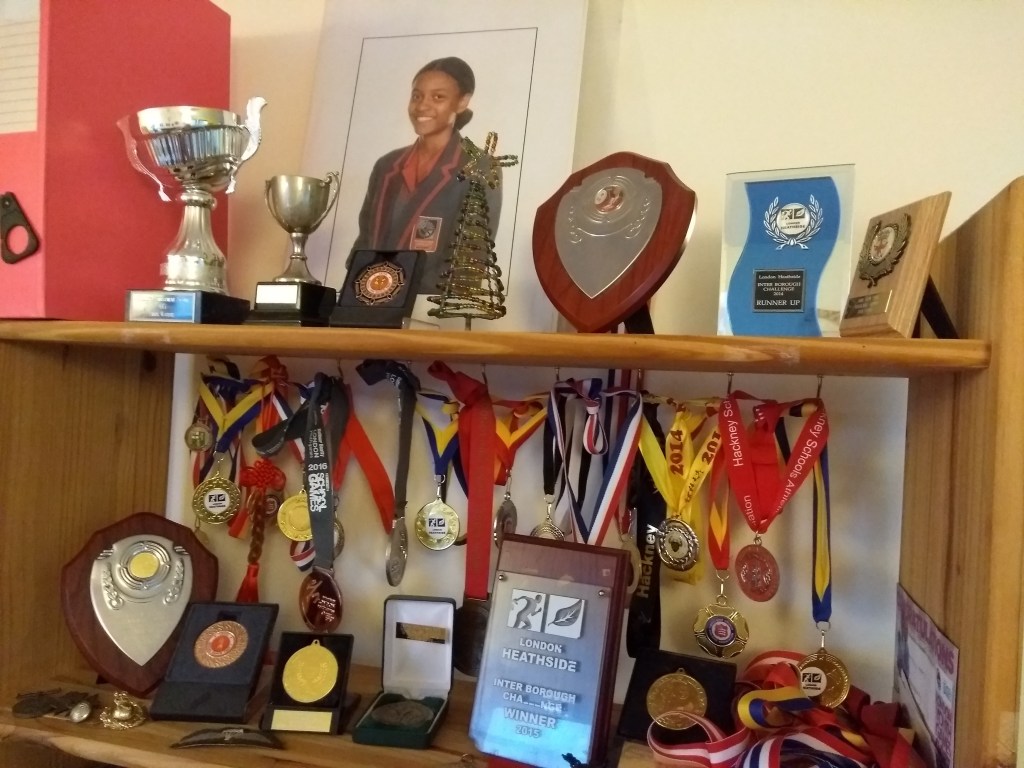
A few of Felix’s medals and trophies

If naming her Felix was to make her a strong character, it seems to have worked.

Soon she will go out into the wider world, with two identities. Felix Kate Zali Waters or, (if she is being formal), Kate Zali Felix Waters.

Fleeing the M23 rebels, a Refugee in Rwanda

Researching Pygmy Healthcare during Congo’s Civil War, part 2

20 minutes

[Continued from last week:Volcanoes, Pygmies, and M23; Researching Pygmy Healthcare during Congo’s Civil War]

We could hear loud noises that sounded like artillery fire coming across the lake. According to the UN news feed, the M23 Rwandan backed rebels attacking Goma were not meeting resistance from the Congolese army. And Goma was on our route back to Bukavu. My colleague, and by now good friend, Jean Claude had left his 3 year old daughter with his sister in Goma, and needed to pick her up. But we had just started our field work, and what we were finding was vital for getting thousands of Pygmies access to life-saving healthcare, so I was profoundly reluctant to stop in the middle of such productive work…

Sunday 18th November, 2012, Minova, South Kivu, DRC

I was up early again on Sunday morning. There was a cold fog off the lake, which made the morning wash in a bucket of cold water unpleasant. I walked the 1km through town to the restaurant where we met. Though it was one of the few places to eat in town, we were often the only customers. The restaurant had a couple of secluded booths inside and half a dozen tables out back under a palm leaf awning, overlooking a yard with chickens scrabbling between the banana plants.

We were all three worried by the dangerous situation. The others had been through this before, as the civil war, and war lord rampages, had been going on for fifteen years, their entire adult lives. They had lived through the dangers directly, though they rarely spoke of it. I only knew the risks from hearing and reading about it second hand.

Minova was the first town on the only road that connected Goma to Bukavu, and the M23 were expected to attack here next. Some years ago, their previous incarnation had stormed through Minova on their way to capture Bukavu at the other end of the lake. We all had our different concerns. Bems lived in Minova, with his wife and young child, and was of course very worried that his town would become a battleground. He worked for UEFA, but was not paid when they were between contracts, so that the small amount he earned working on my project was important to him, and he also understood the value of the project. Jean Claude was the lead researcher for UEFA, and had played a key part in developing the research methodology, so he too was invested in the project. It would have been hard, but not impossible, to carry on without him. He needed to get to Goma and pick up his 3 year daughter. I had had the idea for the project nine years earlier, and had failed to get funding. Now, I had my one chance to show that Pygmies were denied healthcare. At each village we were finding, and beginning to help, half a dozen people with serious problems. But the real value would be if we could get Pygmies (and it was clear many other indigent men, women, and children) their right to health care consistently respected. This would save thousands of lives and stop enormous, unnecessary, pain and injustice. We had a lot to play for, and just this one opportunity.

It seemed that the route back through Goma was already too dangerous, and so while we tried to get more information, we agreed to do another field visit. Bems, Jean Claude and I walked the 2 km to the internally displaced persons (IDP) camp, just outside Minova.

Minova IDP camp

The camp was about a hundred makeshift shelters, using some reclaimed tarpaulins from the UN, even though it was not an official camp. It was occupied by people who had been displaced by the incessant fighting and pillaging further north. We went to the Pygmy section of the camp.

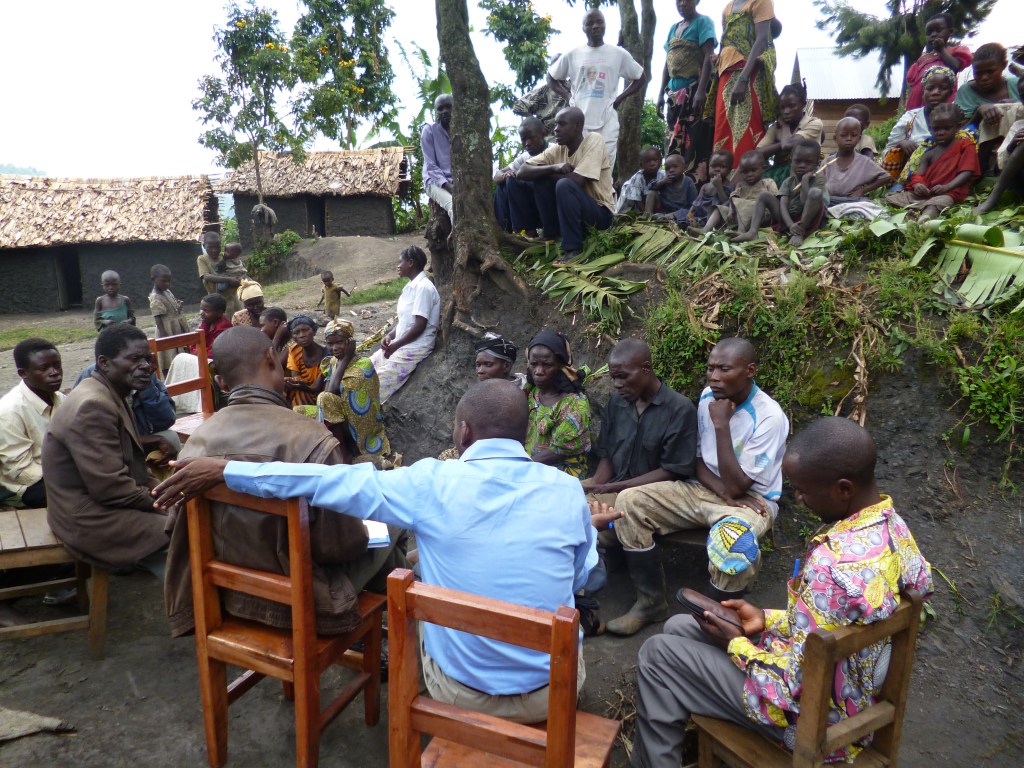
Meeting in Mubimbi IDP camp; 18 men, 7 women

The Pygmy IDPs have been in the camp since July 2011, having walked a hundred or more kms from Masisi, when their villages were looted by rebels. They had almost no access to healthcare, but for three months at the height of the cholera outbreak, they had got free medicines for cholera, malaria and diarrhoea from Doctors Without Borders. Though there is a water tap in the camp, it often does not have water, and they have to go 5km to fetch it. Otherwise, they use the river, which has passed through at least five villages and is polluted with human waste. There are multiple cases of water-borne diseases. They are often hungry as they have no regular source of food. The landowner wants his land back, and they will be forced to move again soon.

Minova IDP camp meeting

It was hard to focus on the research as we could hear the sound of artillery fire coming across the lake. This was particularly distressing for Jean-Claude with his daughter in Goma. As the morning progressed, the explosions were more frequent, and harder to ignore. We were also not sure if the M23 had either bypassed Goma, or at least made a move along the lake towards Minova. The artillery fire sounded closer, and I worried the M23 was already on their way….

Jean-Claude, exhausted and worried. He’s listening to the bombardment of Goma where his sister and daughter are.

I was taking pictures and worrying too- both about the increasing danger, and about the consequences of leaving before we had finished our research. I had a light-hearted moment when a musician sang a song for me.

I was reluctant to leave before we absolutely had to. I had reason to be concerned with the quality of the work we might get from the other team. Matata, who was leading that team, was officially the UEFA coordinator for the whole project, but didn’t seem at all interested in his role. Godlive, who was a young recent graduate in rural development was a quick learner, but she’d come into the project a little late. And she didn’t have the experience or authority to make sure the research was carried out as well as possible. If we had three more days in Minova, we could visit 2 or 3 more villages; visit Minova hospital and see what services we could get for our already identified patients and learn what we could expect if we sent some on to Goma. Several people’s long term health and well-being depended on our being able to help them, and I felt it had to be done immediately when I was in a position to make on the spot decisions and talk directly to the medical staff.

When planning this field trip, I had met with many field workers working for international charities in Bukavu. A doctor from one of the leading health NGOs had told me she was going to Minova to run workshops for village health workers. I asked her whether she had invited any Pygmies to her outreach programme, and she had replied, “There are no Pygmies near Minova.” This was where we had just researched in three Pygmy villages. I wanted to meet up with the international health teams who had dealt with the cholera epidemic. I needed to find out if this denial of even the existence of Pygmies was common.

My mind was going in circles. I had an obligation to follow up on our patients to make sure that those we’d identified got at least the primary care they needed and to explore the costs and possibilities of taking a few patients to Goma for critical treatments. But damn, Goma was off for the moment, and I knew our time was running out.

Finally Jean-Claude said “ Monsieur Simon, You have to leave.” I realised that Jean-Claude couldn’t leave without making sure I was safe for all kinds of reasons- he was my host, and he could quite possibly be held responsible if anything happened to me. I had already suggested he leave, but I finally realised that I had to go first, so that he would feel able to go and get his daughter. We wrapped up the research hurriedly, without doing any individual interviews, and walked quickly back to Minova along the empty highway. As we got back to town, we passed a group of soldiers, milling in an undisciplined group by the road. There was real tension in the air, and the atmosphere of buzzing electricity was frightening. [The only time I’d felt a stronger buzzing electric charge was once, climbing in the Canadian Rockies, where I felt a similar crackle in the atmosphere in the last minute before I was struck by lightening]

The soldiers were scared, and about to explode. It was dangerously close to going off. Suddenly I wasn’t sure that I could get out of town without real trouble. I walked back to my hotel and in 30 minutes I was back at the restaurant with my kit. Paying my hotel bill, I used a hundred dollar note, and they had no change. I needed the change to fund our next move, but also didn’t want to hang around waiting as the situation was deteriorating fast. I asked that they brought the change to me at the restaurant. And, with great courage and honesty they did.

Back at the restaurant I stayed in the back to avoid attention. I counted my stash. I did not have much money, but there was enough to take $20 to get back to Bukavu, and $50 for emergencies. I gave just $20 or so to Bems, as he lived in town, and didn’t have emergency travel costs, promising I’d send more from Bukavu. I gave the rest to Jean-Claude (about $100 plus his travel costs) as he had the hardest journey back, and might get stuck in Goma for a while. Jean-Claude had also come with a budget, and ought to have had some of it left, as I had paid for all our expenses since arriving….

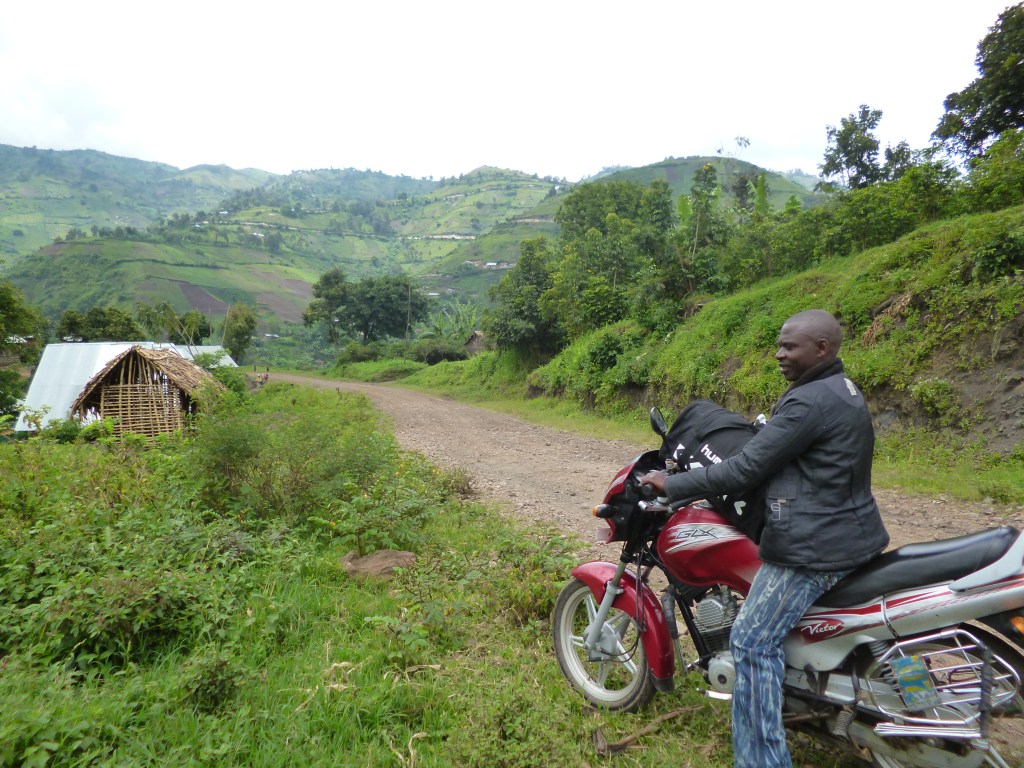
Then Bems went and got François, a moto driver he knew, and negotiated the price to get me to the next town along the lake. Most moto drivers are in their late teens or barely 20, but this was an older man of 40. I offered to double the agreed payment if he drove slowly. I didn’t want to be in an accident on top of everything else. I felt bad leaving my colleagues, but also felt the fear that seemed to fill the street. I got on the moto and set off up the slope to where the soldiers were milling, but I did not look in their direction. After we had swept, rather too slowly, out of town and around the first corner, I felt a great sense of relief. We had been under strain for days, and I had been working twelve and fourteen hours every day for almost a month. I had a wonderful journey up and over hills and back to the shores of the beautiful lake Kivu. It was a real relief to be on the open road, and I felt my stomach unknot. I got the driver to stop for a few pictures, as it was the first time since I arrived that I had not been in a rush to get somewhere.

Francois stopping so I could grab a few shots

Occasionally we’d come around a corner and see a lone soldier standing by the road. I realised it wasn’t a good idea to give them the time to think, and by the time they noticed a white guy on the moto, and said stop I wanted to be as far past them as possible. So, my desire to go slow to avoid risk of accident, became dwarfed by my desire to zoom past any military before they realised what was happening. But, François would not listen to my plea to speed up passing soldiers. He’d been persuaded by my offer of double pay if he kept slow, and I was unable to explain my new reasoning as we sped along in the wind. But probably he was right, perhaps zooming past would have raised suspicions and even a shot, if we hadn’t stopped. We continued along, climbing up into the hills or careering down steep slopes to the lakeside, through small villages and past plantations of quinine, and fields of banana, plantain, and corn. It was a lovely day, and I was relieved to be out of Minova and enjoying the journey.

The west shore of Lake Kivu

After 50 km, we arrived at the first town of any size, and where I’d paid to be taken. I thanked François, who had brought me safely out of immediate danger, and paid him his well deserved bonus, and went to get a beer in a restaurant in the market. Two people pulled up in a big, brand new 4×4 SUV, and after they had ordered a beer and settled in, I negotiated a ride to Bukavu for $20.

They put me in the back seat and ignored me. They were clearly important and even the young driver was well off, wearing $100 jeans and an expensive watch. I was joining members of the Goma elite making a last minute dash out of danger. The older man had a lot of authority. When we got to a road block he got out, and sauntered up to the officers and chatted amicably. Sometimes he just said a few words at a roadblock, was saluted and we were let straight through. The soldiers were still nervous, but the tension level was far lower.

In two or three hours, I was dropped in Bukavu, and took a taxi back to my lodgings at the CAP mission lodgings. I logged on to the internet to get the latest news, and looked up the Foreign Office advice -which was to get out of Bukavu NOW. I called the emergency mobile number and talked to an embassy staff-person at the border, and she said she would leave the next morning. This might be my last chance to get out, but I did not want to leave. My project depended on researching in enough villages to prove that the refusal of medical services was not just a local phenomenon, but universal. I hadn’t got enough yet, and the next week would be crucial. We had decided to focus on access to medical care, access to vaccinations and access to clean water. If we went to a Uvira, we could meet with Oxfam who had an ongoing well-building project. I had heard from Oxfam that when they built wells in communities, the villagers paid a small monthly fee that covered the costs of maintenance. This wouldn’t work with Pygmies and other indigent people. I wanted to interview field staff to see whether Oxfam was enforcing this policy, to the detriment of the most needy, or whether had they found a solution that might also be helpful in getting medical coverage for the indigent elsewhere. Given the importance of Oxfam in delivering development aid, and their name recognition, I really wanted to be able to include their work in the report (whether good or bad). I needed to know whether they were getting services to Pygmies and the most destitute. And, I have to admit, I really wanted to visit Uvira where they were working, and see the great Lake Tanganika.

I talked to the CAP staff, and from my friend the accountant I heard some horror stories about the last time rebels from Goma had rampaged through Bukavu. Tragically, there was no reason to believe that the Congolese army, would be able to stop them. And there was the substantial risk that the Rwandans would close the border, to stop a deluge of refugees, and I’d be stuck in Bukavu under rebel occupation. This risked being looted, beaten, and possibly accidentally killed. I thought of my obligations to my daughter Felix, who wasn’t yet 11. She couldn’t afford to lose her dad and I realised my responsibilities were first to her. I called the embassy emergency number again, and the embassy person agreed to wait for me until noon the next day: “But no longer.”

And so, the next morning at 11 am I bailed, crossing the border into Cyangugu, Rwanda, as a refugee. I had a packet of good biscuits, and offered them to the charming young embassy staffer in thanks for waiting for me. I took a taxi up the hill to town to the hotel she recommended, and she stopped by to talk when she left the border an hour later. She also introduced me to a VSO volunteer, an English woman in her 50s, who suggested I move to the guest-house of the organisation where she worked. The last words of advice I got from the British embassy were: “Give the biscuits to the VSO volunteer, she’ll appreciate them.” I felt I was getting value for money from my taxes.

I’d already paid for a night at the hotel, so I indulged in one night of luxury, with clean sheets, a balcony door left open for fresh air, a hot shower, a good meal and a couple of beers in the restaurant. This was living way above my pay-scale, and so the next day after breakfast, I happily went to stay at the same place as the VSO volunteer. It was enjoyable chatting in English for a change, though in a couple of days, the volunteer left for the capital. But the NGO staff were hospitable, and I had a room, access to internet and, luxury of luxuries, I could make a cup of tea anytime I felt like!

Next: Cyangugu, the congopygmyblog and fears for Jean-Claude.

For the few: there are some 2012 postings (now); the prelude to this field trip and my Pygmy Health Project report (soon) on https://congopygmyblog.wordpress.com

Volcanoes, Pygmies, and M23

Researching Pygmy Healthcare during Congo’s Civil War

15 minutes

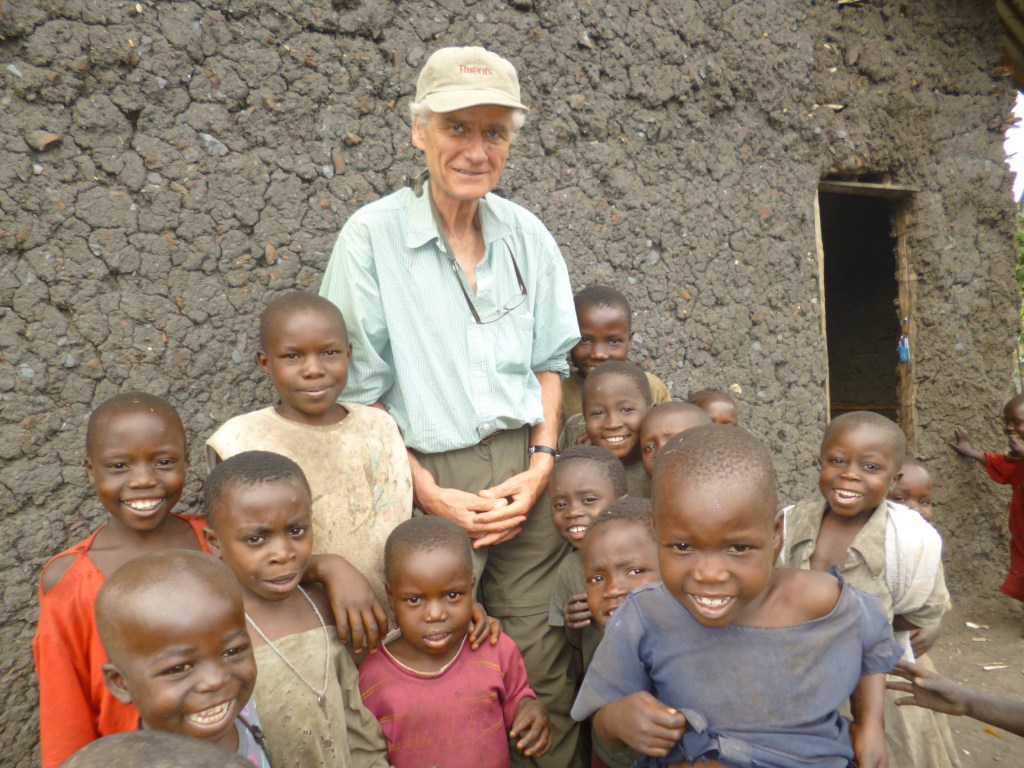
Making friends with the kids

I was worried I might need to cancel my field trip in the eastern Congo, and the Foreign office travel advisory was less than reassuring:

We advise against all travel to eastern and north eastern Democratic Republic of Congo (DRC). The only exception to this is within the towns of Bukavu and Goma, where we advise against all but essential travel. In Bukavu and Goma we advise against travel at night and to avoid travelling alone at all times.

My journey seemed to ignore a few of these recommendations. I planned to travel alone from Bukavu to Goma, and then on to the small community of Minova, to spend a week visiting Pygmy villages with Congolese colleagues, only one of whom I knew. It was 2012, and I was in the DRC, setting up a small-scale research project to document whether Pygmy people were being denied access to healthcare. After running a training workshop in Bukavu, the capital of South Kivu province, we prepared research teams to visit villages in two areas where my partner organisation, UEFA, a Pygmy run woman’s organisation, had field offices. Rebels still controlled large areas, and hijackings, armed robbery and pillaging in rural areas were common.I felt at home in Bukavu, and knew my way around, but I didn’t know Goma at all (I’d just passed through once in 2002). The Foreign Office website had further cautions about armed robberies in Goma, including robberies of vehicles. I then needed to leave Goma, on public transport, again alone, and during a cholera outbreak. (In fact I’d chosen our research area to see whether Pygmies had access to the free treatment offered during the cholera outbreak). In spite of the risks, I really needed to get into the field, to make sure that the research was effective, and to get direct experience of the situation faced by Pygmies in South Kivu. There was one further danger. The M23 rebels were reportedly moving in force towards Goma, beating back the Congolese army.

I was lucky, as the accountant at the CAP Protestant mission guest-house, where I stayed in Bukavu, offered to phone his colleague in Goma and reserve me a room. He also negotiated a reduced price as I was on a tight budget. Better than that, he arranged for the director of the CAP Goma to pick me up from the boat and drop me off the next morning at the bus park for Minova.

Thursday Nov 15 2012

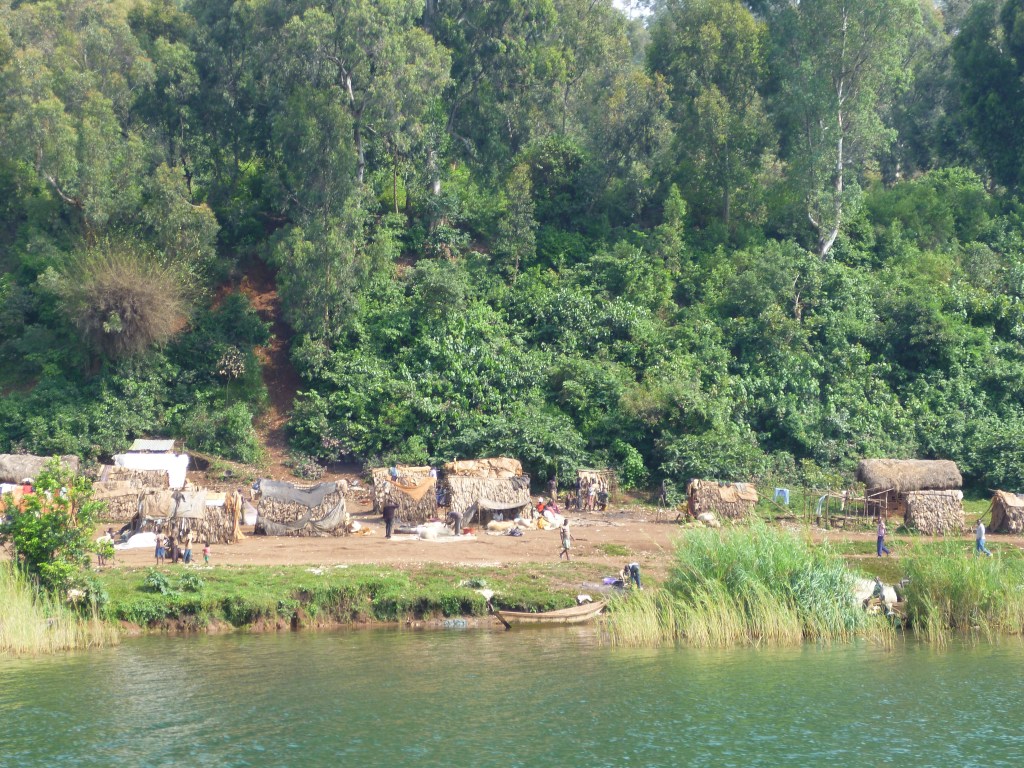
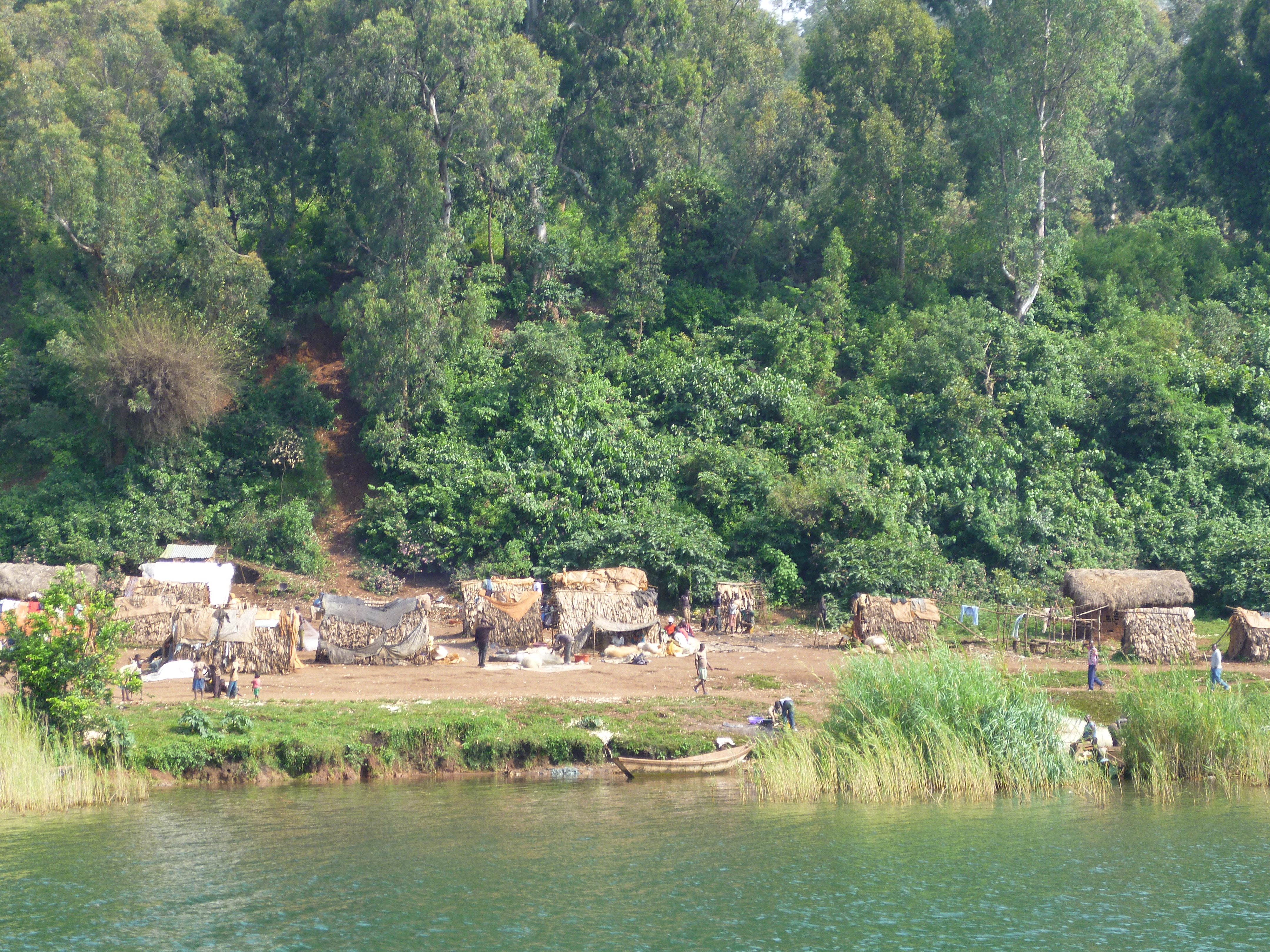
An enjoyable five hour boat ride up Lac Kivu to Goma, passing numerous islands, and the occasional dugout canoe. I had a good conversation with two fellow travellers about the disastrous situation in North Kivu, with the Rwandan backed M23 rebels on the rampage again, and the reasons the international community have supported Rwanda, in spite of its aggressive behaviour towards the DRC. I bought pineapples and green oranges from the jetty, as a gift to my new host, when we made a stop at the island of Idjwi, and also saw a couple of poverty struck Pygmy camps near the ferry stops.

Pic of Pygmy camp on Idjwi

Pygmy camp on Idjwi from ferry to Goma

The ferry arrived in Goma at 5.30pm. Goma, a city of half a million, had been inundated by lava just ten years earlier. The 2002 eruption of Nyiragongo volcano was the world’s most dramatic example of a lava flow through a major town. Three huge lava flows swept into the city, and destroyed perhaps 40% of Goma, including the business district and part of the international airport. Lava flows created fires in the commercial centre, as cars and petrol stations exploded. Two of the city’s four hospitals and 80 out of Goma’s 150 pharmacies were buried under two meters of lava. Tens of thousands of people were made homeless, businesses destroyed and 400,000 people evacuated.

Pics of 2002 eruption to be uploaded

The director of the CAP picked me up from the ferry and drove me through town and into a new quarter of luxury modern mansions. It was strange to see what would be million pound houses in the UK built on top of the 2002 lava flow. It was an eerie feeling knowing I was sleeping under so dangerous a volcano. That night I had a frisson of fear before I fell asleep.

Goma 2012. New homes on the 2002 lava-flow. View from CAP window

Friday Nov 16

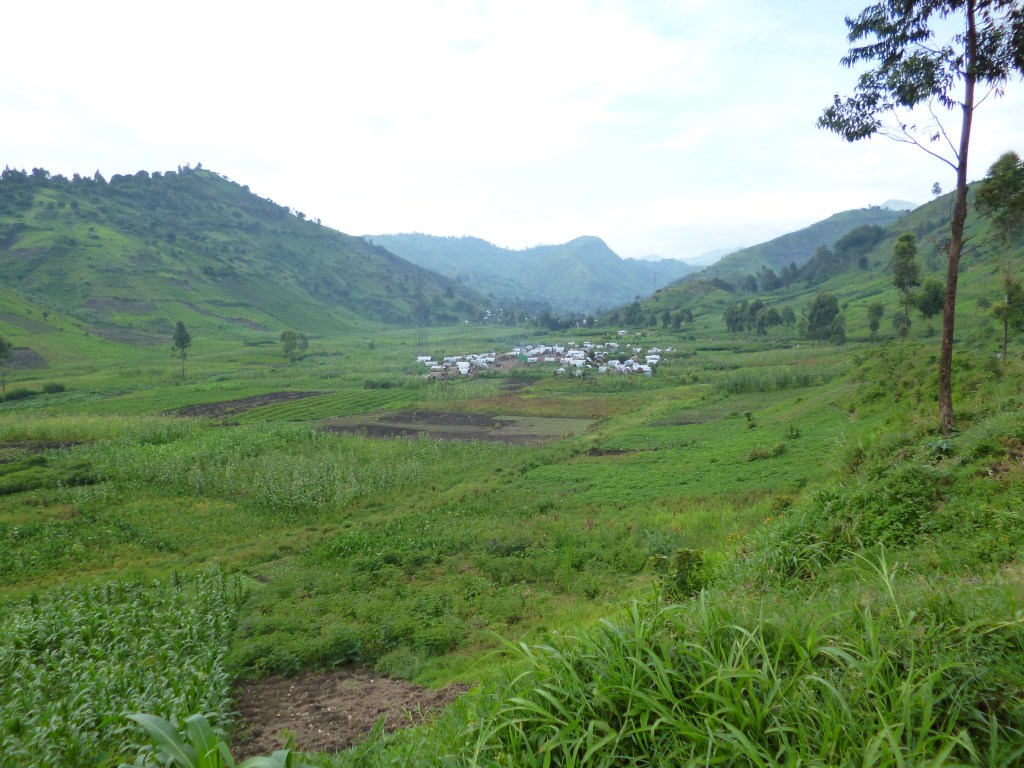
I got up at 6 and the director kindly dropped me at the mini-bus for Minova at 7. As I was one of the first in the bus, we spent 90 minutes cruising to pick up other passengers before leaving town at 8.30. The 45 mile journey was initially through a bleak landscape of shrubs growing on recent lava flows into Lake Kivu. We arrived a Minova, a small district centre with a hospital and two hotels, at 10.15. There were several other NGO teams in town, each with its 4x4s buzzing up and down the one street. Arriving on a crowded local bus, I was in a different league. Jean Claude Kateo, my colleague from Bukavu, had come to the market to meet the bus, and we immediately set off, sharing a moto (motorbike taxi) to Kalunga, 7km away. Bems the Minova coordinator and the Kalunga field worker met us in the UEFA office, a simple and almost empty wooden shack, then we walked up a steep mud track, between square, tin roofed mud houses, to the Pygmy quarter (section), of about twenty thatched mud houses, at the end of the village.

Kalunga village meeting: 16 men and 14 women.

Meeting in Kalunga. Watched by Bantu villagers on the bank

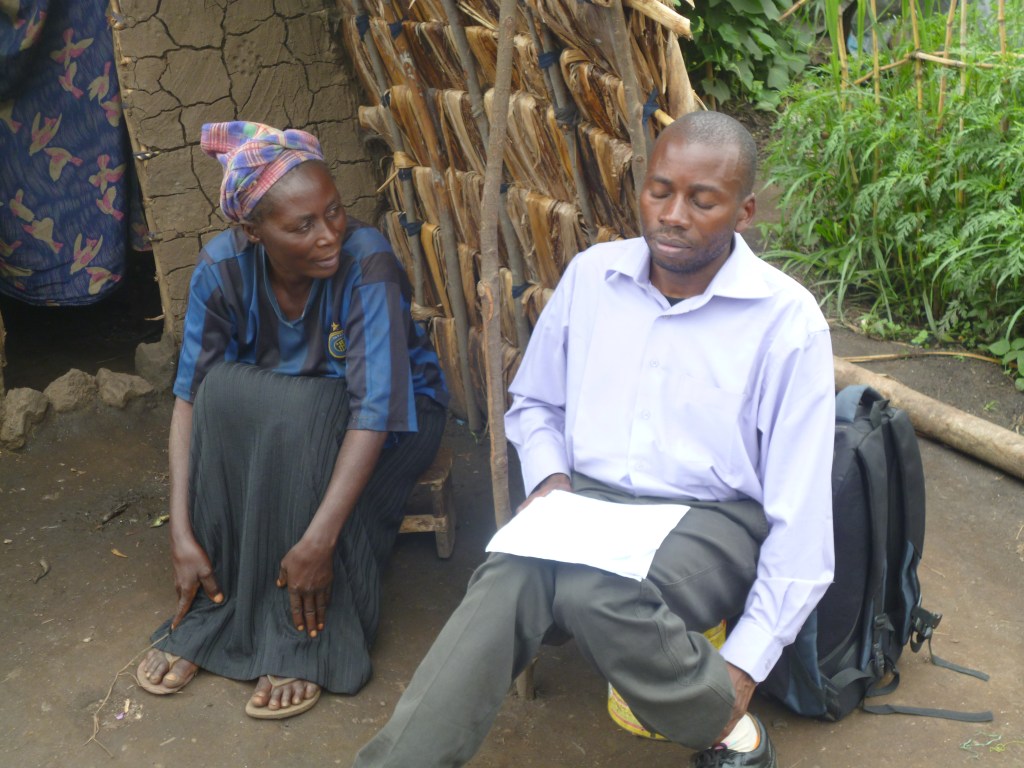
We were greeted warmly, as UEFA has worked in this village for a while. Jean Claude led the meeting, going through our village questionnaire. Then Bems took a small group of men, and Jean-Claude a group of women for smaller focus groups. Afterwards several villagers were interviewed individually. After watching and listening for a while (the meeting was in Swahili, which I don’t speak) I began to take photographs for the report. The Pygmy quarter is crowded into small space at the edge of the larger Bantu village. The Pygmies own no land, and most work on the farms of neighbouring Bantu for a small amount of food or money. They live hand to mouth, and often do not have any food that they have not earned that day. Many of the Pygmies were off working in fields to get that nights meal for their families. The researchers discovered that, in spite of the ongoing cholera epidemic, there had been no cholera prevention outreach in the Pygmy quarter. However, they had earlier benefited from the campaign of free mosquito nets. One person had used his net for fishing, and one man said he’d sold his for 200fc, (about 15p/25 cents).

In this small village, with a district hospital in the adjoining town, there were a number of untreated sick people.

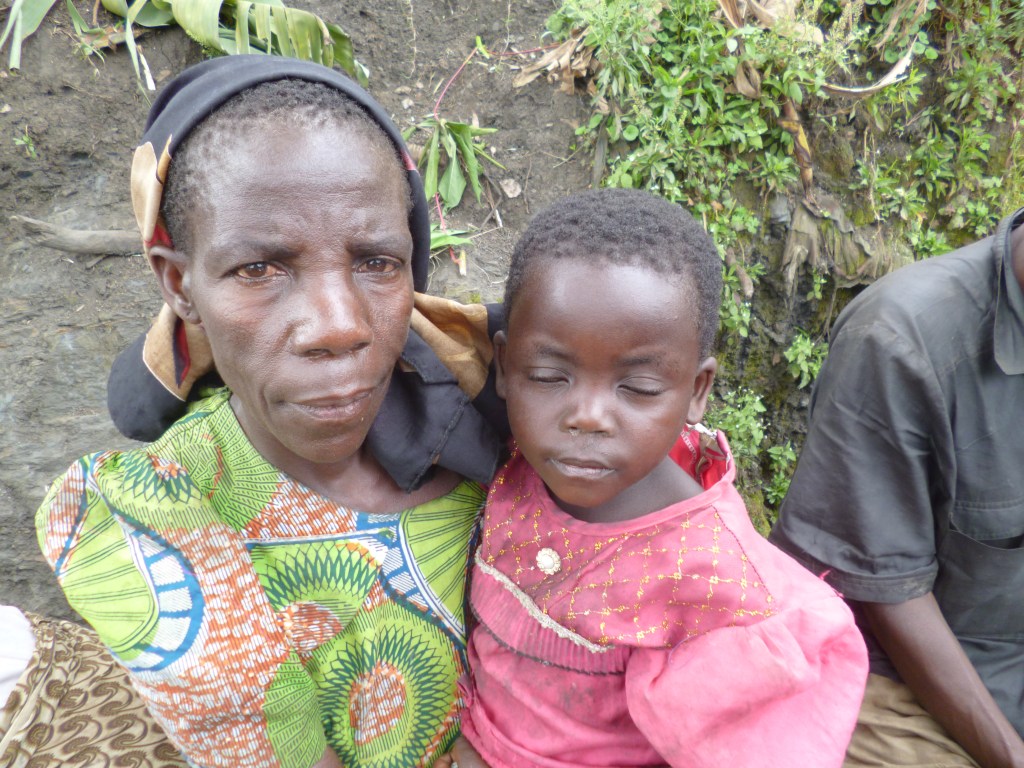
A girl of 3-4 years old with a severe (treatable) eye infection, and almost blind

Young girl with untreated eye infection which leads to blindness

Adolescent girl of 12- 15 with a severe (treatable) eye infection, and almost blind

A man of perhaps 35-40 with a large growth on his forehead

A man of 35-40 with a very large protruding hernia

A woman of 20-25 who had recently suffered a miscarriage and was in pain

A child of 3-4 with a weeping ear infection.

The policy with health care in poor countries, promoted by the World bank and others, is that people pay towards their care. This helps fund the system and also supposedly discourages unnecessary usage. The indigent- those without any money, are supposed to be treated without cost. As all Pygmies meet this criteria, they ought all to receive this free treatment. The meetings discovered that free treatment was consistently refused at the local hospital, and so medical care was unavailable to the villagers.

At the end of the meetings and interviews, Jean Claude asked me if there was anything else I would like to ask. I thought it important to discover more about whether the mosquito net campaign had been effective. From the information already gathered, it would appear that the campaign had been a failure. One net had been used to fish (though as the village suffered from malnutrition, that was a substantial unintended benefit), and one had been sold for a miserable sum. I wished to get more details on this so we asked how many people had still got their mosquito nets. Several said they had kept them, though one woman said that she had hers hidden away, as she thought the insecticide coating was poisonous. She would use her net when the smell went away.

I offered 500fc (about 35p, but as much as a Pygmy might earn for a day’s work) to anyone who could show me their mosquito net in place. This was an adventure, as we got to explore the village and go into many houses and saw nets placed above eight beds. I noted that several of the nets were hung too high, and that mosquitoes could get under the edge. As the cord with which they were attached was already at its max, we arranged that the local staff-person would bring string on his next visit to help hang those nets more effectively.

We promised to return the next day to take the sick with long term conditions to the local hospital. We took the girl with the weeping ear infection to the hospital immediately. She was seen by a nurse, her ear cleaned out, and antibiotics were provided at a cost of $4.33. This was easy for the project to pay for, but beyond any of the village’s Pygmies. All the hospital doctors were in a meeting, so we interviewed the nurse after she’d treated the little girl. Later, the head of nursing arrived from the doctor’s meeting. She told us that as the Congolese government had not paid the doctors and nurses their salaries for many months, the hospital survived on the payments made by patients seeking treatment. Since the international NGOs (Doctors without Borders/Doctors of Africa) had begun to give free health care due to the cholera outbreak, the hospital had had almost no patients. This meant that now the hospital didn’t have the money to pay staff at the end of the month, and the head nurse feared that the doctors would all leave. This was a complication of some organisations supplying free treatment I hadn’t known about. Also the head nurse had not seen the official Ministry of Health Criteria of Indigence, which is supposed to be used by all health professionals to determine who gets free health care. She said, “According to this list, almost everybody is indigent!” As the government wasn’t paying wages and bills, and the hospital relied on fees, that would have serious consequences for the finances of the hospital unless they were properly compensated.

It was already past five. We needed to get back to Minova, eat our first meal since 6 am, and plan the next day’s activities before the curfew at 7pm. We made a rendezvous for 7am with the local animator and left.

Dinner in Minova

When I had eaten and was set up in my dingy hotel room, I sat writing up the day’s events under the dim, flickering light bulb. This was my first field visit as part of this project. The process: whole village meeting, focus groups, individual interviews, interview local health professionals, appeared to produce excellent results. The lesson for me was you can only do useful research if you dig a little deeper. Had we not asked to see the mosquito nets in place, we would have left the village to report the complete failure of the free net campaign, as nets were reported to be used to fish, kept stored away and sold for a paltry sum. This inaccurate narrative reinforced negative stereotypes of untrustworthy Pygmies who resisted health care interventions and would justify the feeling that outreach to Pygmy villages was pointless.

A mosquito net in use.

Already, this one visit had demonstrated that there were a large number of chronic and urgent medical problems going untreated due to the lack of freely available health care. The cost of treatment could be very small- less than $5 for a weeping ear infection. Other treatments (eye infections/conditions) would cost more and some conditions, (such as an operation for a hernia), were not treated at this level- the patients would have to go to Goma. It was already clear that the free medical treatment promised to the indigent did not apply to the Pygmies in Kalunga.

Saturday 17th November. Before leaving the hotel, I lowered the hotel mosquito net, which had been hung too high so that mosquitoes could get under the edge- in fact at more or less the same height several Pygmies had hung theirs. I found it ironic that more than half the Pygmies had placed their nets more effectively than my hotelier.

At 6.30 am, we set off, with Jean Claude and Bems on one moto and me on the other. We stopped in Kalungu to agree when we would return to take the persons identified yesterday to the hospital. This turned out to be a mistake, as we were unable to return at the time specified, and kept a lot of people waiting unnecessarily. We continued on to a village a further 30 km along the road. Here we found that the Pygmy village had moved to Munganzo Teme 4 km further on. We went to pay a courtesy visit to the chief, but he was out. On the way to the Pygmy village we met the chief who was returning with several dozen villagers from a work-party clearing the route for a road up to a planned local health centre. The chief disdainfully checked out our authorisation from the Ministry of Health, made some rude comment about working with Pygmies, and carried on back to the village.

We continued up to the Pygmy village, which was about a km above the village proper, and set on both sides of a path. The space they have been allowed to use is tiny, and hemmed in by the fields of the Bantu, with just enough room for the houses and just one small field for growing food. These villagers had been chased from their own village by their neighbouring Bantu. They had brought a legal case, and won $6,000 for having their houses destroyed and $7,000 for the digging up of their burial sites. Following this judgement, they told us that the Bantu had appealed and then corrupted the court (both the judge and their own lawyer!) to win the case against them. They were now landless and forced to move from place to place.

We began the village meeting outdoors but it soon started to rain. Five men and 6 women moved into a hut to continue the meeting. Pygmies don’t have chiefs. But they nominate someone as such, otherwise they have no spokesperson with the authorities. Their “chief” had a positive attitude to medicine and mosquito nets. We also interviewed a father who had recently taken his two year old daughter with cholera to the local hospital but was refused care as he had no money. His daughter died two days later. It is shocking that this is still happening.

The list of sick people: Chief; problems with eyes; a woman with a massive goitre; a child with a serious skin condition; two women with pain in gut.

Going to hospital with sick people

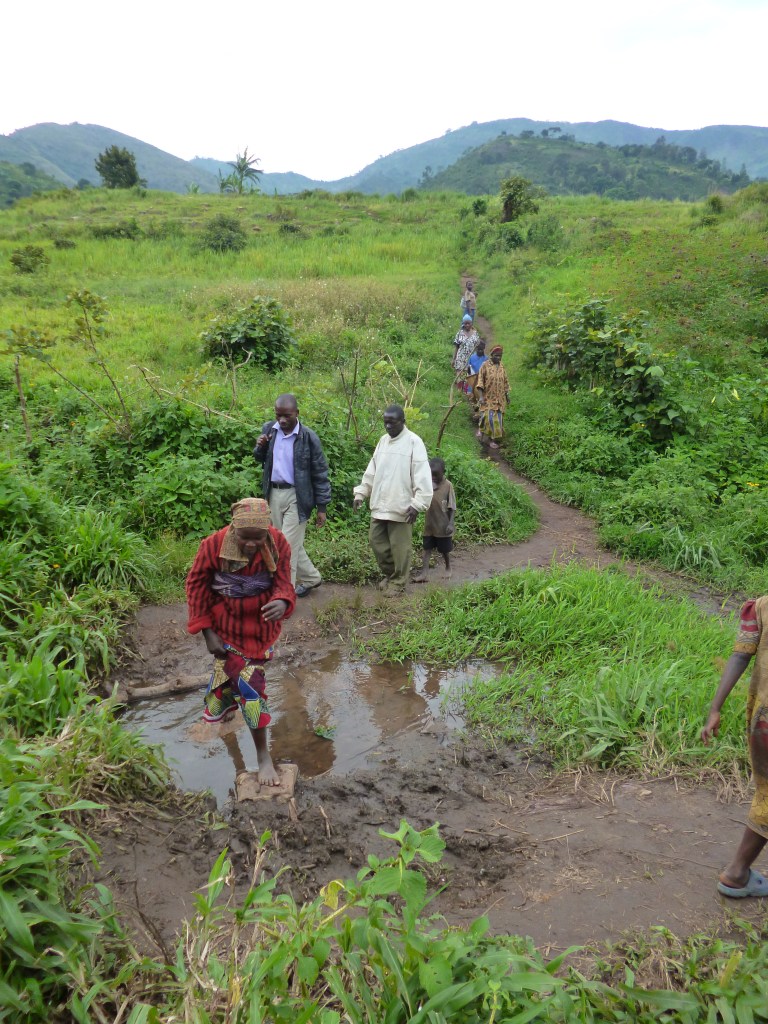
After our meeting, we set off to walk the five kilometres to the hospital with the sick patients. On the way we passed a drunken soldier who had commandeered a villager to carry his load and now ordered one of the sick Pygmies to carry the rest. Bems, the Minova staff person stood up to the soldier, and for a minute I thought it would end very badly. But the soldier backed down, and muttering venomously carried on his way. It was a Saturday, so that the hospital was only partly staffed. But the five patients got various blood tests and some got medicines right away, and the others were asked to return on Monday. We prepaid the fees for Mondays consultations, and arranged for Bems to return during the week to follow up on the care given. Again we interviewed the head of nursing and while we finished up, Bems returned to Kalungu with $50, to take the patients from the day before to the hospital where we would join them.

We returned on two motos, but it was a frightening journey as my driver was speeding and lost control badly on a gravel corner, and even after that maintained a dangerous speed. It is a mad irony that in spite of all the tropical diseases, and rebels, the greatest risk is a serious motor vehicle accident. And I had seen the quality of the medical services available, and I didn’t look forward to using them with a serious injury. Bems had also had moto problems, as his moto had broken down, and he had not made it to Kalungu in time for the hospital clinic. We went to the hospital to look for local UEFA staffer and asked him to apologise and gave him the funds to take the sick people to hospital on Monday.

We returned to Minova for the first meal of the day at 6pm, and quickly to the hotel before the curfew. There were now a lot more Congolese army soldiers in town. Many had fled the M23 forces outside Goma. Minova would be the next point on the M23 drive towards Bukavu. The soldiers seemed extremely nervous, and there was a visceral tension on the street. There were rumours that the M23 rebels had by-passed the UN peacekeepers and were already in the outskirts of Goma. We could hear loud noises that sounded like artillery fire coming across the lake. This was terrible for the people in Goma, but also bad for us. It was my safe route back to Bukavu; otherwise I would have to travel by road down the insecure west bank of the lake. It was far worse for Jean Claude as he had left his 3 year old daughter with his sister in Goma, and needed to pick her up. We had just started our research and I was reluctant to stop so soon…

Next: Visiting an internally displaced persons (IDP) camp, listening to the M23 bombardment of Goma and becoming a refugee. Researching Pygmy Healthcare during Congo’s Civil War, part 2

https://wordpress.com/post/writesimon.wordpress.com/674

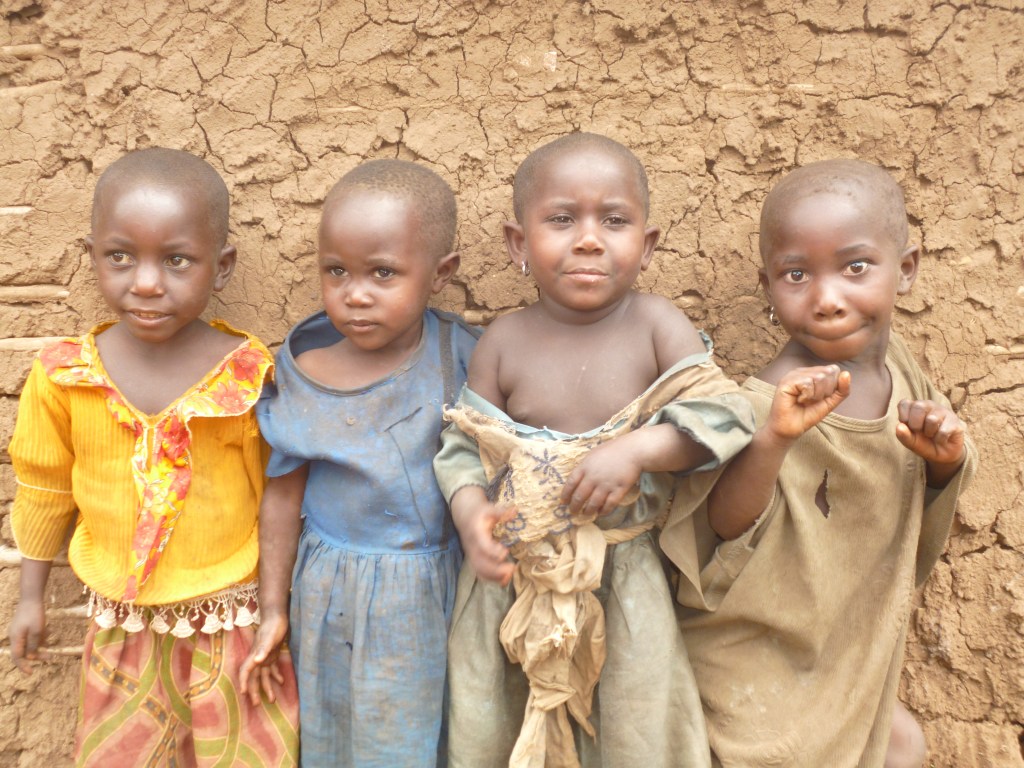
Pygmy kids

The Lions Gate Bridge Caper

Greenpeace Daze part 6

15 minutes

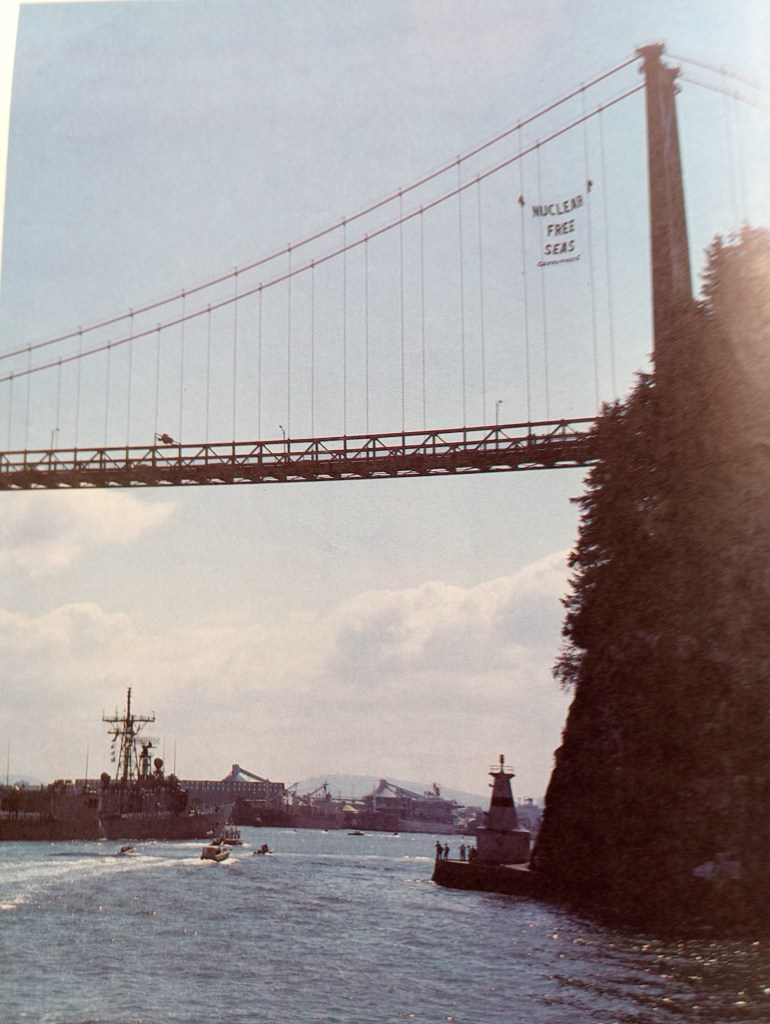
In the spring of 1987, Greenpeace launched an important new international campaign called Nuclear Free Seas. Most of the nuclear weapons in the world are carried by the world’s nuclear navies, especially the US and the USSR, but also by China the UK and France. With the majority of the warships carrying nuclear weapons, and fleets from all these navies in constant movement, there are numerous (usually unreported) accidents and the great risk of an ‘incident’ that could lead to those weapons being used. Greenpeace demanded that the world’s navies remove these dangerous and provocative weapons, and the first stage in the campaign was publicising the widespread visits by nuclear armed ships into the heart of the world’s metropolises. Jim Bohlen, Greenpeace Canada’s nuclear campaigner discovered that nuclear armed US warships would be attending SeaFest, Vancouver’s annual family event celebrating boats and boating, in July.

I had taken three months off from Greenpeace in the summer of 1987. My pal Bob was visiting from the UK, and I intended to spend a relaxing summer enjoying British Columbia’s wild places, as well as Vancouver’s music, fringe theatre and dance festivals. Then Jim asked me if I would hang a banner on the Lion’s Gate bridge, at the entrance to Vancouver’s inner harbour to protest the warships. This was right in the middle of my holiday, but I had to say yes.

We had been buffeted by the wind when we’d suspended ourselves from the Cambie street bridge the year before, even though the bridge was far lower and relatively sheltered. I felt it would be dangerous to hang off the Lions Gate bridge. The banner would have to be large to be visible hanging off the roadbed two hundred feet off the water. It would be very difficult to stop our ropes chaffing on the bridge edge, which I worried risked them breaking, and our plunging to our death. So it was necessary to climb up the bridge instead.

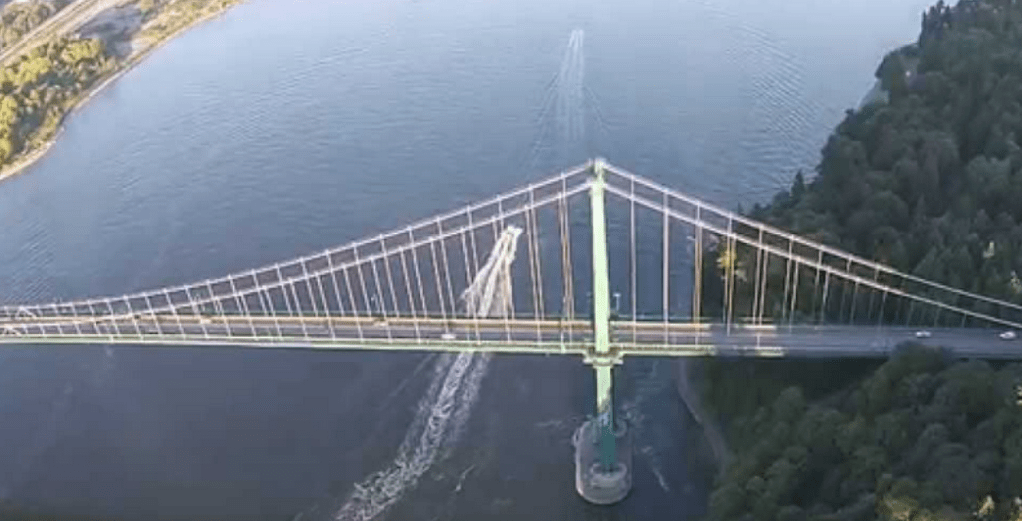
The Lions Gate bridge connects Vancouver to the north shore. It is a smaller version of the famous Golden Gate bridge in San Francisco, but in a more dramatic setting, soaring out of Stanley park with its giant Douglas firs, towards the north shore mountains. The main span is 1,552 ft, the towers are 364 ft high, and it has a ship’s clearance of 200 ft.

We would be climbing the first two cables to the left of the tower.

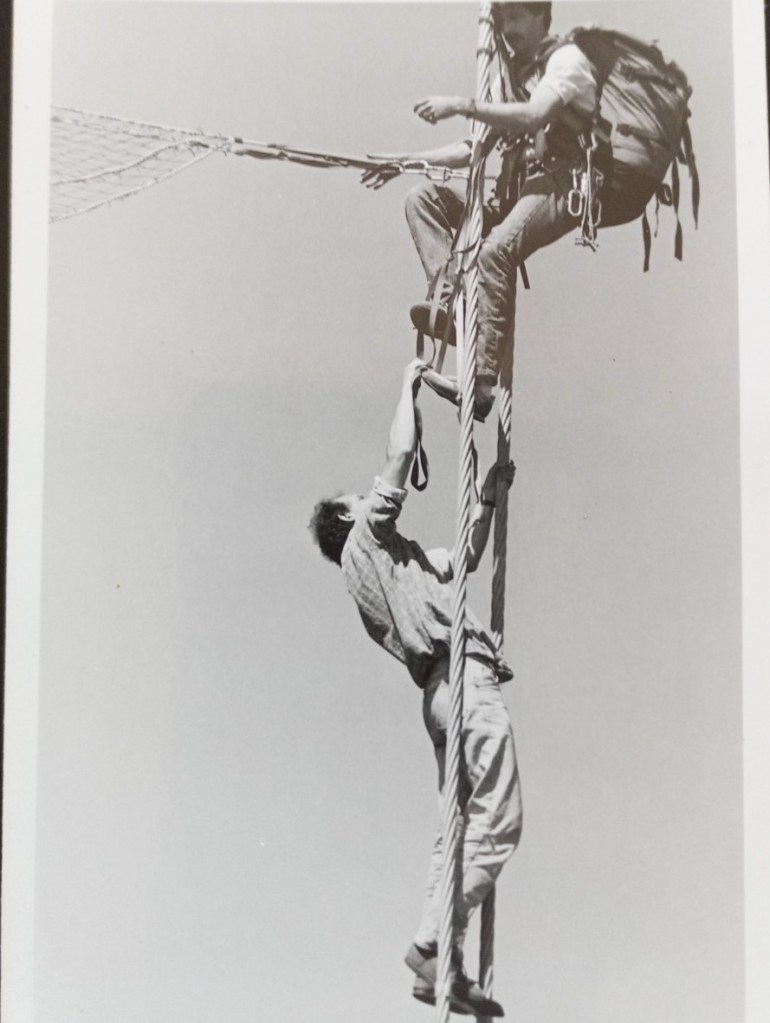
I had looked at the bridge earlier in the year, out of professional curiosity, and had told Jim I thought it possible to climb the vertical cables that connected the bridge to its giant suspension cables. To make sure, now it was more than theoretical, I went back and had another look. The vertical cables were made of braided steel and perhaps two inches in diameter. They were in pairs, and connected like a ladder. But, to stop pranksters or drunks climbing the ladder, there was a twelve foot section at the start where the rungs had been removed. I knew that the prusik knot could be used to climb a one inch nylon rope. But I didn’t know if the knot depended on compressing the rope- as it certainly wouldn’t compress a steel cable. I tested this by prusiking up a thin telephone pole support cable and it seemed to work.

If we were going up, the banner would be fixed to the vertical cables, and wouldn’t give in the wind, and I felt sure it would rip. So, I looked into using a net banner, following the lead of Jim Bohlen and Kevin McKeown’s Cruise Catcher [see Refuse the Cruise]. I went to see a fishing net maker and explained what I needed. He asked what bias I wanted, and I got a brief course in net making. He argued a net wouldn’t hang strait without some bias, but I was worried if it was too curved the slogan would not be legible. We compromised on a 15 percent curvature, and I ordered a 30 x 40 feet net of heavy duty netting. Then, in spite of the curvature, using my usual graph paper calculation to layout the slogan, I ordered five-foot high letters made out of heavy duty black vinyl. One night several canvassers helped lay out the net in the office and attached the slogan ‘Nuclear Free Seas, Greenpeace’, using plastic cable ties.

The plan was to spend the night on the bridge, to greet the warships as they sailed past in the morning, so we would need to carry up a lot of gear. The local climbing store, the marvellous Mountain Equipment Coop, had hammocks used by big wall climbers. Unlike the usual hammock that is tied between two trees, these hammocks are attached to a single point. I bought two, and began practising how to set one up when suspended in mid air.

Practicing with the hammock on the back deck

I found setting up the hammock was not easy when I hanging from a roof beam on my back porch. It was quite a manoeuvre to get in and out, and I spent a long Sunday afternoon getting the hang of it.

We had to carry all the equipment we’d need for spending 24 hours on the bridge. We’d need a large backpack with our hammock, a sleeping bag, food, water, warm clothing, and spare climbing gear. All, our gear would probably be confiscated, so I didn’t want to use my own camping gear, as I was planning on going camping a few days later. I bought sleeping bags, backpacks, water bottles, new climbing gear and other kit. We were also going to use a newfangled device, a mobile phone, to keep in touch with the office and take press calls as we hung in our hammocks. I had never used a mobile phone before. It was massive, and each battery weighed about a kilo, and I had to carry a spare as they didn’t last anything like as long as a phone battery on a smart phone nowadays.

I also needed a safe and trustworthy partner. This was going to be a difficult and potentially dangerous action. We’d be high up and blasted by any wind or rain, and could not afford to make any errors. Bill Gardiner was not a climber, but had already done at least one climbing action with Kevin McKeown, the Vancouver action coordinator. Bill volunteered, in spite of the extra complications, and risks, of the height and wind, and setting up and sleeping in a hammock. We would need to have a number of training sessions, both to refresh Bill’s basic climbing skills and to practice prusiking with a large backpack and setting up and sleeping in a hammock. Bill was right in the middle of his masters degree and hard to get hold of. I was worried when he missed two of our planned training sessions due to deadlines for his M.A. Perhaps because I was still officially on holiday, and had a friend over from the UK, I left dealing with this until rather late. Finally, the morning before the action, I arrived at his house and roused him from an all night study session. After just a couple of hours, Bill had had enough, and left to catch up on his sleep. This put me in a real quandary. Bill had not really had adequate training, and I ought to call the action off- as it was far too late to find a replacement. But Bill was dedicated and determined, and I thought of the first Greenpeacers going off to Alaska to stop nuclear testing. Each of us makes our own decisions about the risks we are prepared to take. Bill had made his. He promised he’d practice using the hammock at home, and so I dropped him back home with his kit and made a silent prayer for our safety to the god of good causes.

I had been avoiding the office as I was still officially on holiday, so the campaigners were not aware of these last minute problems. I was ready, the kit was ready, Greenpeace was all set up to support a major action, and Bill promised to take a break from studying and practice some more that evening. I arranged to pick him up at nine the next morning.

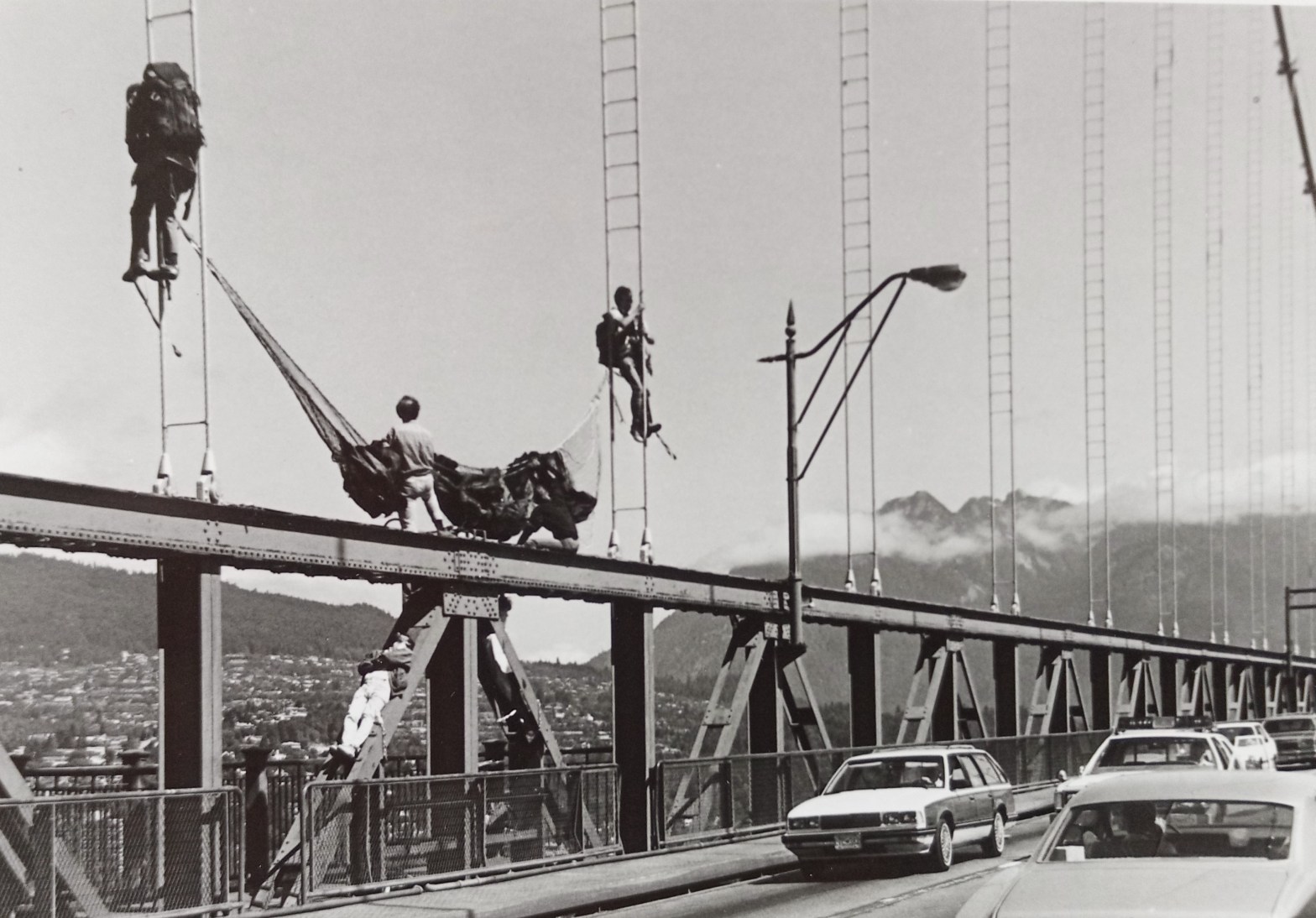
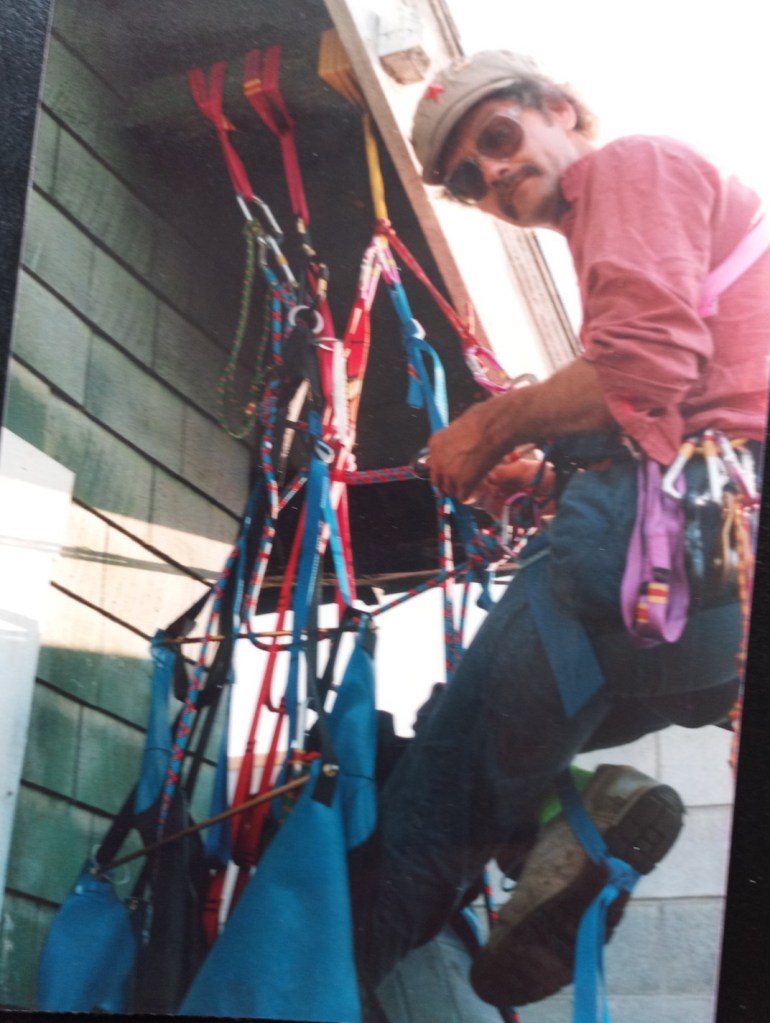
We drove to the Lion’s Gate lookout car park, where Kevin had assembled a team of helpers, went over the final details and waited for the ‘go’. Bill looked exhausted from too many all night study sessions, but said he was fine. He is bigger, younger and tougher than me, so I had to hope he was right. We put on our packs, and then slipped a couple of spare slings over our neck and shoulder, ready to go. There was a delay, and we took the packs off and rested until we got the ‘ok!’ on the radio from our scout on the bridge. It was just a few hundred yards down a flight of steps and along the pavement to the small balcony which protruded from the side of the bridge tower two hundred feet above the water. We were going to go up the first two sets of cables past the first tower. The cables started on a narrow beam ten feet above the roadway. Bill got onto the beam with his helper, and attached himself to the cable he was going to climb, and I did the same. My friend Bob had offered to risk arrest and be my helper for the day.

Bob holds the banner, as we climb up towards the ladder steps

The beam was ten feet above the road, but on the other side the drop off was two hundred feet, a potentially fatal fall into the turbulent waters of the First Narrows. The banner was stretched out between us along the beam, as it was too big and too heavy for one person to carry in a pack with all the other kit we needed. At this point in the action, we were vulnerable to anyone grabbing the banner from the roadway. Though this would be a risky manoeuvre for them, as they would need a leg up in a very exposed and precarious situation. Unless they found a ladder. Fortunately, the Vancouver police behaved sensibly, focussing on closing the middle lane and directing the traffic.

But the action was at a critical point, and we had to move fast.

I attached my prusiks and prusiked up the twelve feet to where the rungs began. There I realised I couldn’t make the step up from a sling at knee height onto the first step of the ladder at chest height carrying a forty pound backpack. I had to make some intermediate steps. I took one of the slings off my shoulder and looped it onto the first rung of the ladder. I was still unable get my foot in this sling with the backpack pulling me backwards. By using the other sling, and my spare prussic I made another step and using these two extra steps, I got my foot onto the first rung of the ladder, my arms exhausted with the effort. After clipping into two higher rungs with safety slings, I looked over at Bill, and I could see that he had the same problem. I shouted to him to make a couple of steps with his spare slings. But when he had put his pack back on, after we were delayed, he had put it over his slings! I watched as he tried several times to haul himself up without extra steps, but with the weight of the pack and pulled by the banner, he slumped back. Bob was near the middle of the beam holding the banner up to stop it dropping further towards the road and the police. I didn’t want to alert the police that we were having difficulties, as they might feel obliged to interfere and stop us. I called Bob over, and told him, as discreetly as possible, that what he had to do was critical, and dropped two slings to him, which fortunately he caught.

He walked insouciantly half way over the beam, to pass the slings to Bill’s helper. Understandably, given the exposure, Bill’s helper was clinging to the beam, and was not able to take the slings. Then, in the most astonishing act of daring, Bob stepped over him, poised above the deadly 200 foot drop, and walked the rest of the way across the beam, and then stood on tip toe and passed the slings up to Bill. This was the critical moment. Without this act of bravery, we’d have been in serious trouble.

Bill, tied a sling onto the first rung of the ladder and stepped into it, another step and with an enormous effort, he pulled up onto the ladder, where he stopped completely beat. I went up as far as the banner between us would allow, and now the banner was out of reach, Whew.

After we had both had a chance to recover, we carried on up the ladders and stopped a hundred or so feet above the road. We slung our backpacks onto the cable, and then much relieved to be free of their weight, attached the top of the banner to the cable and then climbed down the ladder forty some feet to set the bottom corners. As the banner filled in the wind, I could feel the force pull painfully on my harness. It required all my strength to heave the banner line and attach it to the ladder and get the weight off my harness. The banner ballooned out, looking magnificent in the wind. We’d done it. We climbed back up the ladder to arrange our hammocks near the top of the banner, and climb in. The view was exceptional, but it was early afternoon and we had press calls to deal with.

Next: First night in a hammock, and media interviews from my aerie.

Dedicated to two heroes Bill Gardiner, who braved 24 hours, 300 feet above the water, having missed much of the vital training, and Bob Stafford who stepped up at a critical moment and saved the day. Without their bravery, this would not have been possible.

A Short Walk in the High Sierras

15 minutes


https://www.pcta.org/discover-the-trail/photo-gallery/california-media-gallery/
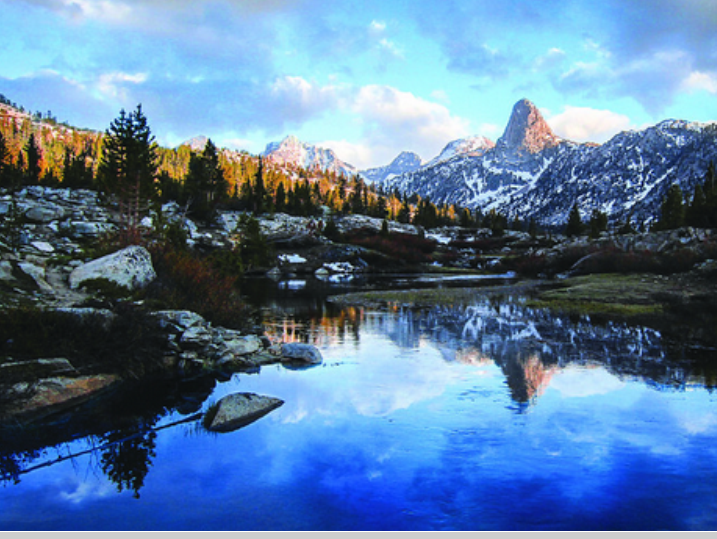
Fin Dome towers over Dollar Lake, Kings Canyon National Park. Photo by Brandon Sharpe

In September 1968, hitch-hiking through the Central Valley of California, I got a ride in a vast Ford F350 Pickup and told the driver, a guy about the age of my dad, about hitch-hiking from New York. After a while he said. “I think my son would benefit from meeting you. He’s dropped out of college and just hangs around the house doing nothing. If you’d enjoy clean sheets and a hot shower for a couple of days. I can put you up, and make sure you are well fed. Maybe you can encourage Arnold to get out of the house and do something with his life.”

This seemed a tall order, but good food and a comfy bed appealed. He pulled into his driveway in front of a large and impressive suburban log cabin, in Visalia. Inside, he offered me a drink, and went upstairs to see his son. “He’ll join us for dinner,” he reported on his return. Arnold when he showed up, with a certain reluctance, was clearly depressed, and not much interested in his dad’s new friend. However, over great big steaks, and good California wine, his father persuaded Arnold that night at dinner to get a job at the tomato packing plant twenty miles away. With nothing else to do, I went with him the next day. My job was taking the full flats of tomatoes off the end of the conveyor belt and stacking them onto pallets. The pace was extreme, and I had to run, carrying two 25lb flats at a time, either at arms length, biting into my legs, or lifted to chest height. I got back after the first night very sore and completely exhausted. But, I was making a little money, and the excellent board and lodging were free. After the three hardest days of my working life, Arnold quit. Without a ride to the plant, I was unable to continue the job, but I was very happy to be free of the badly paid and excessively hard work. We went back the next day to collect our wages, and that night over dinner it was obvious that my time of steaks and feather beds was up.

In one of our dinner conversations, the father had told me about the Sequoia National Park, in the foothills of the Sierra Nevada mountains just fifty miles away, and I decided it was well worth a visit. In spite of his father’s encouragement, Arnold refused to join the trip, but he was volunteered by his dad to drive me to the park. I managed to leave some of my stuff in his room so that I could go for a hike in the Sequoias without any unnecessary extra weight.

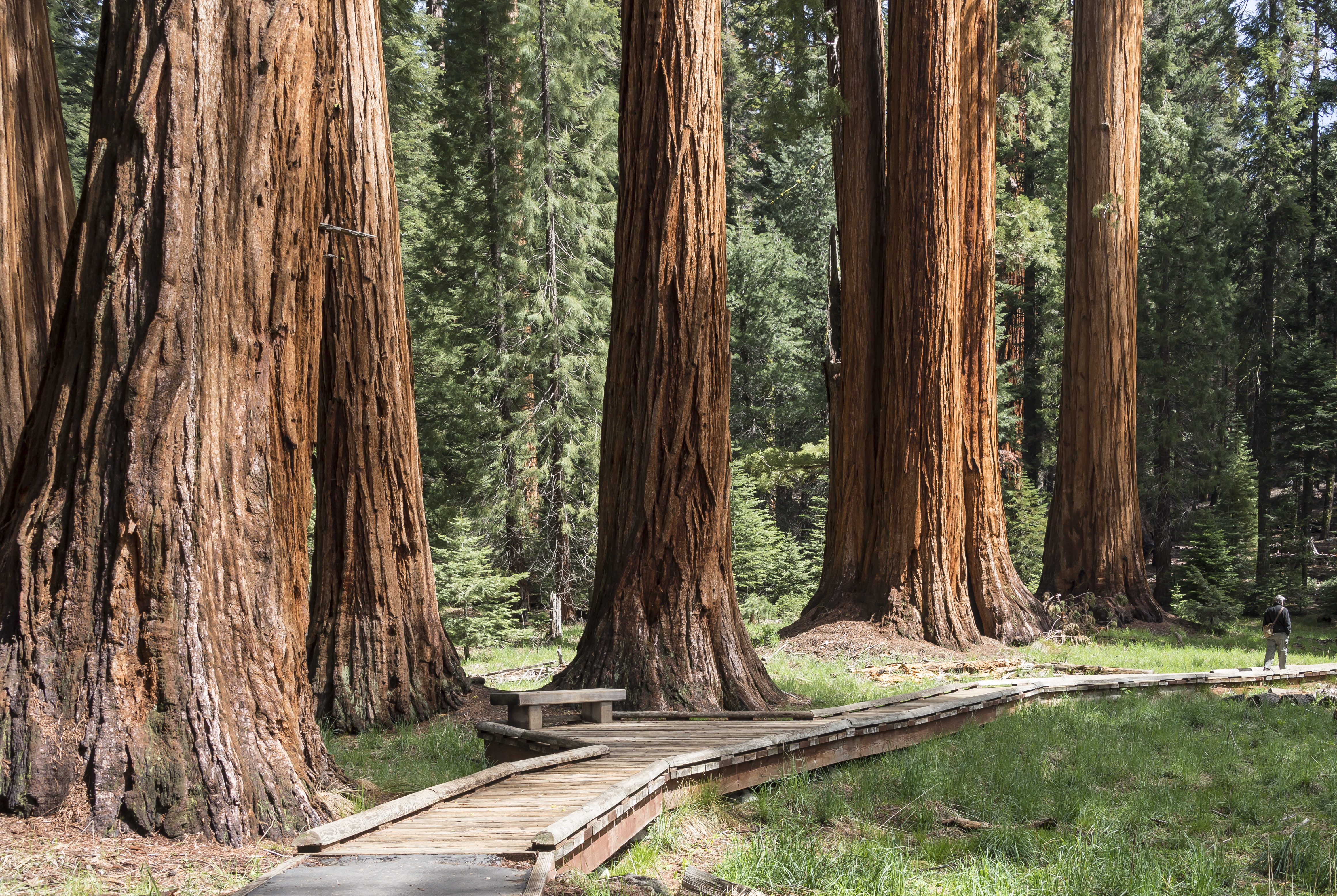
The mountain Sequoias are the most massive trees on the planet, with a deeply furrowed scaly bark of a beautiful red. They tower over two hundred feet and an old postcards shows a carriage driving through a hole cut in a tree a hundred years earlier. Nowadays, cars drive less impressively through the same tree.

Giant Mountain Sequoias

After a delightful few hours, getting off the road and wandering footpaths through groves, I went to the visitors centre. There I saw a map of a trail system that would take me to Mt Whitney, at 4421m/14,505ft the highest summit in the contiguous United States, in just over 60 miles.

It was getting cold in the mountains, but there was still no snow this far south and it was an opportunity not to be missed. I hadn’t been planning on going high, but I had a Black’s Icelandic Special sleeping bag and a reasonable pair of shoes. I went to the camp-ground shop and did my best to get appropriate supplies from their limited selection. I bought instant soups, bread, cheese, jam, tea, powdered milk, corned beef, a pound of carrots, an onion and some apples and chocolate. I remember they only had a 1lb box of sugar cubes, so I discarded half the cubes in the bin. I also bought a 1 lb tin of bacon and a tin of baked beans, which were to turn out to have been a good choice.

That afternoon I walked up a steep trail for half a dozen miles and stopped for dinner on a ledge of rock with a great view. After the sun went down, the temperature dropped quickly and significantly at 8,000 ft, and I crawled into my sleeping bag laid out on the flat rock shelf. My previous experience at altitude had been in the Himalayas sleeping on snow, but with an air mattress under me, not to mention a blazing fire to keep me warm till bed time and hot tea delivered in the morning to my tent! That night I was bitterly cold, and I learned from experience how the cold penetrates from below when you don’t have insulation under your sleeping bag.

I was too cold to sleep, and so at first light I got up but was unable to stuff my sleeping bag, as I was in an early state of hypothermia and had half frozen hands. So I wrapped the sleeping bag around me instead, and set off fast. After a couple of hours, finally warmed up by hard walking and the sun, I stopped and packed away my sleeping bag as my hands now worked again. Sometime after nine, I came across the first people I’d seen. A young couple were starting a fire by their tent and I asked if I could join them. After collecting a large armful of wood to add to their woodpile, and toasting by their fire, I broke out my stove and made tea. I had a heavy pack with only the car camping foods available at the store, so decided to eat my bacon and beans that morning as a treat. I offered my new companions a share but they refused several times.

“I know it’s only tinned bacon” I said, “but it’s all they had”.

“No, it’s not that” Jeremy replied. “We can’t eat your food, you’ll need it.”

Jeremy and Alice had worked all summer in the park, and at the end of the summer they’d got married. They were spending their honeymoon hiking in the high country, and had had nothing but the lightest freeze dried foods since they set out on their hike two weeks earlier. Though their mouths were watering at the thought of bacon and beans, they didn’t feel able to accept so wonderful a gift from a stranger.

I assured them that I was happy to share, and persuaded them I didn’t want to carry an opened bacon can around in bear country, and we set to, eating a feast of bacon, beans, their delicious home made bannock and coffee and my pot of strawberry jam. They were a delightful couple, and very well informed about the park and the history of the Sierras. We spent a great day together, walking a dozen miles along the trail, stopping to enjoy the views and look at the late flowering plants.

Hearing about my miserable night, Jeremy invited me into their tent that night, and astonishingly, into their double sleeping bag. This was more than I expected for sharing my bacon and beans, and the only time I’ve shared a sleeping bag with a honeymooning couple. Though, for some reason, Jeremy put me on one side, and slept in the middle.

The following day, I stopped off at Kern hot springs, planning to catch the others up later. The hot springs had been fixed up by the parks service, with an old cast-iron bathtub, its four legs cemented in to a small platform, in a meadow fifty yards from the trail. The very hot water, hot enough to burn, had been piped in to a tap with a two foot long handle. To get a comfortable temperature, there was a bucket to pour in cold water from the Kern river just twenty yards away. I spent a couple of hours, wallowing in a constantly hot bath, as the tap could be foot operated! Once or twice when I overdid the hot water, I jumped out, red as a crab, grabbed the bucket and ran naked to the Kern River just yards away for some icy water. It was a real treat, lazing neck deep in a comfortable tub at almost 7,000 feet, amidst such fine mountain scenery. I enjoyed myself so much, effortlessly warm, reading, soaking and gazing at the mountains, that I stayed for hours.

When I reluctantly set off, the afternoon was half over. I was anxious to find Jeremy and Alice again; they were such good company, and I did not look forward to another bitter night alone. However, as night drew in, I did not find their camp site, and continued into the dark, thinking I would soon see their campfire. Instead, I had to admit defeat, and make a camp in the dark. At least I was camped on grass and pine needles, and able to make a small fire in the fire pit to keep me warm as I cooked. I had a cold night, but not nearly as cold as my first night camped on bare rock. The next day, Jeremy and Alice passed my camp site as I was making a late start waiting for the sun to warm me up before setting off. I had missed their camp in the dark. They asked if I’d seen the two girls that they had passed soon after leaving me the day before. I hadn’t, and supposed they had seen me cavorting in the nude and passed discreetly by, much to my disappointment.

That day, I decided I’d better get a move on as I didn’t have that much food. So, soon after my friends passed me, I caught up and after a final chat I set off fast to get to Mt Whitney. That night, I had a cold camp above the tree line, but made sure that I used all my spare clothing underneath me in the sleeping bag.

Night sky in the Sierras

The following day, I arrived at the summit of Mt Whitney, where I found about 20 people, day hikers who had come up the shortest and most popular route to climb Mt. Whitney, a 10.7 mile (17.1 km) trail from Whitney Portal, just west of the town of Lone Pine on the east side of the Sierras.

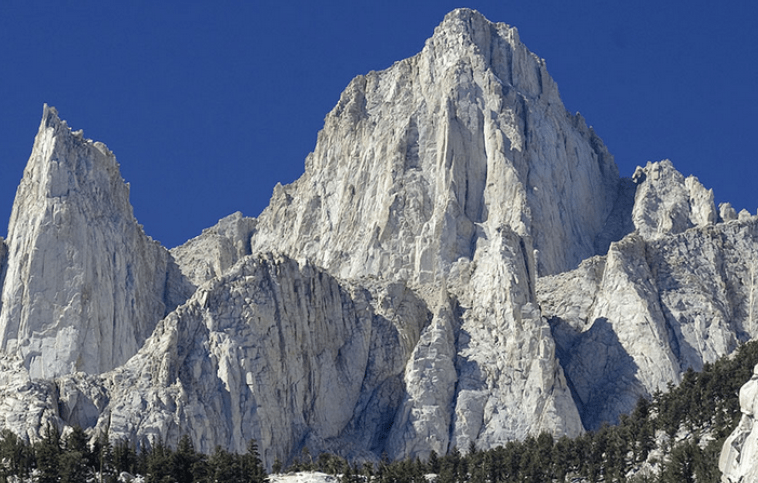
Mt Whitney from the east. The view I didn’t see!

On the mountain’s large flat summit, I ate almost my last food and chatted to Lance, a pleasant guy from L.A. about my walk in from Sequoia, and he was impressed. Whilst I was happy to be on the top of the highest mountain in the contiguous US, I did not want to end my trip by descending a busy trail, followed by a 400 mile hitch-hike around the Sierras back to Visalia to collect my stuff. If I could, I wanted to continue up the John Muir trail, perhaps another 30 miles, and leave through Kings Canyon National Park, as it would be far more interesting, and would put me back on the same side of the mountain chain as my bags.

Lance said “I have too much food- I’m sure lots of people here have extra too.” He very generously offered to give me his surplus food, then he wandered around the mountaintop picnickers and asked a dozen other people if they had any extra to help me on my trip. He collected a carrier bag half-full of sandwiches, dried sausage, cheese, biscuits, chocolate, candy and sweets. So, thanking him and the others profusely, I returned down the western trail, and set off north towards Kings Canyon.

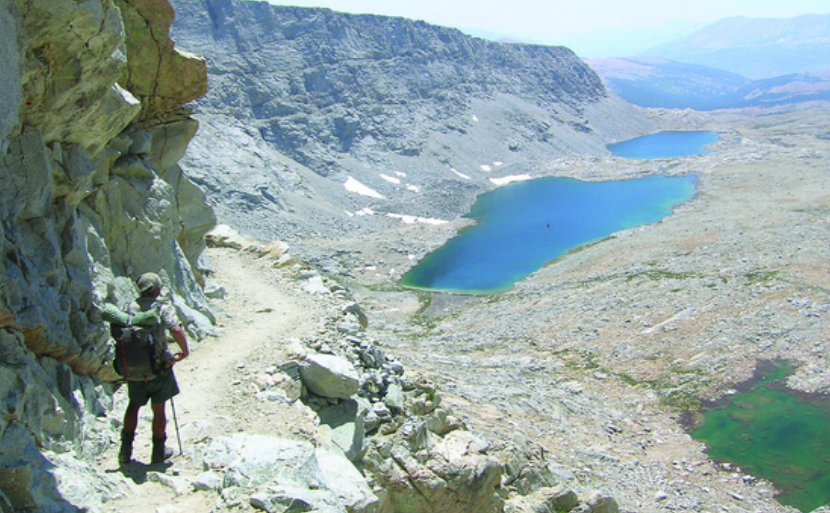
Looking back at the lake where I had my morning swim

I spent the first night in a great rocky basin with no sign of a tree, but views of lovely blue lakes. After a cold dip in one of the lakes in the morning of my sixth day, I began the hard climb to the summit of Forrester pass the highest pass in the contiguous US at 13,160 ft/4011m. In the barren landscape, I saw someone coming down the switch back from the pass. When we met up, he set my adventure into context, as he’d spent the entire summer hiking the Pacific Crest trail, from up near the Canadian border. He climbed down to a post office every so often to collect supplies sent him by his brother. He shared an Italian dried cheese he carried and I shared some chocolate with him.

Kings Canyon NP, the most dramatic views of the hike

Next afternoon I met an very overweight fisherman, who was hiking slowly out to his car. He offered me a ride from the road head, so I walked along with him for an hour. Suddenly, he became quite ill. He stopped and sat down holding his chest. After a minute or two, he told me he was having a heart attack. It was painful just watching him, and knowing that there was nothing I could do. After few more minutes, he started to look better. He told me he’d had several heart attacks already, but this was the worst and in the most worrying situation, so far from the road. He managed to recover sufficiently in half an hour to continue, now very slowly, the last few miles to his car, me carrying his fishing tackle. He kindly took me all the way back to my stuff in Visalia.

Note: I travelled without a camera. All images from the internet

Next: A walk across Death Valley and a meeting with a contract killer.

An early Christmas (fiction)

A tale of the joys and tribulations of homesteading in the Canadian wilderness

20 minutes

Michael was first up. He slid out of the double bed, onto the sleeping platform above the kitchen, and went quietly down the ladder. Slipping on a warm coat from behind the cabin door, he unhooked the latch and went outside. Michael warmed up quickly splitting a couple of armfuls of logs, and making more kindling. He looked across the clearing, the trees starting to turn colour, to where the river ran fast, cold, and deep. Beyond the river, the forest swept upwards towards the distant blue hills, now already dusted in snow. In another month, they’d be snowed in. As he carried the first armful of wood and kindling into the cabin, letting in a gust of cold wind, Diane stirred in the bed. Michael stacked kindling and split logs onto the remaining embers in the airtight stove, and opened the vents to get the fire burning hot. He made coffee and took the pot outside into the morning. He’d grown to enjoy this first half hour, starting the day with brisk chopping then coffee on the bench outside the cabin. It was his time, a time alone to appreciate the quiet morning. With the thick coat over his pyjamas he leaned against the cabin, revelling in the bitter, sweet taste of strong Java. It would soon be too cold to sit out in the mornings, with winter temperatures of 30 below. The cabin was almost finished: the roof on, the doors and windows in. Michael felt real satisfaction. He and Diane had arrived just four months earlier to an empty clearing, with just the ramshackle remains of an old trapper’s cabin from long ago. After they had dragged all their supplies by sled over the frozen, snow laden ground from the lake where the float plane had left them, they’d set up the big tent, which had room for a double bed and a small kitchen area. The rest of the tent had been filled with the two tons of supplies they’d brought for a year in the wilderness. It had taken almost thirty journeys from the lake, three miles along a trail they’d brushed out and worn down through a stunted, waterlogged wood, across a mile of marshes, all still frozen in the pre-thaw spring. They’d cut logs, dragged them to the clearing and fashioned a cabin with a dirt floor, airtight stove, sleeping loft, and a kitchen with shelves and counters of rough wood. Then they’d hauled in their food, pots, dishes, lamps, books and clothing from the big tent.

The big tent was now a store room and workshop, where they were getting the last pieces of furniture finished and building racks for skis, snow shoes, heavy boots, and their winter camping kit.

Everything had gone well- better than Michael had expected. He and Diane had complimented each other. He liked big jobs, cutting down trees for the cabin, (though he’d often had to ask her to help drag them back to the worksite), stacking up the cabin walls, chopping firewood, making rough furniture for the cabin. Diane had managed the supplies and organised the food- though Michael still did most of the cooking. She seemed to really love the place they’d chosen for their year in a cabin. The last few days, though, she’d been moody and uncommunicative. Michael knew he should have talked about it earlier, but he also knew that Diane had places she did not like to share. He went in to take a coffee up to Diane and start breakfast.

-o-

Michael sat stiffly on the just completed log bench, staring at his boots as if appalled at their covering of mud and sawdust. Michael looked up at Diane, realising for the first time the terrible finality of what she wanted. He muttered ‘I see’ so quietly she barely heard him. Diane got up from across the log table and slowly, exhaustedly, crossed the cabin floor and went out into the early September sun. Michael followed her out with his eyes, watching the roll of her hips covered in a pair of old jeans. When the door closed, the only movement in the cabin was the slow roll of tears from eye to cheek. At first Michael sat in deadened pain. His mind wandered back for signs that their idyll would turn to this. When the idea struck him, it seemed contrived and yet there was poetry and hope both in the plan.

Diane came back at twilight to find Michael, unusually, lighting all three lamps.

‘I’ll make supper,’ he said and went into the cabin’s kitchen area.

‘We have to talk,’ said Diane.

‘Do you mind waiting until we’ve eaten?’ asked Michael over his shoulder. He waited for Diane’s unenthusiastic ‘alright’ and continued rooting around the shelves and food boxes.

As he cooked, Diane sat at the table and tried to write a letter.

After supper Michael said, ‘I know you want to leave, and there is no point in my trying to dissuade you.’

He looked at Diane across the candle lit table. ‘No,’ she said.

‘I just want to make a suggestion before you go,’ he continued. We’ve brought enough food for another seven or eight months and I know we can’t take it back with us, but there is one thing I think we should do before you leave.’

Diane looked at him with a puzzled expression.

‘Maybe you think it’s foolish, but we went to so much trouble to plan Christmas…’

‘No, Michael, the river will freeze soon, I have to leave now.’

‘I didn’t mean wait till Christmas.’

‘What then?’

‘I just think we should have our celebration now, an early Christmas.’

By the end of the evening, Diane had reluctantly agreed to postpone her departure until the 27th. The river would still be flowing, and they could make the journey down to Blackwell by canoe in two days if things went well. How, or if, Michael would return to the cabin was not discussed. He’d got her agreement to stay the next six days by promising to accompany her out. It was the evening of September the 20th, so they had four days to prepare for Christmas on the 25th.

The next morning, while Diane was still in bed, Michael took his coffee into the storage tent and began to move boxes. Diane found him 45 minutes later towards the back of the tent, pulling out a crate from the stacks of food crates, winter clothing boxes, survival gear, and other parts of their vast resources. ‘I’ve found the first Christmas box,’ he said, ‘the other one shouldn’t be far away.’ Michael spent several hours in the storage tent, and unusually, didn’t make any lunch. Diane had no enthusiasm for the Christmas preparations. Instead, she spent the morning sorting out what she would take, and writing up a list of what she needed to find buried in the boxes in the storage tent. Later, feeling hungry, she snacked alone on cheese and crackers. In the afternoon, Michael came into the cabin. ‘I am going to go and look for a Christmas tree,’ he said and Diane watched as he crossed the clearing into the woods. A little later, she heard the ring of the axe.

The next day, the 22nd, Michael was again rummaging around in the storage tent. By two, feeling hungry, Diane began to make a meal for them both out of tinned soup, tinned cheese, and some bannock that she made. She had never made bannock before, but she had watched Michael make it many times. She realised that she had not really pulled her weight during the last four months, though Michael seemed happy to do a lot more than her. She felt a real sense of satisfaction in the bannock, which turned out crusty and delicious. She called to Michael when the meal was ready.

On the morning on the 23rd, Michael asked her how they should organise Christmas. How were they going to divide the food between Christmas Eve and Christmas dinner? He pulled out the Christmas boxes list and showed it to Diane. There was a tinned duck, a tinned salmon, a large tinned ham as well as oysters, cheeses, wines, liqueurs, nuts, dried fruit, Christmas cake, Christmas pudding, mince pies, Christmas crackers, decorations for the tree… the list went on. At first, Diane found the thought of so much stuff intimidating. She was not in a Christmassy mood, the weather was wrong, her mood was wrong. But as she read down the list…Christmas stockings, mistletoe, holly, Christmas candles…. she remembered her family Christmases of long ago, her mother enthusiastic to have all the kids together and focussed on a common celebration, her two sisters both excited by the lights and the prospect of presents and a slap up meal. There was no man in her memories, as her father had left them when she was very young, and her mother had remained alone, bringing up her three daughters. Diane looked over at Michael fiddling with a set of battery operated Christmas lights. She saw the concentration, the relaxed posture. Michael obviously loved Christmas, and could forget his sadness and focus on the little tasks necessary to setting up the cabin. Diane realised that he was a good man. She knew he was good looking, and hard working, and focussed and kind to her, but this was the first time she had realised that he was a good man. What would happen when they got out of here? Their relationship would be over, and she would be back looking for a job and a place to stay. She could reconnect with her friends, but apart from Angela, she’s missed none of them; and Angela was getting married and would be busy with her new husband. She felt a wave of despair sweeping over her. There was no going back to what it had been like. She was sure that everybody would have carried on with their lives and she would have to explain why her idyll of a year in the wilderness, isolated and self sufficient had ended so soon. ‘Why had it ended? Was it Michael’s fault, or hers?’

She shook herself and realised that she had become afraid. Afraid of a whole eight months stuck in this small cabin. Eight months with Michael. She had known him already for six months, and largely enjoyed his easy going, but focussed presence. But two of those months had been spent in the social whirr of Vancouver, still working for the first month and a half, then a fortnight of final preparations, and a mad rush of saying goodbyes. It was Michael’s idea to spend a year in the wilderness. It was Michael’s money that had paid for the supplies, the equipment, and the float plane in. It was Michael who had chosen the spot, bought the maps, made the equipment and supply lists. Michael had been planning this trip for at least two years, and dreaming about it for far longer. Diane had been drawn in by his enthusiasm, and had believed that she wanted to do it too. Michael had been looking for a partner to join him when they met, and when he’d asked her to join him, she’d jumped at the idea.

Why had she? Was it a real interest in spending a year in the wilderness? She’d liked Michael, but she wasn’t in love with him. She could remember reading about a couple spending a year in the Nahanni wilderness when she was at school. She’d read the book, but the idea of doing it herself had never occurred to her. Diane was 27. She had been three years in Vancouver, and stayed in three different apartments. Groups of girls formed and broke up as people moved in with their boyfriends, fought with a flat mate, or returned to Ontario or Quebec, where most of her friends and acquaintances came from. She’d been friends with Angela since soon after she had arrived in Vancouver, and they’d shared two places together with other girls. But that had changed when Angela met James. Diane wondered what she would do when she got back to Vancouver. Would she even want to spend another wet winter there? She loved skiing, but the cost of an annual pass was beyond her, and the cost of a day pass and all the expenses travelling up to Whistler meant she only skied five or six times a year, and several of those days were on the mountains just out of town. But she couldn’t stay! Six months stuck in a cabin, snowed in, with six or seven hours of daylight, chopping wood to feed the fire, getting water from a hole in the river, no light but lamplight and candlelight. No friends, just the two of them. No, she’d go, but she should make the last few days as enjoyable as she could. Diane resolved to help with the preparations.

On the morning of the 23rd, Diane got up early too. Shall I put up the decorations?’ she asked. ‘In my family, we put the Christmas tree and decorations up on Christmas eve,’ said Michael. ‘When do you do it at home?’

Diane had flown home for Christmas two years ago. Her two sisters were there, and they’d put the decorations up with her sister Millie’s two children the next afternoon, about three days before Christmas. The two Christmases she’d spent in Vancouver, she’d put decorations up with her flatmates for a Christmas party a week or ten days before Christmas, so that their friends who were going away for Christmas could come. ‘It depends,’ she said. ‘I like your family’s way of doing it on Christmas Eve, but as I’m leaving on the 27th, we wouldn’t see them for long. Let’s put them up today.’

‘OK,’ said Michael. ‘Let’s do it after lunch. I’ll get the decorations sorted out.’

‘I’ll come and help,’ said Diane.

After sorting out the decorations, and untangling the Christmas lights (there were three sets! One for the tree, one to hang above the kitchen area and an external set to hang on the cabin front).

‘No wonder we had two tons of supplies,’ thought Diane, but she was strangely pleased that Michael had put so much effort into Christmas preparations. Diane had packed a small bag that had gone into one of the Christmas boxes- there seemed to be more than the three boxes she had expected. Diane had brought a present for Michael, a set of red candles for the Christmas table, a nut cracker and some nuts in shells.

Setting up all of their lamps, Michaels usual thrift had gone by the board, and with Christmas carols playing on the cassette player, they had set up the tree in its incongruous metal stand, placed numerous decorations, tinsel and taffeta, and then a large Angel on the top. ‘I have crepe paper,’ said Michael. ‘We used to cut it and twist it and string it across the room. What do you think?’

Diane remembered the arguments at home about which colours went best together. Her mother had said, ‘why don’t each of you make them from your favourite colours, then everyone will be satisfied. Her sister Claudia had put red and green together, Millie had preferred pink and yellow. Diane liked purple and yellow best.

Michael said they had done the same at his house, but as he only had one brother, they’d had two choices each. ‘What were your favourite,’ asked Diane. ‘I liked purple and yellow too’ said Michael, ‘my other choice was orange and green.’ ‘Ugh!’ said Diane. ‘I know,’ said Michael,’ let’s agree not to use that combination, ok?’ Diane had laughed, suddenly enjoying herself, and again realising what a nice guy Michael was.

After dinner, they brought out the mince pies and egg-nog. ‘We used to save that for Christmas Eve,’ said Diane. ‘We can if you want to,’ said Michael, ‘but I was thinking mulled wine, and a warming brandy.’

Diane looked at him with surprise, ‘I didn’t know we had any’ she said. ‘Well, I just slipped in a sachet of wine spices and a couple of bottles of Gluwein,’ he said. ‘Anything else you’ve kept to yourself’ she asked

‘Oh, I don’t know,’ he said mysteriously, ‘I thought it would be nice to have a few Christmas surprises.’ That night, when she got into bed , Diane felt warm and pleasantly woozy from the egg-nog and a generous glass of excellent Cognac. She realised that for the last week she had been turning her back on Michael when they went to bed. He’d said nothing. Tonight she felt warmer towards Michael, and a little horny too. She turned and lay facing him when he got into bed a few minutes after her. He did nothing though, just put his arm tentatively around her waist, and went to sleep. Diane felt slightly cheated. But she realised, that Michael couldn’t read her thoughts and would need a clearer message before he risked touching her more intimately.

Diane woke up on the 24th September, their Christmas Eve, and heard Michael humming to himself in the kitchen below her. When he heard her stir, he called up, ‘Do you want pancakes? We have real maple syrup.’

She put on her dressing gown, taken out of the winter box early, and slipped on her winter slippers. Michael was poised in front of a couple of packets of flour, dried egg mix and a real lemon. ‘Where did you get that!’ asked Diane. ‘I had it wax wrapped to keep. I thought it would be nice on pancakes.’ The pancakes were delicious, and a very pleasant change from oatmeal or Muesli, their usual breakfast. Diane had noticed that Michael had simple tastes. She thought that many of the luxuries were brought just for her. But, on the other hand, when he did have something special, he seemed to really enjoy it. The pancakes were delicious. Light and fluffy, with tinned butter and oodles of maple syrup and some tinned peaches. ‘Tinned strawberries don’t really work for me,’ said Michael, ‘I hope this is ok.’

Diane had gotten used to their simple meals, though she knew that Michael expected to be able to keep providing the occasional fish from the river (he had a plan to drill a hole through the ice and continue fishing when winter set in) and even a plan to shoot a deer, which were supposed to come to the meadow in late autumn. After breakfast, Michael asked for an hour alone in the tent, ‘I have a few things to take care of,’ he said as he left the cabin. Diane realised that she too would need an hour or so to wrap the presents she had brought- two for Michael and two for the cabin. As she sat nursing her coffee after Michael had left she remembered the thrill of anticipation before she came, the day dreams about an idyllic winter, snuggled up in her own cabin, making snow-shoe, or ski-trips across a pristine landscape, drawing again, making a pair of moccasins for each of them…. If she had thought about Christmas in the cabin, it had been of a simple affair; she’d thought more of missing going back to see her mother- this would be the second year in a row.

Continues, after Christmas

Agadez, Heart of the Sahara

Saharan Daze 4

15 minutes

[Hitch-hiking across the Sahara in 1972, I got a ride with Jacques across the most isolated part of my route, the 1,000 km from the Tamanrasset, Algeria to Agadez, Niger. We had run out of spare tires at the tiny community of Tegguiada In Tessoum, and Jacques had managed to get a ride with four flat tires and an empty jerrycan into Agadez, leaving me to look after the car until he returned. When two Germans showed up three days later with the spare tires, I’d driven off to take the car to him in Agadez. But the car stalled in the desert, and when cleaning sand out of the carburettor, I dropped a nut into the sand. I waited until morning to look for the lost nut…]

I woke up in the early dawn light, breakfasted on stale baguette and water (it was a little early for sardines) and waited until the sun came up. Then, with some trepidation, I crawled under the car to look for the vital nut I’d dropped the night before. The sand was covered in a scattering of tiny dark stones, and in the half light under the car, I had to pick up each one to be sure it was not the essential nut. Finally, poised on the sand, there it was. Whew! I reopened the hood and put the carburettor back together. Now came the critical moment. I turned the ignition and the engine coughed. I tried again and the engine burst into life. I left the engine running and threw in my sleeping kit.

I had observed Jacques method of driving as fast as he could, and smashing into various obstacles which had slowed us down so much. Instead, I decided to keep slow enough to dodge the frequent depressions or oversized rocks and avoid getting a puncture or damaging the car. But I still needed to keep going fast enough to get through any soft patches: I couldn’t afford to get stuck, as I had no one to help me push out.

In a state of exhilaration, I wondered at my luck. To be hitch-hiking across the Sahara, with no preparation or planning and yet to be driving my own vehicle, alone, with three spare tires, spare petrol and water and the excitement of sub-Saharan Africa ahead. Everything seemed more real than real, and I was conscious of everything around me and everything I was doing in an intense electric supra-awareness. I felt a wonderful lightness, as if I were floating on a magic carpet.

I had a hundred and fifty kilometres to Agadez, which might take just a few hours. But, if anything went wrong, I could be in trouble. I enjoy an element of risk. Risk keeps you alive to what’s around you, and aware of the importance and consequences of your actions, and also of chance. When there is a risk, once I identify it and, if possible, deal with it, I’m pretty good at relaxing, or at least not worrying too much. And this was fun.

I remember my fascination at seeing mountains uncluttered by vegetation, as if looking at the very bones of the earth. Without soil, geology is visible directly. And, without plants, or animals, or signs of humans, it’s the geology that dominates your experience. Geology on a vast scale and a sense of one’s frailty, though not of insignificance. In fact the absence of other life, and of human temptations, rather does the opposite, and you realise the significance of your existence, and the absolute magic of each particular moment.

In a few hours, the track became a well-made gravel road. I saw the sign to the camp-ground, 6 km before Agadez, and drove a few hundred feet off the gravel road, up a narrow track. The Camping was a small, walled oasis with a swimming pool, palm trees, cold beer and simple food. This was luxury compared to the limited services offered in Tamanrasset (a tent space, a wall, a cold water tap and a cold shower…)

Reception gave me the unwelcome news that Jacques had left with a party of Germans in two VW campers two days earlier. Damn, it must have been Jacques calling and whistling at me when I took off from Tegguiada In Tessoum the second time. I didn’t think Jacques would be happy to be abandoned in the desert. I thought it would be wise to stay at the camp-ground, both to keep the car safe, and so that Jacques could easily find me on his return.

After a couple of days lolling around the camp-site, swimming, drinking the occasional beer and with the luxury of a car of my own, I was driving a few of my mates from the campsite into town. Suddenly, a Land Rover coming the other way pulled across my path and I had to brake hard to stop from running into it. Written in large letters on the side of the Land Rover was POLICE. Out jumped Jacques and the Chief of Police!

I was in real trouble! Jacques ran up to me.

“How is the car running,” he asked

“Very well,” I replied.

“Follow us,” he said and jumped back into the Land Rover, which turned and drove back into town. I followed the police chief as he drove into the police compound!
What was going to happen now?

I let out my passengers who, picking up on my nervousness, scuttled off into town, and Jacques and I followed the Chief of Police into his large office. Fortunately, Jacques was focussed on the upcoming negotiations to sell his car, and we cleared up the misunderstanding that had led me to leave him behind in Tegguiada In Tessoum, in a few brief words. The police chief pulled out a bottle of Johnny Walker Red Label with six fingers of whiskey left in it, and poured all three of us a good shot and the two of them got down to some serious negotiation for the Renault. We finished our drinks, and were poured another large Scotch. It was not yet noon, and I don’t particularly like Scotch, drinking in the mornings, or drinking spirits in the heat, but under the insistent hospitality and the powerful personality of the police chief, we finished the remains of the first bottle and another, full, bottle was produced and placed ceremoniously on the desk.

Before the bottle was opened though the negotiations stalled, and the second bottle was hastily removed.

The police chief became bad tempered and we were quickly hustled out of his office and into the hot desert air. Jacques drove at speed out to the camp-ground, packed up the few belongings he’d left behind when he’d gone with the Germans and took off immediately for Lome, in Togo, to sell the car. I packed up too, and got a ride with him into Agadez. He dropped me off on the way through town. And spun away, in a hail of gravel.

I had a meal of macaroni and unidentified mince in a cheap eatery on the edge of the market and asked if I could leave my bag there while I went to explore. Agadez has been called the town at the gates of the Saharan desert. It is larger, more interesting, and much older than Tamanrasset. I spent my first few days exploring the newer part of town, largely one story concrete breeze block buildings, a business quarter with a few modern services (a bank, a post office, a petrol station, government offices), several truck yards, the large open air market, and numerous cheap eateries. Trucks in various stages of repair were parked here and there, propped up on blocks, with missing wheels, or dissected engines and the driver, helper and a mechanic or two camped by them. The market was largely run by Hausa stall keepers selling fruits and vegetables, mounds of unpleasant looking meat covered in flies, watches, radios, cheap clothes, cooking pots and hardware. The Hausa are the farming and trading people of the Sahel. The stall holders wore patterned and embroidered robes and Hausa was the language of the market. I met Andrew who ran a stall selling and repairing sunglasses and spectacles. He spoke English, and had a sad story. He was a Yoruba from southern Nigeria, but had been kicked out by the Nigerians in an operation to remove illegal immigrants, as he’d been born across the border in Niger, and then returned to Nigeria with his parents when he was a toddler. He was Nigerian and had been brought up in Yoruba and English, but he’d been stuck in Niger for the last several years, and had had to make a new life, without his family, or friends and even though he hardly spoke French, or Hausa the lingua franca. I met Andrew when he charged me a pittance to fix my glasses. I thanked him and said he was a good man. He replied with what became my catch phrase, “It’s good to be good.” Each day, I would stop by Andrew’s stall and we would chat. Sometimes we shared a lunch of baguette, onion and local cheese, or a tin of sardines.

Agadez market

I learned my way around the market, chatting to some of the vendors who spoke French, picking up a smattering of Hausa, and buying a small pile of tomatoes or onions to go with my bread and sardines. After a few days, I knew the local price for these two items, but one day a stall holder asked for twice as much for a small pile of tomatoes (6 instead 3). I was confident I knew the “real” price so I tried a new negotiating technique by raising the price. Instead of 3, I offered him 10, and the ears of the other stall holders picked up. We then had a very entertaining public negotiation, with me offering progressively more ridiculous amounts as he embarrassedly and rather quizzically dropped the price. He dropped to 5 and I responded with 20; he looked confused, “4?” “30”, “3?” “Okwhy dadi” (good!).This greatly entertained the other market vendors, and by the time we had finished, I had made a few mates and guaranteed I would get good treatment from all the traders from then on.

In the evening, I returned to the restaurant for another meal, and took my sleeping gear out into the desert, walking two or three hundred metres to the first tree, where I laid out my bag, and slept under the stars. I returned to the restaurant in the morning, had a breakfast omelette and put my kit away. From then on, I had one meal a day there and had the benefit of a free left luggage depository.

Agadez has a large medieval quarter, the pre-colonial town of traditional mud-brick houses with high mud walled alleys. It has an impressive, ancient, mud-brick mosque, and a weekly camel market. It is difficult to get around the old town, as most alleys fizzle out in dead ends. Finding a way through to the square in front of the sultan’s palace took me several days exploration, and I often still got lost. I discovered that Agadez is a town it takes a long time to get across quickly!

Agadez: The Sultan’s Palace

There were the black tents of several Tuareg camps on the edge of town. The Tuareg are the desert people, the camel herders, oasis dwellers, warriors and one time masters of the trade routes, that had criss-crossed the Sahara from the great trading cities of Djenne, Gao, Timbuctu- and Agadez, as far as Morocco and Libya. The Sahel is a transitional zone between the arid desert to the north and the belt of humid savannas to the south. A great dry was upon the Sahel, and thousands of Tuareg were unable to find grazing for their herds as they were used to. The Tuareg were having to deal with severe drought and a seriously degrading climate, and the Sahara advancing into their grazing areas. Encyclopedia Britannica says:

In the second half of the 20th century, the Sahel was increasingly afflicted by soil erosion and desertification resulting from growing human populations that made more demands upon the land than previously. Town dwellers and farmers stripped the tree and scrub cover to obtain firewood and grow crops, after which excessive numbers of livestock devoured the remaining grass cover. Rainfall run-off and the wind then carried off the fertile top-soils, leaving arid and barren wastelands.”

This description follows a western pattern of placing responsibility on local people for their deteriorating situation, when the primary cause of desertification is climate change- something for which local people had no responsibility.

Britannica continues: “The fragile nature of agriculture and pastoralism in the Sahel was strikingly demonstrated in the early 1970s, when a long period of drought, beginning in 1968, led to the virtual extinction of the crops there and the loss of 50 to 70 percent of the cattle. In 1972 there was practically no rain at all, and by 1973 sections of the Sahara had advanced southward up to 60 miles (100 km). The loss of human life by starvation and disease was estimated in 1973 at 100,000. Severe drought and famine again afflicted the Sahel in 1983–85, and desertification progressed despite some government reforestation programs. The Sahel continued to expand southward into neighbouring savannas, with the Sahara following in its wake.”

I was travelling across the Sahara, and the Sahel in 1972, unaware that the climate was dramatically drier than it had been, and that I was watching the slow-motion tragedy of a massive climate change disaster.

Tuareg dancing outside the Great Mosque

Each night I slept out in the desert, usually near a tree. In the morning, I would wake up and wonder why I was surrounded by dried human shit. I tried a number of different places to sleep, and yet each morning I was again surrounded by dried shit. One day in the heat of noon, I decided to avoid the filthy lavatory at my restaurant/luggage storage, and walk out into the desert to take a crap. I found a comfortable spot in the shade. It was only then it occurred to me why I kept waking up surrounded by poop.

So, for two good reasons, I started sleeping away from the lone trees. I was fascinated by the night sky, with up to four thousand stars visible in the perfect conditions. I had watched the sky from my sleeping bag, night after cloudless night, coming down through the desert. Amidst the blaze of stars, and constellations, I noticed the moving stars. I thought I had soon identified five planets: Venus, Jupiter, Saturn, Mars, and Mercury. I watched their wanderings against the backdrop of stars, but then began to notice something very strange. Some of the planets appeared to move one way against the stars, then turn and go the other way. I paid careful attention, and this was definitely happening. Discussing this with other travellers, I was pooh-poohed. “That’s impossible.” But I trusted my observations, and found later that this is the retrograde motion of the planets. I was curious about the lack of excitement with the stunning star-scape, or at least the lack of any careful observation from the other travellers. For me, the brilliant stars swirling nightly across the sky, with wandering planets and the great swirl of the milky way was a continuing delight.

Not knowing of the slow motion destruction unfolding around me, I gazed at a low range of blue hills in the distance to the north east. This was the Air plateau, inhabited by Tuareg farmers who lived in a dozen oases in the mountains. The hills were 100 miles away and required permission to visit. I wanted to travel there by camel. This turned out to be too complicated to arrange on short notice, and too costly for my remaining funds, so I decided to visit on my return north. But for now I had places to go and things to see.

Next onwards to Niamey and the wonderfully named Ouagadougou

https://en.wikipedia.org/wiki/Apparent_retrograde_motion

Overland To India 1963

An Impecunious Beginning

20 minutes

A couple of months after my sixteenth birthday, I set off from London to hitch-hike to India. I’d only hitch-hiked once before, when I was twelve, from London to a caravan in Suffolk with a woman I’d just met who had offered to show me how to make toffee! However, my father Jake, always picked up hitch hikers, and I had happy memories of chatting to interesting strangers in the back of the family Rolls on our occasional family trips.

The idea of going to India had come about gradually. In January 1963, when I was fifteen I’d left Dublin, where my family had moved in 1960 from Soho, and moved back to London to find a job. I didn’t go to school in Dublin, as all schools were either Catholic or Protestant, and we were neither. This meant I made one or two friends of my own age, and they were at school or working, and so I found the days dull. And apart from the occasional post-pub party, where I met numerous interesting, if inebriated, people my life was largely limited to reading voraciously, playing chess, going occasionally to the theatre and long walks alone exploring Dublin.

On the other hand, when I did start work in London, I found it so miserable an activity that I decided it could only be justified if I could save up enough to take a really long holiday. I realised that I needed to go somewhere very cheap for my holiday, given my low wages and how little I could save. Michael, a sculptor who had spent many weeks making a terra-cotta head of me, also when I was twelve, was a family friend. He had a house on a Greek island, and I thought he would put me up, so my plan was to hitch-hike there for the summer. However, as the idea of the holiday developed I thought, “if I can get to Greece, I can get to Turkey”; then, “if I can get to Turkey, I can get to Persia,” and a month or so later, “if I can get to Persia, I can get to India!” The idea of hitch-hiking to India wasn’t so far-fetched, as another family friend, Bob, had travelled overland from India to England on the way from Australia.

My knowledge of India was limited to a love of Indian restaurants, the Taj Mahal, the ‘Indian mutiny,’ and images of Rajahs with bejewelled turbans riding elephants. To get some practical help, I met up with Bob one evening, in his miniscule room behind Harrods,. His room was so small that the mattress stopped the door opening fully. He got out of bed with an attractive woman, and we all went for a drink at a nearby pub. At 15 I was technically too young to drink, but I looked older than my years, and had not had a problem ordering a pint for some time. Bob gave me some useful advice, sprinkled throughout a long narrative on Indian culture and history. I only remember now his advice to stay at Sikh Gurdwaras in India, which provided free food and lodging to travellers, and to make sure my rucksack weighed no more than thirty pounds, or I would regret the extra weight. The only other advice I remember was from my mother Bobby. I went back to Dublin for a couple of weeks for my sixteenth birthday and to see the family before I left. Bobby’s advice was “Look both ways before you cross the road, and always wash your hands after you use the lavatory.” For many years I shared this advice as an example of the daftness of my mother, but discussing this with Bob recently, he pointed out that it is the best advice you could possibly give to a young traveller setting out to the tropics for the first time.

Armed with these wise counsel, I set about assembling the kit I’d need. Another family friend, Christie, lent me an old army rucksack and a US army down sleeping bag. The sleeping bag caused me much embarrassment later on in Turkey, when finally airing it out after several weeks of use, I turned it inside out. A pair of red knickers fell out on the floor in front of my three German travelling companions, to all our astonishment, and my teenaged embarrassment. I bought maps of Europe and India, books to enable me to teach English to augment my miniscule funds, cotton socks and a sun hat, mosquito repellent and a net. Weighing my bag a few days before leaving, I discovered it was already 33 pounds. Many of the things I needed weren’t yet packed, so I had to ditch much of my weight, including the language books and maps. I was now more or less ready, but I had been waiting around since the beginning of September for my boss Jack to pay me the £65 he owed me.

Six or seven weeks after I started my trip, I was given a diary by a printer in Pakistan. That night, I went back to the beginning of the trip and wrote in where I’d stayed each night until then. I also wrote up the first two days of the trip.

7 September 1963

Enter Belgium-YMCA

Left England: travelling; Dover- Ostende- Brussels

6/7 o’clock to Euston to meet Philip [my older brother, who was coming from Dublin]. Missed first boat-train, but he was on the fourth. Back to Wilton road. Philip went to bed and I packed my haversack, then went to find swine Jack Buckle [my boss who owed me £65 in wages]. Tracking him down at his flat at 10 am, he gave me a tenner and promised to post the rest to me. Back with cakes for Philip, then not wanting to delay any longer, I set off with just £36. [I never heard from Jack.] Before noon, I took a No. 24 to Charing X and the 12.30 train, (4/ 9d), to somewhere in SE London. A one mile walk to the A20, which was the high street at this point. Hitch-hiking conditions didn’t seem ideal, standing waving my thumb outside the line of parked cars on a busy shopping street, but I soon got a lift in a broken down Austin van to beginning of M20. Then another lift with a clothes factory owner, for 30 miles with a stop for tea on the motorway. A third lift with a sergeant in the engineers into Dover. I arrived with my companion of two lifts at 4. Walked to quay and caught the 4.30 boat to Ostende. Good company on boat including an American student off to Vienna, an English solicitor, and a Lancashire family off for a week in Ostende. They were excited, as they had never been abroad before. When they asked me where I was going, “India” didn’t seem real. It was dark when the ferry arrived, and I walked across the docks to the car ferry, but one wasn’t due for hours. So I walked 5 miles along a motorway under street lights until I got a lift into Brussels with Flemish speaking Belgians. I was dropped in the north of Brussels. After 3 mistakes, I caught a tram to the YMCA (youth hostel closed) and got the last bed. Talked for an hour in the wash-room, then kip.

Sunday September 8 1963

I got out of the bottom bunk having listened to a party of Germans who made an early and noisy departure. I packed and went downstairs. I hung around for sometime, wondering if anyone would notice if I slipped out. I paid the lodging fee (about 7/-) with a £2 travellers cheque, after some hesitation, and got change in Belgian francs. My measly funds were going far too fast, but at least that night I had free lodging near Koln with Volker, a hitch-hiker we’d given a ride in the family Rolls a couple of years earlier. I left the YMCA at about 10.30 and walked for half an hour through Brussels in the direction of Germany. I saw a Volkswagen parked with a Negro reading the paper and asked him if he was moving off soon; he was. Brussels (what I saw of it) grand, with impressive buildings, broad avenues, tram rails and trolley bus wires covering the street, very French. A peculiar collection of lifts, mostly short distances. It was Sunday so lots of people out for a spin in the car, which meant they were mostly full. I got to the German border, and didn’t manage to change my Belgian equivalent of 30/- . I walked across no-man’s land towards the German border and hitched a Belgian journalist. Onwards. Next lift a girl in a fiat to Koln. She was quite beautiful, but a poor driver and spent five minutes on a steep hill with traffic lights at the top, unable to pull away. She parked her car outside a friend’s block of flats, and said she’s take me further if her friend wasn’t in. I entertained ideas of her returning and taking me to her warm home. Sadly, after five minutes hoping her friend wasn’t in, she waved from a balcony. I walked 100 yards, bought a loaf (I still had the cheese, tomatoes and butter that Bob had advised me to carry), and just near the river walked up to a line of cars at the lights and got into one,which took me half way. Another lift and I was dropped in Solingen. A student told me the bus to take to Volker’s place, and kindly gave me a bus ticket. I was dropped almost at the door. I spent an evening with Volker and his family, including some beer and a very good nights sleep. In the morning, Volker gave me a map of India, a jacket and some sandals- which in spite of breaking my 30 lb weight limit, I took. They were prove their worth. [End of diary entry.]

My notes from the time give an idea of some of the themes of my first days: good luck hitch-hiking, a bold approach to getting a lift, the kindness of strangers, who bought me the occasional coffee or meal. Brussels was one of the few nights I paid to stay until Istanbul. I lived on simple sandwiches with the bread and cheese and the occasional apple, or banana, and a few coffees and occasional meals bought for me.

I wrote where I stayed each night on the top of the next many pages until my next entry on the 1st of November when I spent the night in the Ladies Inter class waiting room in Shikarpur in Pakistan. So for the intervening journey, I will have to rely on my memory, and the few remaining letters I sent home. I will use my minimal notes from the diary, and anything remembered.

9th September

Left Solingen at noon. Munich 11.30pm

Volker had most kindly given me Marks for my useless Belgian francs.

Travelling Frankfurt, Mannheim, Munchen.

Several people helped me on my way: one driver took me on a scenic detour; “You must see the Rhine”, he said.

10th September; enter Austria

Travelling Munchen- Salzburg- near Salzburg

When I arrived in Salzburg, in the late afternoon, I made my way to the road to Vienna. But, there were twelve people ahead of me, so I moved to the road going south to Yugoslavia. I soon got a ride with an Austrian peasant family, who kindly took me home to their large wooden farmhouse. It was late and they’d eaten, but they put out a vast loaf of home-made black bread, a half pound dish of butter and a big jug of fresh milk. I ate it all. Their twelve year old son spoke some English and we plotted my journey on a globe. It took a while to convince them that I was planning on going all the way to India. It seemed a little unlikely to me too. They put me up in a bed with clean sheets and a massive down duvet [the first time I saw that magnificent covering] and fed me a massive breakfast before I left in the morning.

11th September; enter Yugoslavia

My journey was across the Alps through magnificent scenery. Crossing the border into Yugoslavia, my driver took me for dinner in Ljubljana, and then took me to the youth hostel. I don’t remember paying, so perhaps my host treated me.

12th September

The next day I didn’t get very far. Late at night, I was dropped off near an all-night petrol station just after Zagreb, and walked 100 yards into the woods across the road to bed down. During the night, I woke up to discover I was being robbed! I shouted and a figure scurried away. I gathered all my kit and put my head on top my pack and went back to sleep. A short while later, I had the horrifying experience of seeing an upside down face just inches from my own as someone ransacked my pack’s side-pockets. I shouted out and scared the thief away again, but I was now too scared to sleep. I picked up several scattered objects on the ground around me, bundled up my stuff in the dark and spent the rest of the night sleeping under the arc lights of the petrol station.

13th September

In the morning, I discovered that I had lost several items from my side pockets during the late night pilfering. There was not much early morning traffic, but I asked for a lift as cars stopped for petrol, and got a ride in a massive black car, with two silent black-suited apparatchiks, who dropped me in Belgrade before eight am. I asked for the road south and was directed to a lonely spot on the edge of town. After several hours with only two vehicles passing by, one of them a pony and cart, my spirits sank. I felt as if I would never make it any further. Depressed, I returned to Belgrade and found a hostel for the night. I had a look around Belgrade, with its over-wide streets, and triumphalist architecture, and returned to the hostel. I had a large dorm room to myself and felt very lonely. I was depressed at the lack of traffic south, thinking I’d been on the main road, and lost the confidence to continue.

Saturday 14th September

Early in the morning, a large and noisy group of high school students around my age moved into my dormitory. They asked me where I was going, and when I told them, their enthusiasm for my journey reinvigorated me. They also showed me the right road out of town. Getting onto the highway after breakfast I quickly got a ride going all the way to Istanbul!

I had planned on going via Greece, but realising how little money I had, I opted to go straight to the east, where I hoped living would be much cheaper. The driver was a Turk who was returning home for a holiday after spending many years working in Germany. He spoke no English, and we had difficulty talking. He tried to teach me German but I was a poor student, irritating him by quickly forgetting most of what he taught me. In Nis, there was a mosque with a tall minaret and I felt I was already in the east. He was going through Bulgaria, and I worried that I’d get to the frontier and they wouldn’t let me in as I had no visa. However, there was no problem and we spent the night near Sofia in a hotel, which he paid for.

Sunday 15th September

Enter Turkey!

I got to Istanbul on my ninth day from London.

Next: A week at Hostel Amerikanski

The Blue Mosque, meeting some interesting travellers, another crisis of doubt and the puddings of Istanbul.

Dane (fiction)

A cautionary tale (Written in 1983)

20 minutes

Half a dozen people stood and watched two pool players in the pale light, through which cigarette smoke curled blue and grey. Tan coughed. One of the pool players looked up, and saw a man in his late thirties, unshaven, wearing an old coat, his hand on his stomach, a fist at his mouth to stop a deep retching cough. The pool player eyed along his cue and lined up on the two ball. Tan, his coughing fit over, climbed the hardwood steps to the street. Outside, the late summer air was loud with traffic. As Tan rounded the first corner he saw a man with a great head of red hair. “Dane! Dane!” he called. Dane turned around, “Tan!”

We were both quite drunk as we walked through the early evening traffic.

“Who cares,” said Dane, “my wife has gone. Good riddance to her.”

He lurched against me. “I’m glad we met up. You know I’ve been wondering where you were Tan. Jeez, it’s good to see you again.” He put an arm around my shoulder.

“Your wife gone too eh? Both of them, phht.” He waved a hand away from his chest, “both of them gone,” he paused, “I haven’t seen you for years. This calls for another drink.”

“I know a bar just around the corner,” I said.

A dozen beers later we sat silently. Dane’s eyes did not look at me; they seemed to look beyond my shoulder. Dane began to speak. “Since she left me I cannot sleep. I lie exhausted; little sounds can drive me to despair. If I must be up at a certain hour, I set my alarm, but I barely sleep. The sound of a ticking clock, I swear could drive me over the edge. Strangely, I need an alarm, for I always sleep, just before dawn, just before the moment that would give meaning to the night, that would give the night an end. I lie awake through ages of black. Night does not begin at dusk, nor end at dawn, the night is a state of mind, a black despair, and I never see nights end. Daylight does not help, a stark, ugly light. It’s the soft dawn I long for, that I never see. I wake to noises, cars in the street, trains shake the house. I don’t know how long I can go on.”

He paused in terrible sadness. “I’m dying from a lack of Diane, but it is a disease that Diane’s return would not cure. It has not been weeks or months since she left, but years, empty years.”

He looked up. In his eyes I saw despair so deep I lost equilibrium, I literally lost my balance. I had to put my hand out to steady myself. The table felt cold, my hands clammy. I felt my stomach as tight pain.

I looked again at Dane. Now he looked at me fixedly. His eyes penetrated me. His hands holding the table edge. Across the table were a dozen empty glasses. Around us people murmured. I could think of nothing to say. My stomach, less knotted now, felt bilious. I’d had too many beers, but it was not just the drink that made Dane’s speech so awful… he seemed lost to me. I could not admit that he was lost, but I had no hope. No hope that he would not soon die. No hope that he was not already dead. Dane, Dane, his great mop of red hair now streaked with grey. I was lone guest at his wake, his wake and mine. I felt my life over; empty too as his. The rituals of my day were tedious, the relaxations empty, stupid. Hopeless despair, his life in death.

Dane slumped in his chair, then fell onto the floor. It didn’t matter where he lay, or how. Walking corpse, drunken corpse, dead now, me the only guest, the only witness.

Dane and I, both twenty, had met in college. We’d roomed together. We’d shared everything, except our taste in women. Perfect really. For two men to desire the same woman hardly helps. We both liked jazz. I’d been more musical than him, and also fond of the blues, folk and the classics. Dane was more simple in his tastes, “jazz,” he’d said, “or jazz, either will do.”

He liked best of all to dance to jazz. He danced wonderfully at parties, and to a jazz band in town. I wonder how many women he’d turned on to jazz, because they liked him or loved him. I could never express Dane’s joy, his incredible love of life. Whilst I would sit,

often the whole evening, with a book, listening to music alone; Dane, when home, would dance around the kitchen, cook extravagant, and peculiarly delicious meals, sing (badly), and laugh.

He was at his best when he had a good dancing partner, He said once that he would decide if a woman really appealed to him when they first danced. I asked him the obvious question: (unfortunately, I had not enough evidence of my own to decide) “Dane, are the ones who dance best, the best in bed too?” He’d laughed, “Tan, I only sleep with women who dance well.” so I had had no answer. I still wonder.

Dane had had no real favourites. Sure he’d been excited by many of his partners, but he’d never stayed with any very long. When he dropped them, some of his lovers were deeply upset; he captivated people.

He and I got on really well. He with a string of beautiful and interesting women; me, usually mooning after someone who hardly knew I existed. But I was happy, playing music, drinking with Dane and a few other students we knocked around with. If I ever did get lucky, it seemed always to be with someone from out of town, someone who’d leave soon after anything began. Someone for me to moon about, exchange long letters with, but not see again. Dane laughed at me, and I took his ribbing with little complaint. It’s funny we got on so well. Dane, loud, popular, funny, always laughing. Me quieter, with a few good friends, quite funny too I suppose, but not a crowd stopper.

I wondered sometimes why we were such good friends. But then we liked each others humour, never competed, and didn’t get upset with each others idiosyncrasies.

I remember one night, I sat at home practising my guitar. Outside an enormous storm shook the house. It moaned through the power lines and banged the porch door. It was raining hard. The sounds excited me, and also soothed me. I was practising a Bach fugue I needed to have ready for the following afternoon. I felt happy to be warm, to be dry, to be listening to the wind and the rain. The front door opened, letting the torrential rain blow into the front room.

Dane seemed to be blown in on the wind; he came in soaked, and dripped tremendously onto the carpet.

“Wo! Yippee!” he sang, “can you beat it, what a rainstorm!”

He took off his jacket, hanging it on a chair, and water ran off making a puddle like someone coming out of a bath.

“Tan, Tan, here you are on a night like this, missing all this wonder!” he said striding around the room.

“I want this piece ready for tomorrow,” I said, “and anyway, I love to sense the tremendous power of the storm, without getting a single hair wet.”

I looked at him, his hair windblown, knotted, his jeans a deep blue, stuck to his skin, his boots squelching puddles where he walked. I smiled. It was always a pleasure to see Dane.

I looked down at Dane, now lying across the floor. No one had noticed him, or if they had they didn’t care, I could see no reason to move him; he was as well off there as anywhere. Burial of the dead, it seemed to me was a problem of the living. The dead don’t care about it either way. As well dead here as anywhere. As well dead drunk as dead on his feet, or dead asleep.

Dane, Dane. It wasn’t nostalgia for him that made me think of those days. It was nostalgia of my own. It was my life that had essentially ended with those day’s end.

I was young dammit. I had hopes, dreams. I had no doubts that one day I’d be… what I don’t know. I didn’t assume that one day I’d be a great musician; but I assumed I’d be… whatever it was I wanted to be. I was not success oriented. I despised those that were; students that already knew what they wanted to be. First year students that had their post-graduate studies planned out, I found self-seeking and tedious. More than that I knew, with a certainty, that the world wasn’t as they imagined it; wasn’t a place where you could say; in five years I’ll be doing this.

But I realise now that I was the same. I didn’t think of success in conventional terms; but I did assume I’d carrying on being happy with the way I was. That living as I did would always be enough- or that there would be a painless transition to some other sublime state. Though I doubt I put it this way to myself. I doubt any of us did.

Oh sure we were cynical among ourselves, disparaging the future, disparaging success. But, deep down, both Dane and I felt we had found the answer- felt we were saved.

And so Dane’s fall was my fall.

Perhaps that was the secret of our bond. Both of us reinforced, proved, the worth of our mutual certainty. Our very difference was our strength. A style, a belief, what shall I call it, a way, our way; seemed the more a reality, the more certain because it was true, independently, to two so different.

Of course we were not so different.

Dane dying. Me dying too.

It constantly amazes me to think that in the four years we lived together, in all my four years of college, we stayed, both of us, so consistently as we ‘d been when we first met.

That last year I studied no more, no less than usual. I got an A or a B on most of my papers or performances; with an occasional C if an exam or recital came too soon after one of our more extravagant parties. I could almost sum up my student days by saying that I did well at everything that didn’t fall on a Monday.

Dane on the other hand never studied. On rare occasions, he would read a book from school, perhaps whilst cooking, the book open in his hand as he stirred the wok. And Dane would poke fun at the book, not study it. It was hard to know what his classes were, for even in the fourth year he had not yet chosen a major. What was amazing to his friends was not that he failed some of his classes, but that he passed any; that he passed over half.

We rarely talked about school/college, either of us; but just before I graduated Dane told me he planned to stay on another year to get his degree. Even then, he made no mention of a major.

In fact he didn’t graduate. A year later, he was still short some credits, and Diane, a woman he’d been seeing for four or five months, was pregnant, so he left school and took a job. But, looking back, the rift had begun to open up before then. The rift, we discussed it as that; was not between us, between Dane and I, we carried on meeting and remained the best of friends, the rift, the separation, was between us and our certainty. Our certainty we were ready for the world; ready for anything; ready for ever.

Both of us in our own way were outside of time. That’s why we didn’t change. I know we were not the first, not the only students to cocoon ourselves. But we both felt we were different. We didn’t just cocoon ourselves from life, we cocooned ourselves from time itself. That’s why we had no fear, no hesitation, no doubt. We felt beyond time. And when we found we weren’t, it was too late.

Now, ten years later, both married, both divorced; we were two drunks without hope. I felt sick. My eyes focussed for a second or two on the table in front of me. A dozen empty glasses. The number increased, the images dividing. My stomach heaved, an acid liquid rose up my throat, a fine spray went through my clenched teeth. I tried to get up, but fell back into my seat. I tried again. I stumbled to the wash room, and threw up on the floor of the cubicle. Some went on the toilet bowl, some in. The seat was up. I put it down and sat. Between my feet I saw the mess. I held my head in my hand.

Above my head, through a small window set at street level, feet clattered along the pavement. Behind the sound of tires, the rumble of traffic. I knew the street outside well. I’d drunk here occasionally since moving to town, more frequently in the last few years. Now, living alone, I drank here almost every night.

I felt disgusted. Disgusted with my condition, with myself, with life. Since Shirley had left me, since my divorce, what was there?

Tan got up, pulled up his pants, their cuffs sodden with spew. He lurched out of the cubicle and fell against the far wall of the wash room, staggered out of the bathroom and knocked into the the first table. The people looked up. One gagged.

Tan moved with difficulty, barely balancing, across to his table. Dane wasn’t there, he had gone. He called “Dane, Dane” frantically. A woman at a neighbouring table said, “your friend left, he’s in bad shape”. She turned back to her friends.

Tan moved to the steps. He climbed them, falling several times, once banging his knee and once cutting his cheek just below the eye. Holding onto the doorway he looked down the long, well lit street. Dozens of people still wandered the side walk at this late hour. In the distance, he saw a man stagger. The man tripped, falling into the gutter between two parked cars,

Tan called out, “Daaaaaaaaaaaaaaane.”.