Exploring London’s Underground Heritage
Simon Waters
I recently joined those few Londoners who can say they have visited every tube station in London. Even better, I was able to record the exterior of each station building, use every entry and exit, and to walk every foot of every platform, staircase, booking hall and corridor. This wonderful opportunity began with a call from my friend Jon Clarke, telling me he had won a contract to document the heritage of all 270 of London’s tube stations. Like many people who have lived in, or visited London, I have a fascination for the Tube. So, when he asked me if I’d like to give him a hand, I jumped at the chance.
London Transport takes a great deal of pride in the upkeep of its stations, and invests in maintaining them as originally built. To do this it keeps a register of the heritage features of each station. Our job was to update and enhance this register, and we were painstakingly thorough, walking the length of each platform. This was because, early on when looking over the fence at the end of an above-ground platform, we saw a heritage signal box that had not been visible from further back, and so not recorded on the previous survey. Encouraged by this we maintained our ‘completist’ approach, occasionally discovering further treasures, including several previously unrecorded Victorian gas lamps. I even found four unnoticed Victorian cast-iron pillars half hidden under a staircase!
We began with the lovely semi-rural stations at the east end of the Central line which were originally railway stations, later taken over by the tube. Several still had their original cast-iron columns supporting a platform canopy, and platforms with much of the original furnishings. But it was a bitterly cold January, and our hands froze writing and photographing outdoors in the near-zero temperatures.
After a couple of stations we would retire to a coffee shop to thaw, and then do another station before lunch. After lunch we’d do one or two more stations then, as it was not possible to get good pictures with the platforms filled with passengers, we would set off to the pub to finalise our notes before the rush hour. It was a very amiable schedule.
As the cold snap continued, we accepted that it was far too cold to work outside, and moved to inner London to work in the warmth of the deep stations. Sometimes, station staff gave us tours of abandoned corridors, or took us inside closed waiting rooms. One closed off corridor still had the original film posters from the 1960s, including Raquel Welch resplendent in an animal skin bikini in ‘One Million Years BC’.
A station with just two platforms on a single line, could be thoroughly surveyed in an hour. The major central London interchange stations took more work, and as they were usually too busy during the week, we would start them early on a Sunday morning. While Jon photographed, it was my job to make sure that we had not only visited every platform, but also every tunnel, corridor, stairwell, lift and escalator. Once in a while I lost track, and we had to go in search of a feature listed in the previous survey that we’d missed. Kings Cross St Pancras, with its eight platforms and Bank Monument stations took over five hours each. After a seven am start, we would arrive back above ground sometime after noon, blinking in the light of day, and in need of a recuperative pint at a local hostelry.
Jon is an industrial archaeologist and building heritage specialist, and he was already an expert on cast iron, and showed me that on the many platforms with canopies, one of the columns would usually be stamped by the foundry. He was usually able to read the embossed lettering, and decipher the foundry name, in spite of over 100 years of repainting. I took a special liking to the woodwork, delighting in the numerous designs for hand-made benches, and the lovely wooden waiting rooms and kiosks on some stations. From Jon’s enthusiasm I also began to appreciate the elegant lines of the early concrete platform canopies, benches, and free-standing concrete advertising hoardings.
London’s underground railway was the first in the world, and each line has its own history and character. From 1863 when the first cut and cover underground line opened from Paddington to Farringdon, London’s Underground system has grown, changed, aged and remained a key part of the London experience. The “Tube” is one of the central aspects of life in London, and it is used to make over a billion trips each year. One of the delights of exploring every station is the surprise you get popping out to photograph the station building. With no idea what you’ll see, you could be in a street filled with Indian sweetshops and sari shops, on a country road with hardly a building in sight, or be in a pleasant suburb straight from the 1930s.
But the Tube is not without its nuisances: from rush hour journeys packed-in like sardines, to missing the last tube home barely after midnight. And, as Jon will tell you, trying to get a clear shot of an empty platform with all those passengers standing around waiting for the next train is not easy. And people do insist on sitting on that bench when you want to take a picture of it. In 1992, London Transport introduced automated announcements on the tube, using a woman’s voice constantly repeating “please mind the gap”. Many passengers found these announcements jarring, so think of the station staff listening to them day in and day out. A platform guard at Chancery Lane told author Andrew Martin that the woman who’d recorded the announcements was nicknamed Sonia, because “her voice gets Sonia nerves”.
In the 65 years since I first came to London, the tube map has become ever more complicated as the system grew. The Victoria line was added in 1968, the Piccadilly line extension to Heathrow in stages from 1975-2008, the Jubilee extension in 1979, the short Northern line extension in 2021, until finally, the jewel in the crown, the Elizabeth line in 2022. To complicate things further, also on the tube map are the Docklands Light Railway (the DLR), and the Overground, both excellent additions, which fill in gaps especially in east and south London.
The tube is slightly more above ground than below, with the Victoria line and the one-stop Waterloo and City shuttle the only tube lines completely underground. It offers a fascinating variety of stations from the impressive Fulham Broadway built with brown terracotta blocks, to the beautiful barrel-vaulted lower concourse of Gants Hill, to the numerous ox-blood tiled stations of Leslie Green, to the mammoth concrete pillars of Westminster Jubilee line station.
There is a local link to Charterhouse too. Just down the road is Farringdon station, the end of London’s first underground line from Paddington, opened in 1863. Note the old signage from 1923 along the top of the station building on Cowcross Street. Farringdon is now set to become London’s busiest underground station with the recent arrival of the capital’s newest and swishiest addition, the Elizabeth line. From here it is just a short hop on the Circle line to Baker Street, the best preserved of the world’s first underground stations, and where you’ll be delivered straight to the original brick vaulted platforms of 1863. Cross the wood-panelled footbridge to overlook the wrought iron arch and war memorial to your left. The rest of the open platforms are well worth exploring too.
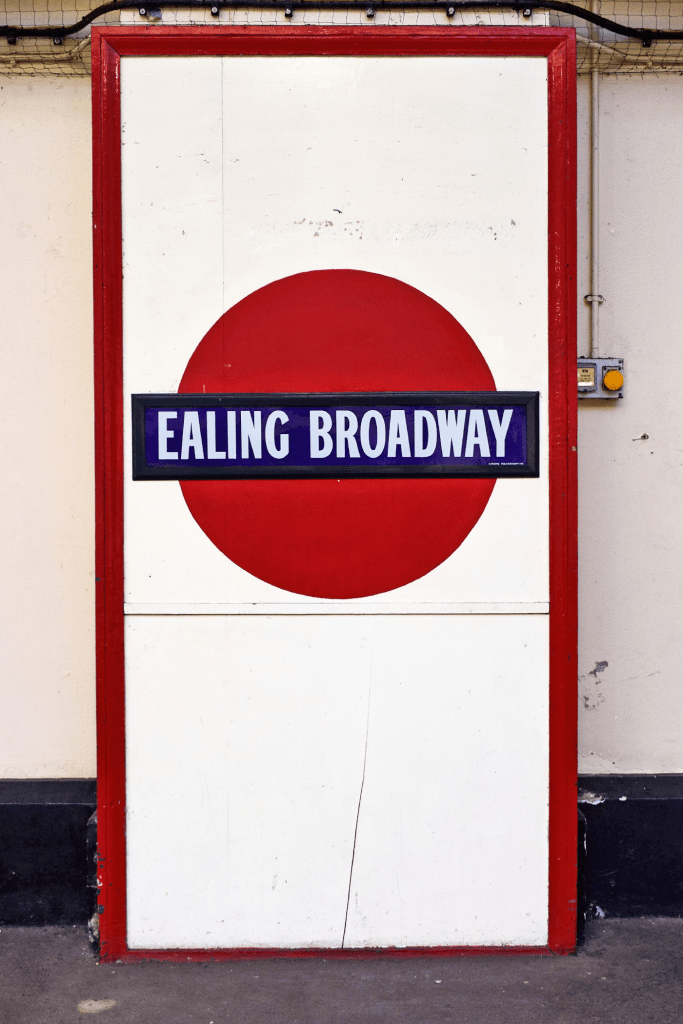
The London Underground is not just a speedy way to travel through and under this sprawling metropolis, it is also a monument to 160 years of architectural innovation that has shaped London from its creative heart to the far-flung suburbs of Metroland. Old though it is, with its early development of corporate identity, its distinctive font by Edward Johnston, and with the timeless stations designed by Charles Holden in the 1920s and 1930s, London Underground was a bastion of Modernism. This has continued with the sleek modernity of the Jubilee line extension, and the wonders of the much-awaited Elizabeth line. When you next take the tube keep your eyes open and look around, there is a lot to discover both old and new.
If you look carefully, you’ll see that there is a different maze somewhere at every station, (there are 270 in total), and I enjoy seeing them as a reminder of the many days I spent scouring the tube for any and every detail that might be worth recording, and saving, for the future appreciation of commuters, occasional passengers and tourists alike.
A list of all the stations: https://en.wikipedia.org/wiki/List_of_London_Underground_stations
All photographs by Dr Jonathan Clarke.
 writesimon