2000 words/15 minutes
[After a year running a youth project in Canada’s NWT…where I lived in an uninsulated cabin in temperatures of -40c, I was travelling around the world, in 1983. I got a crack at being a journalist again, and this time, I actually sent off some articles.]
Slightly smaller than Switzerland, Taiwan lies 150 km off the coast of Mainland China. With a population of 18 million, it is one of the most densely populated countries on earth. The tropic of Cancer crosses the middle of the island, and the winter is usually sunny, but by March it had rained almost every day.
With over two million people, the capital Taipei is the fastest growing city in Asia. Although the newer parts of the city have wide avenues, they are a maelstrom of darting cars, smoke belching buses and kamikaze motorcyclists. Parked motorcycles (one for every five people) block the side walks, jammed with street vendors and food stalls. Taiwan claims the most stores per capita in the world; it probably has the most restaurants too. Imagine your local high street with five motorcycles for every car, a dozen careering buses, a thousand people and two hundred street vendors. Do the same for every street in town and throw in near continual rain and an incomprehensible language, and you have some idea of Taipei!
Most of the city is new, built cheaply since the fifties, and yet it is Oriental. There is a fascination in the street markets and the people maintain their dignity and calm. China is wonderfully puzzling.
I met many kind people. They took me to see temples, their roofs a surge of coloured dragons. Inside, large crowds pray in a haze of incense to a pantheon of terrifying gods. I saw the Sun Yat-sen memorial, in tribute to the founder of the Nationalist party and the General Chiang Kai-shek memorial for its long time leader. More impressive for their size than their good taste, these vast mausoleums are designed to awe, but leave me cold. Giant statues dwarf the visitor. Such totalitarian architecture attempts the manipulation of history, by making the just-dead larger than life. Both monuments are surrounded by parks, two of the few in the city.
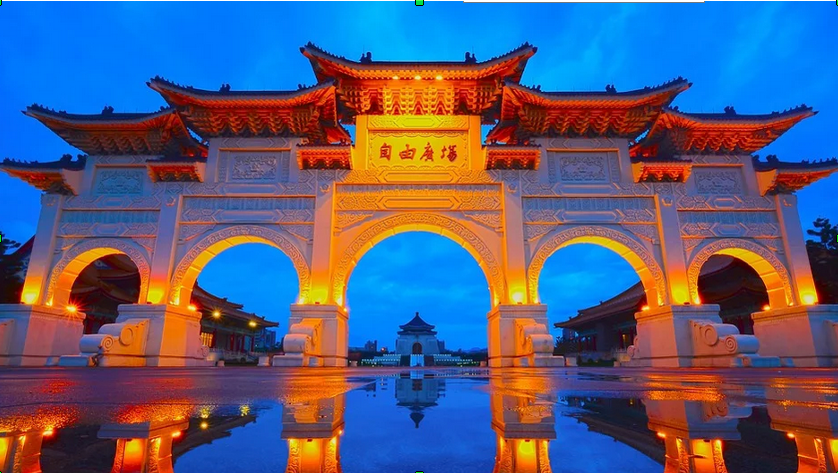
On Sunday, I arrived at Chiang’s mausoleum just before noon. The towering door was open showing a vast hall, empty except for a statue of the great man. Two immaculate soldiers marched to the front and crashed their rifles to the floor several times in perfect unison. Their brilliant helmets, shining like showroom chrome, were perched absurdly high on their necks. Three more guards arrived, and they changed the guard in a ballet of exaggerated, precisely timed movements.
I wandered out of the building onto a wide raised platform at the top of a painted concrete slope between two flights of stairs leading down to a wide walkway, and in the distance a five-arched gateway with a blue tiled roof. On both sides lay wide formal gardens abloom with azalea. Though only moderately sized, it is the biggest park in the city.
I noticed a young man with two young children leaning on the railing next to me.
“Do you speak English?” I asked
“A little,” he said, holding his finger close to his thumb.
He asked me where I was from and then said, “Welcome to Taiwan.”
On the walkway below, two lines of young people practised some movements.
“What are they doing?” I asked, pointing.
“It is high school students practising a folk dance. They have no room to practice, so today is a holiday, they come here.” His children, a girl of six and a boy of four, began playing on the slope below us, between the two wide staircases.
“Did you come here many times?” I asked
“No, I live in Taipei three years. Today is first time here.”
“Do you like it?” I asked
“All this big garden,” he pointed to the lawns between the azaleas, “but we cannot have a picnic.”
“This place is not to enjoy,” I said, “it is to look at. Totalitarian governments want you to be impressed.”
“What do you think of this, as a foreign visitor?”
“I think it is a big building just for a statue. Today, I went to a hospital, it was very crowded. They could build four hospitals instead of this.”
I turned around and looked up at the massive windowless marble structure, its great doorway rising sixty feet. Inside, the eighty foot high room contained nothing but a vast statue of Chiang Kai-shek. The two chromium plated sentries, now immobile, stood behind a braided cord barrier. In front, a dozen visitors were overlooked by three cameras mounted near the ceiling.
“I do not like to see giant mausoleums built for the just dead.”
“Now he is dead, his son is president.”
“Was he elected?”
“They say elected,” He turned back to lean on the railing.
Below, a man was shouting at the children to get off the slope. My companion called to his children to move to the side.
“I do not think it is good, when the dead are more important than children.”
“You are right,” he said, “they say we are free country.”
“Free for capitalists, you understand?”
“Yes,” he laughed, “I understand.”
Taiwan was settled from the mainland after it was made a protectorate of the Chinese empire in 1206. In the 17th century, the Portuguese called it ‘Ihla Formosa,’ the beautiful island, and fought the Dutch for control. In 1661, the Ming general Cheng Chung-kung brought an army from the mainland and restored Chinese rule. The island was then relatively free from interference until Japan colonised from 1895 to 1945; building railways, extracting resources, and creating a modern system of education. In 1949, Chiang Kai-shek, retreating from the Red army, arrived with almost two million people. Whilst the many professional and business people came voluntarily, the often bootless peasant conscripts of the defeated Nationalist army often had no choice. Martial law has been in effect ever since, and the military are visible everywhere. The government hurls invective across the Taiwan strait, threatening to invade the mainland, which a barrage of propaganda describes as a prison camp. Wall posters on the side of a down-town military centre, depict Red guards beating patch panted peasants, a corpse hangs from a tree in the background.
Until the early 70s, Taiwan represented China in the United Nations, and had a seat on the security council. It is now officially, ‘an internal problem of China.’ But foreign consulates remain, calling themselves ‘trade missions,’ and the US will supply $800 million in arms this year [1983]. Taiwan flies in US senators and congressmen on expense paid trips. We must not suppose this influences their voting back in the US. Taiwan’s new budget will spend 41% on ‘defence and diplomatic expenditures.’ Multi million dollar foreign investment and “favoured nation” status at US customs has stimulated rapid growth. Building on the Japanese legacy, the economy still grows. Unemployment is rising, but remains under 3%. Taiwan now has the second highest per capita income in Asia.
On my first evening in Taipei, I went to a small restaurant near my hostel. A couple and their twelve year old daughter cooked for and served about 40 people. I was quickly greeted by the father, who returned almost immediately with a cold beer. I pointed at the plates on an adjacent table, and requested some snacks. He brought me delicious crispy dried seaweed and a translucent green ‘hundred year’ egg. Soon after I ordered another beer and a main course. It was remarkable how they successfully served the ever changing diners, whilst a baby slept in a cot next to the kitchen.
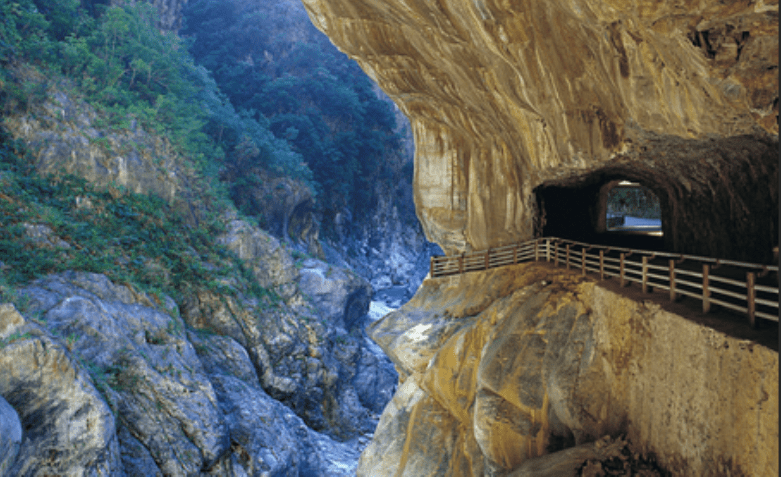
I made a short trip around the island. The road down the east coast has dramatic scenery, especially south of Suao., where a one way system alternates north/south traffic hourly. The system is not entirely efficient, as we met several northbound trucks as my bus hurtled around blind corners, the first vehicle in the southbound convoy. I travelled along the East-West Cross Island Highway, touted as the most dramatic road in NE Asia. Blasted out of the mountains at a cost of 450 lives, the road follows the Taroko gorge, under towering cliffs. Then it climbs, snaking and tunnelling through sub-tropical forest, with eyrie views over temple roofs below.
http://imagebank.biz/wp-content/uploads/2014/02/65482.jpg
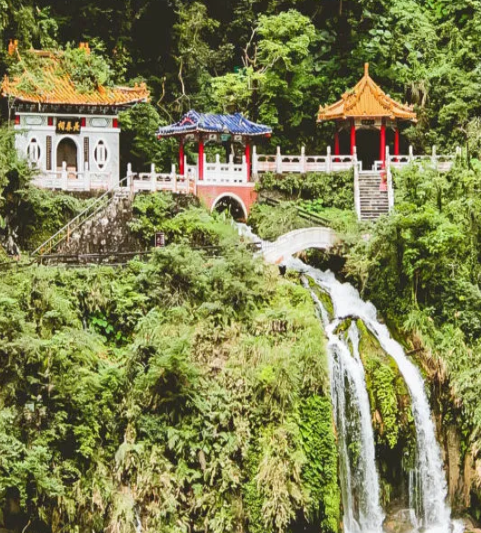
I walked a part of the gorge, up a series of switch backs, under cliffs of marble and limestone. Waterfalls cascade right onto the road littered with fallen rock, and intermittent thunder storms drove me to shelter in dripping tunnels. On the few occasions the clouds parted, I saw tremendous views of mist swirling in deeply cut valleys and over distant, thickly forested ridge-lines. Small temples lined the road and a series of youth hostels, a days walk apart, provide cheap accommodation and meals. As the only guest in one hostel, I ate in the kitchen with the staff. The warden Mr Chao, put a dozen whole pickled garlic onto his plate, and loaded them onto my plate too. They were delicious, but I mimed that I would drive away the other passengers on the bus the next day. (The rain had made me curtail the walking trip). Later, Mr Chao made delicious Oolong tea and showed me how it cleared our powerful breath. Later we played Chinese chess, and I was allowed to win one game. The Chinese know how to treat a guest.
Next day, I bounced sickeningly in the back seat of the bus, as we passed innumerable rock slides and edged along sections where part of the already narrow road had slid into the gorge. The bus was delayed for hours by a serious rockfall, with rocks the size of cars. A small bulldozer cleared the route, and after a narrow passage was opened, just wide enough for cars, I hitched a ride. Later, I saw steep hillside orchards of apple, pear and blossoming cherry tied to bamboo supports. That night at a cheap hotel I spent an hour talking to the receptionist, who spoke English remarkably well after only three years of high school English. As I left to go to bed she asked me, “You want woman tonight?” Thinking she meant a prostitute, I said no. If it had been her, I’d have said yes. I found Chinese women beautiful, with a curious and tantalising sexuality.
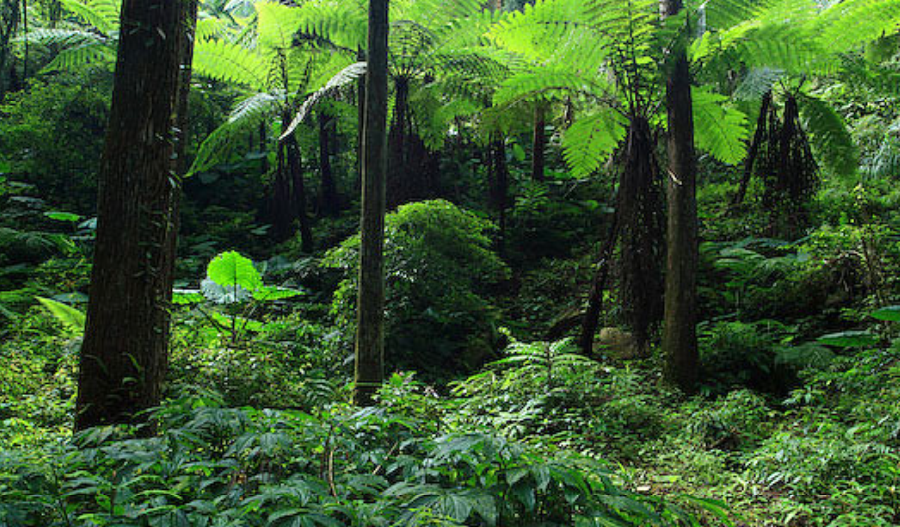
The Taiwanese cannot get passports easily, so the few tourist spots are packed. 140,000 people a month visit the Taroko gorge and tens of thousands walk through the bamboo forest preserve at Chi’tou. When the rain slows to a drizzle, enormous crowds flock to the paved walkways dressed in their Sunday best. At Chi’tou I met a holidaying teacher who invited me for a tea ceremony. We sat for hours, making and drinking myriad tiny cups of delicate, aromatic tea. After five days of rain, I returned to Taipei.
https://live.staticflickr.com/5164/5287586079_c9defc7188_z.jpg
On my last night, I met a business woman in a restaurant. I showed her an article I’d written for my local paper in Canada. She asked me where I got the figures for unemployment in Taiwan. “From the newspapers,” I told her.
“Information and education are controlled by the government,” she said, “the figure is not true. Do not say I said it.” She looked serious, “we have only one party, outside the party they will arrest you. My friend is sent to prison for twelve years for politics. Now I keep silent.”
Later she said, “the only good thing in Taiwan is the the economic development.” I understood her pain, but also remembered the kindness of so many Taiwanese.
Outside the restaurant, the rain continued to fall.
 writesimon

