Cameroon’s premiere spot for the savvy traveller
2760 words/15 minutes
I went to Cameroon in January 1999 to attend a conference in the capital Yaounde. Or more accurately, I went to a conference in Yaounde to get into Cameroon. Cameroon doesn’t encourage visitors, and so getting a visa to Cameroon requires an invitation from a local person or organisation. In 1999, due to the horrendous civil war in the DRC, almost all of the international institutions that had a Central African operation had moved from Kinshasa to Yaounde. This included the World Bank, and various UN organisations such as IUCN (the International Union for the Conservation of Nature). A major IUCN conference on conserving the Congo basin rainforests, which would have otherwise been held in Kinshasa was going to be held in Yaounde in February 1999. I had secured an invitation to this conference on logging and poverty reduction, which was incongruously being held in the Hilton hotel, and the more important invitation letter necessary for obtaining a visa. My contact at the IUCN had also offered to book me a reasonably priced local hotel and send a driver to pick me up at the airport.
Cameroon’s national airline, Camair, had recently gone bust, and so there was no direct flight from London. Instead, I needed to fly to Paris, Brussels or Zurich and change planes. To connect to any of these flights involved a ridiculously early start from Heathrow, and a minicab at 4.30 am.
Most of the funding for this first trip came from the remains of my salary for work I had been doing to stop rainforest destruction in Canada. I had previously set up a semi-formal organisation called TREES (the Temperate Rainforest Environmental Education Society) and so I merely changed a word, and I had another organisation fit for purpose. The new TREES (now the Tropical Rainforest Environmental Education Society) had $2,000 Canadian left in the budget (which was left from not taking all my salary the previous year) and I had $2,000 more in savings. I also got a couple of small donations from people who had supported my work in Canada, and wanted to help me get started in Africa. I spent four months in the UK doing background research about the Congo basin rainforest, meeting up with rainforest campaigners and researching at SOAS and the British library. I lived for very little as I stayed rent free with my family or with my good friend Bob in London. Soon I found two small contracts for undercover work in Cameroon and was ready to go.
When I arrived in Yaounde airport after dark, it was a melee of shouting and gesticulating people, and I was happy when the IUCN driver found me and escorted me through the customs confusion. The driver took me straight to the hotel, but they had no record of a booking, and worse they were full. We drove around to several other hotels, but they were all full too. Finally the driver, Edouard, said that he knew a small hotel that was cheap, but not up to standard. Perhaps I could stay there the night and sort out something better in the morning? When we got to the hotel Ideal, they were cleaning the rooms, though it was now 10pm. This didn’t ring any alarm bells, so I reserved a room and went for dinner with the Edouard, who took me to Club Parallel, (which became my place of choice for a special night out) where we ate well and drank a couple of beers. We got back to the Ideal at nearly midnight, and I was absolutely exhausted as I’d been up since 4 am. We drove down a ramp to park in front of the lower level rooms. Edouard promised to come back at 10 am and take me to the IUCN offices, which were hidden away in the back streets. I was given a room on the lower floor which was dank and slightly mouldy, as the back wall was a bathroom and toilet, and had no window and the front window was shuttered. There was a fair bit of coming and going, and an incident in the night- a woman shouting insistently, a door slamming, a man shouting back and a car driving off. I was occasionally woken by the coming and goings in the other rooms, but I quickly fell back asleep. There was a knocking on my door really early, but I was exhausted and ignored it. I got up at 9am, and waited until noon for the driver, but realised that the dawn call must have been him.
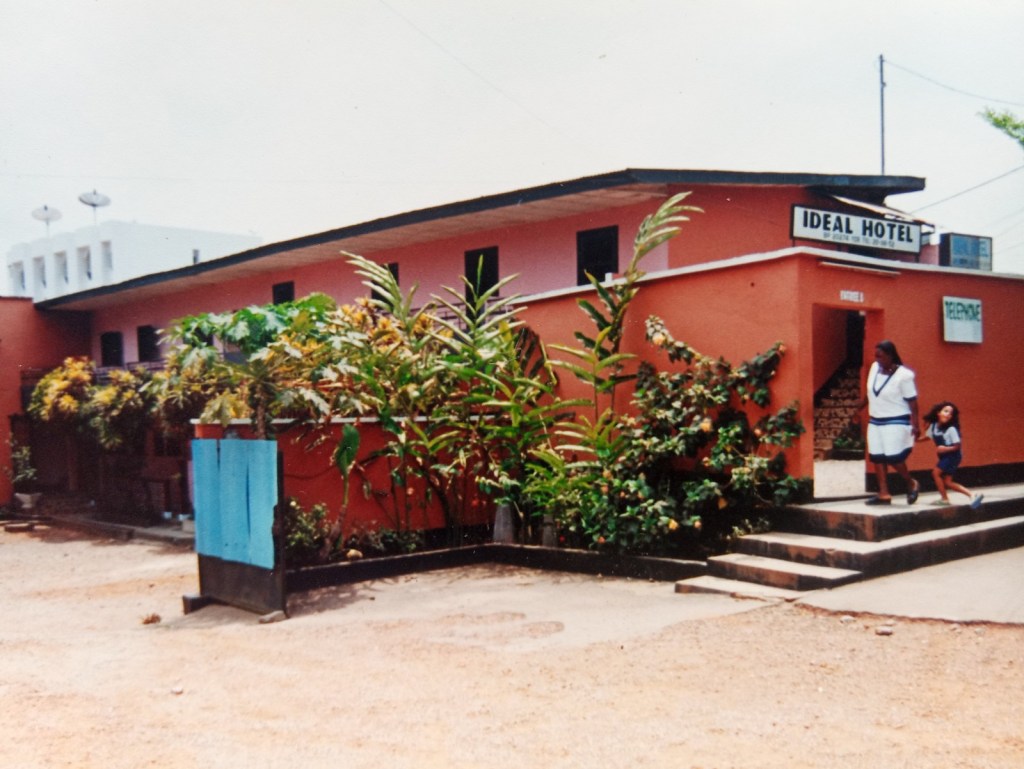
The extensive facilities at Hotel Ideal
Next day, I moved to the upper floor. Stairs climbed past a small reception to a long corridor with a a blank wall on one side, with the occasional brick lattice patterned opening. This was an excellent sound barrier and I didn’t realise until later that this blocked the heavy traffic noise from the rond point Nlongkak, one of the busiest junctions in Yaounde. On the other side of the corridor was a row of doors. Each small room had a shower, a hand basin and lavatory in a cubicle, an almost double bed with just one sheet and a blanket, an overhead fan, a hanging bulb, and a small bed side table. Double doors led onto a tiny balcony, which had a table and a small stool. Many of these items were in poor condition or broken.
Many of the toilets had no seat, and the shower was right beside it. It was advisable to have a pair of flip flops to avoid walking barefoot on the bathroom, or really any other part of the floor. Some of the washbasins were cracked or detaching from the wall. The bed sheet was white and crisp, but it did not completely cover the mattress, and there was only one sheet, meaning you would also touch the dubious blanket if you used it. On rainy nights it was chilly and I needed the blanket, so it was fortunate I had brought my own sheet too.
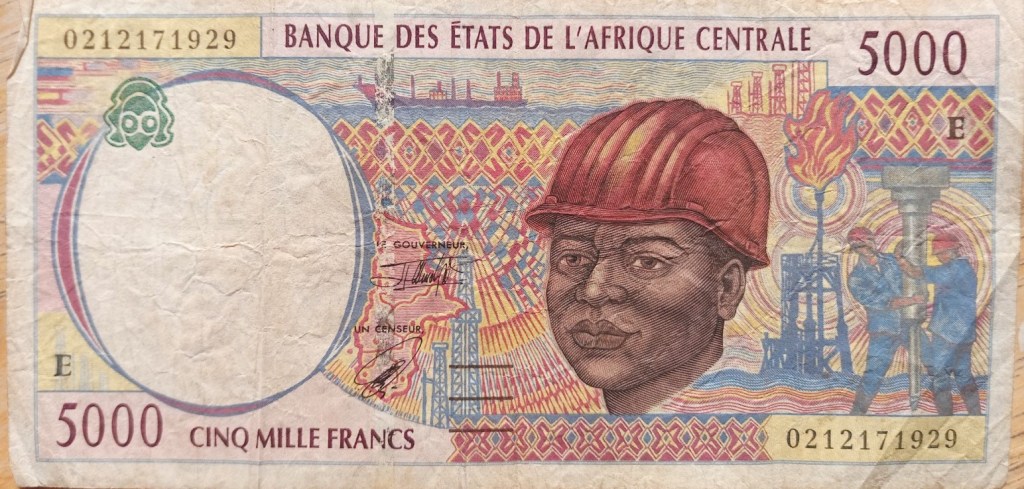
I was lucky that the first night was in the dive of the lower ground floor, so I felt that things had improved dramatically when I moved upstairs. The Ideal cost 5,000 fcfa, (Central African francs) which was a fiver (£5 or $7). The mid-priced hotels that would be used by Cameroonian professionals, and even by economical ex-pats, cost 15-18,000 fcfa. The cheapest room at the Hilton cost over 200,000 fcfa!
Using my room as an office
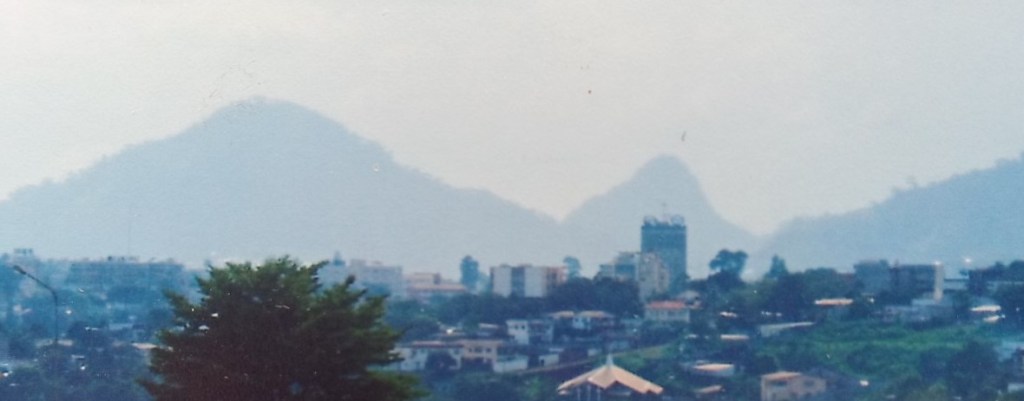
The balcony was the rooms saving grace, as if I was writing or reading I spent much of my day sitting out on the balcony, overlooking the dusty gravel parking, with its large mango tree in fruit. Beyond were the tin roofs of houses, a busy street with little yellow taxis distantly beeping their horns, and the forested hills to the north of town. When it was too sunny, or raining, I could work lying propped on the bed with the balcony door open, and not feel hemmed in. Each of the balconies had its own small table and stool, though most were broken. With some sly reorganising of the furniture, by hopping over the low wall between balconies, I could get a four-legged table and an unbroken chair, and if I was around for more than a few days between field trips, I gravitated towards the corner room, which had the biggest balcony, and was the farthest from the road. With my own sheet and mosquito net, my laptop, a baguette, an avocado or tin of sardines, some fruit and a bottle of water, I was set for a days work writing up whatever research I was working on.
The Ideal was also well placed for eating out. If I’d been able to afford a swanky hotel, I would have also been limited to either the hotel restaurant, or the few expensive restaurant opportunities in the neighbourhood. The Ideal was surrounded by food choices. Half a dozen reasonably priced restaurants were within a few minutes walk. When I felt flush, I could afford to go out and eat in a local restaurant and have a couple of beers for about £3. And there were also numerous street stalls making breakfast omelettes and baguette or a delicious thin maize porage. In the evenings, they served braised chicken or mackerel with baton de manioc, a hand-made cassava stick, for 50p. Good beer in the local bars came in 65cl/24 ounce bottles and cost less than 50p, so I was able to afford a couple each night.
I wasn’t tempted to find anywhere cheaper than the Ideal, as I liked having a room with a balcony, found basic amenities just outside the door, and was on a number of taxi lines. But later, when I visited someone in another hotel which was slightly cheaper (4,000 fcfa instead of 5,000) they had a dingy room, with a small window high on the wall overlooking a narrow alley way, and so a real sense of confinement, and no outdoor space at all.
I became fond of the hotel staff, and especially of Emo Achille, who was a big part of the pleasure of living at club Ideal. Emo was wrestling with his sense of purpose and the meaning of life. I enjoyed the fact that he would ask fundamental and profound questions as conversation starters. It was refreshing, coming down from a day working in my room, or in from a day of meetings, or a few beers to get straight down to discussing god, the meaning of life, the differing beliefs of our two nations, responsibility, duty and other deep topics with Emo. I was improving my French at the same time as getting an insight into a Cameroonians belief system. And while it is harder to communicate your beliefs in a second language, it forces you to express them carefully, and encourages a more thoughtful response.
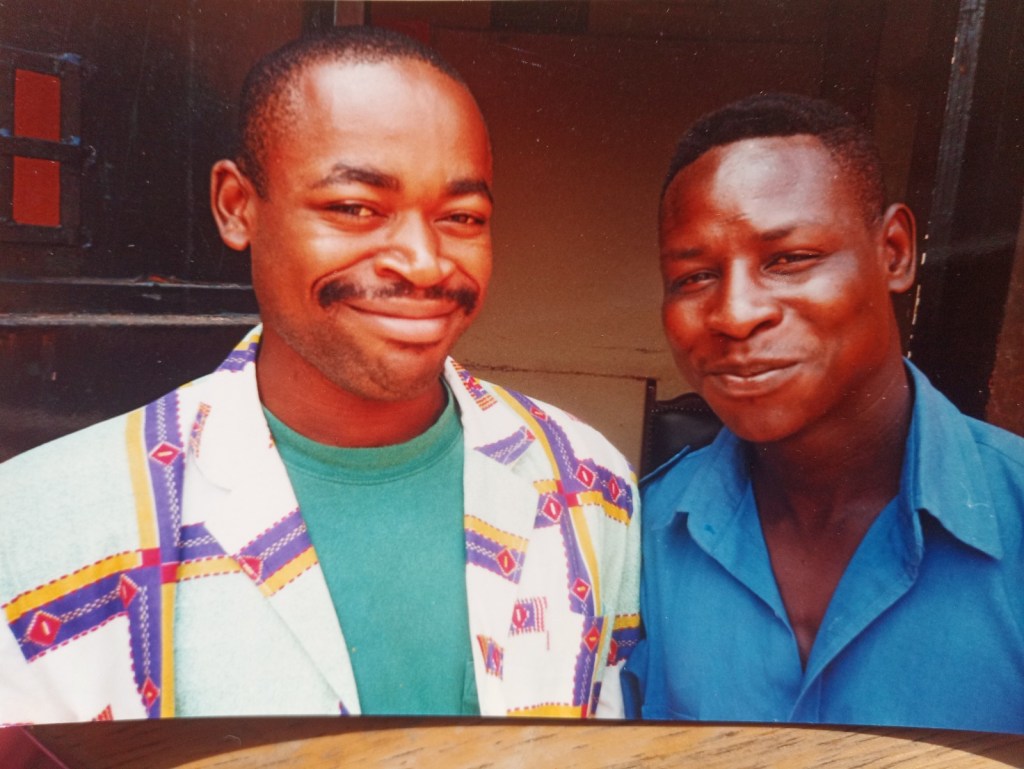
Emo had plenty of time to think on the job. Staff at the hotel worked 12 hour shifts seven days a week. In order to get a day off, they would do a weekly double shift, and get the next day off. So, they were working an 84 hour week!
The Ideal was a full service establishment. There was a phone box in the reception area. You gave the receptionist a number, and they put you through. They also allowed me to use the internet to send emails, by disconnecting the hotel phone and letting me plug in my modem at the reception desk. This was complicated a bit by being in the way of any other reception activity, though by mid-evening there was just an occasional hourly room rental.
The hotel also had a laundry service, but it was rather curiously priced. Anything, from a shirt, to a pair of socks cost the same, a thousand fcfa, and so a weeks wash cost me as much as four nights at the hotel. I soon bought soap to wash my clothes in the sink and hung them on the back of the chair or the railing on the balcony.
I met fellow guests from Niger, the Central African Republic, and all over Cameroon, in town on business, or for a training course. On many evenings three or four of us gathered in the tiny reception area, or out on the steps. I began to call these gatherings “Club Ideal.”
I felt that with our new name, we might perhaps need some further services for the guests. There was already a social space – the gravel floored courtyard in front of the reception, with a television set up at night for guests to watch the current soap opera at 6. But our ambition was larger, and soon we were inventing further facilities for the club. We needed more excitement and entertainment, and so we created the attractions of Club Ideal. My fellow guests, and the staff enjoyed the conceit, and together we developed the plan. I proposed a pool (a basin of water in the small courtyard in front of the reception), and a potted palm tree or two; cocktails would be served to tables under broad umbrellas.
The other staff members included Freddie the manager and owners nephew (and I later discovered, PhD student). Freddie was a budding businessman and was able to provide services like changing money at a better than official rate, and organised the extension to my visa for me.
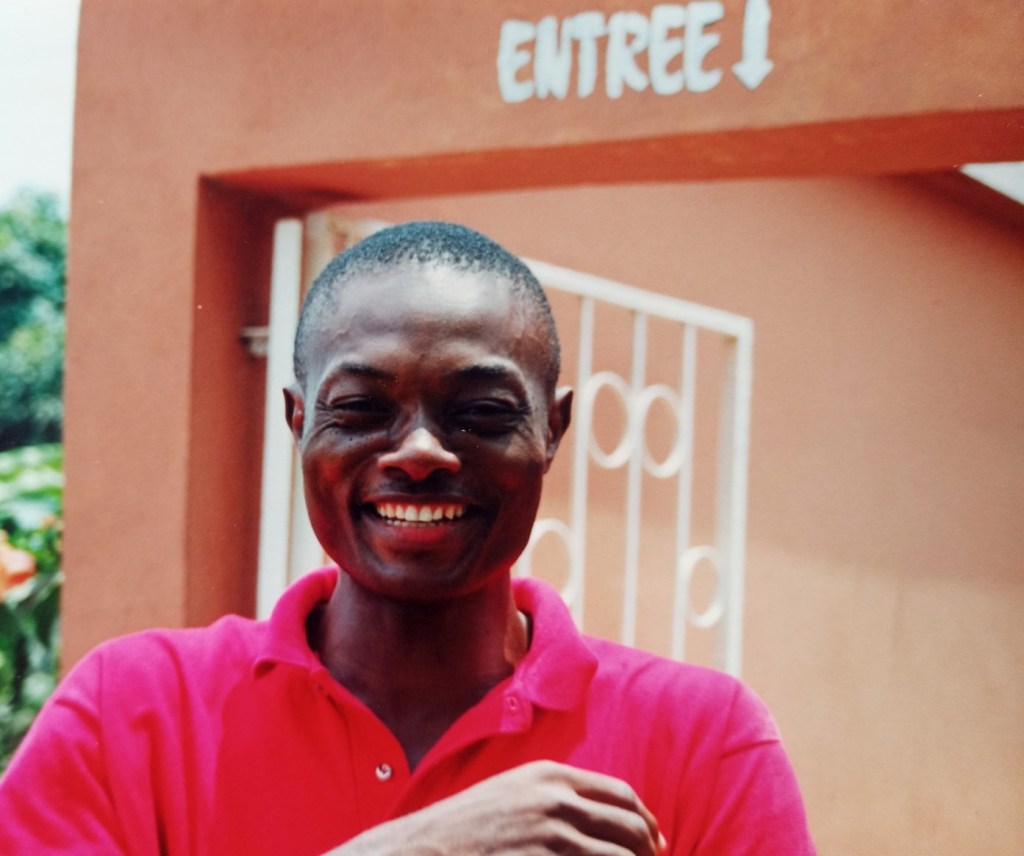
Outside the Ideal, Auguste sold cigarettes and chewing gum from a small portable stall that stood on the wall of the hotel. Most of his business was in selling single cigarettes, or a single stick of chewing gum. Auguste was a pleasant and helpful guy, and I’d stop off and chat for a while whenever I saw him. He was often helpful in finding local services, and sometimes he would do small jobs for me.
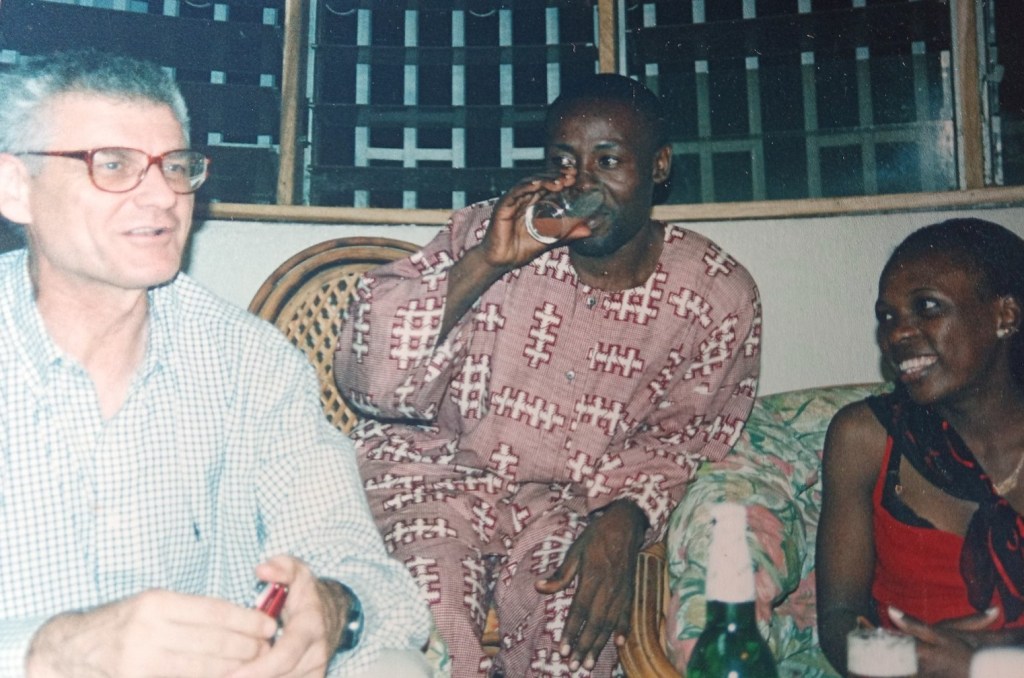
There was an internet cafe on the rond point, and there was also a small office services place, which would do photocopying. If I was not going to be back in time, Auguste would pick stuff up before the place closed. He consistently did what he said he would, and I came to rely on his help. Sadly, he didn’t drink, so whilst he had a few soft drinks with me, he was not up for an evenings drinking. So, many nights, I drank my two beers alone, and spent the time writing letters, or reading the local papers or reports on rainforest conservation to improve my French.
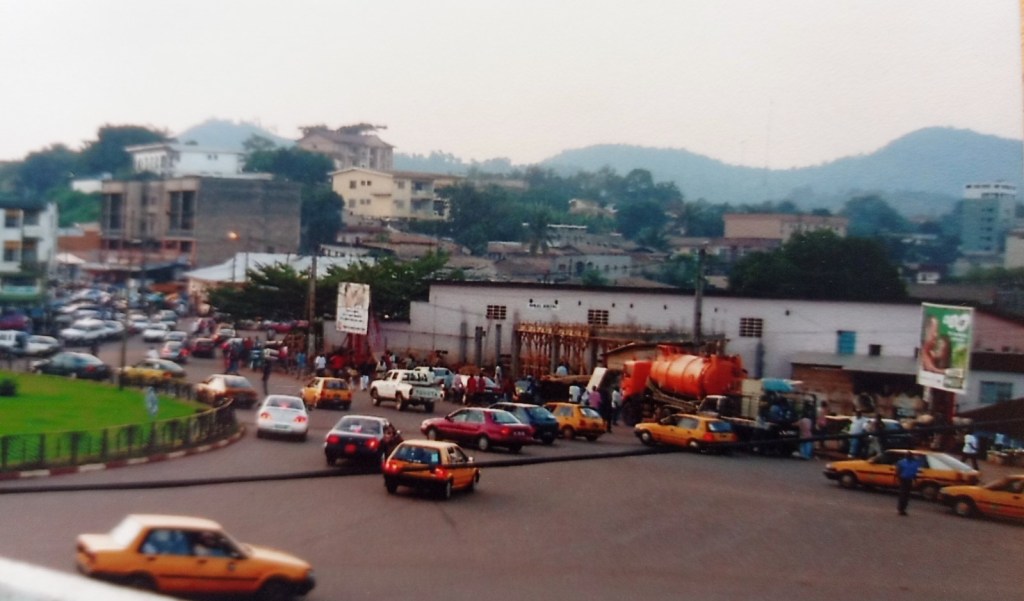
Ideal was also easy to get to and from, which was important as I was exploring the local NGOs, going to the main post office to pick up and send mail, and going to roadside bus parks to set off on field trips. I could comfortably get a shared taxi back late at night, as the rond point was on a number of taxi routes, and I could safely walk the last few yards on a busy well lit street. In fact from early to late, taxis were swirling around the rond point in a melee. There was a bar/restaurant on the hill above the rond point, up 40 steps to a veranda with a great view of the the Ideal and the forested hills to the north of town. Sitting on the veranda, I saw seven taxis careering side by side around the roundabout. At night, starting at around ten, vast overloaded logging trucks tore around the rond point, bellowing their horns to clear their way. I managed to get some good footage of this for Greenpeace, and counted the trucks several nights until late, to get an idea of the scale of logging in the east of the country, all of which came through Yaounde, and passed the Ideal.
I made a number of field trips; to visit Jacques Ngoun a Bagyeli Pygmy activist; to the forests of the east province, where I met Etienne a Baka Pygmy and spent five days in the rainforest; to an oil rig for my report on the Central African oil industry’s threats to the rainforest; and to see Mount Cameroon which was erupting. Each time I left town on a trip I would leave my stuff in the small space behind reception. There was always a room for me on my return, as at a certain hour, at least one of the rooms on hourly rental could be kept for me. But, usually I was lucky, and got a room on the first floor, though the next day I might have to move to a room with less broken furnishings, and again begin scavenging a usable table and stool for my balcony.
As you can see, the hotel Ideal lived up to its name. Or at least, where not yet ideal it could easily be idealised. After about ten weeks, I returned to the UK, but I had found a niche in undercover research and had a plan to return as soon as I could pull together a few new contracts and funding for a small project I’d developed. On my next visit, I spent five months at Club Ideal. Why are some people so lucky?
Note: all the events in Cameroon took place in French. I hope the reader will make allowances for the translation.
 writesimon