Naming our daughter among the Ewondo
1700 words/12 minutes

Felix with Judith and la belle mere
A few weeks after my daughter was born, in the Central hospital in Yaounde, the capital of Cameroon, Judith and I prepared to register her birth at the town hall. Having a baby in Cameroon is not as simple as it might be and, in spite of a number of medical cock-ups, Judith and the baby were fine and ready to leave hospital on the Friday. Then after numerous minor delays, we discovered that the accounts department had left for the weekend, so Judith was trapped in hospital until Monday morning, as we were not allowed to leave until we’d paid the bill.
The process of choosing a name for our baby had begun soon after the pregnancy was confirmed. I had asked Judith, that whether we had a girl or a boy, we name our first child after my sister Felix. Judith agreed; and then began the search for her second forename.
[I find it a curiosity that we accept Robin, Chris, Jan, Leslie, … as names for either sex, but most people find it difficult to accept Felix can be a girls name. Having a sister called Felix, I was used to the assertion by the narrow minded: “But Felix is a boys name!” and I had adopted the response: “It can’t be a boys name, she’s a girl!” And so a positive consequence of naming our child Felix, would be that whilst Felix would still be an unusual name for a girl, it would be twice as less so.]
I subscribe to the premise in Tristram Shandy, that a name is of great significance in determining character and life chances. Finding a second name took ages – I not liking any of the soft, feminine names that Judith favoured, now that we knew we were to have a daughter. One day, while speaking with my sister Felix on the telephone, she told me that each time she had been pregnant, she had planned to call her child Kate if it was a daughter. But, she’d not had the chance, as she’d had three boys. I really liked the name Kate, and returned home from the office eager to suggest this. I was met by Judith who was equally excited. She too had come up with a name she really liked: Kate!
Among the Ewondo, the First Nation that inhabits the area around Yaounde, a child’s last name is usually not the same as their fathers. Few of Judith’s brothers and sisters (she has seventeen) were called Etogo after her father; most were named to honour a relative or potential patron. Judith was named Bambela, after her maternal grandfather, a well known sorciere (sorcerer) and a very powerful man. When Bambela was dying he had called for Judith, still a baby, to be brought to him to transfer his powers to her. Her father Joseph Etogo had refused to let Judith be taken to the village, and the old man died without passing on his secrets. Though, I am not convinced he gave up quite so easily….
Judith Bambela, on her trips to the family village, was honoured by her grandmother as if she were her dead grandfather. Even as a child, her grandmother bowed to her and Judith was fed first and given the choice parts of the chicken that had been prepared in her honour. Like Tristram, the Ewondo recognise that a name has great significance.
I had had much input into the choice of our daughter’s first two names, and was of course happy to concur with Judith’s desire to name Felix after her aunt Zali, a childless family cousin, who had brought Judith up as an adolescent in Douala, the biggest and wealthiest city in Cameroon. Douala is two hundred miles from the capital, Yaounde, where Judith’s mother and extended family lived. And, after three or four years of living with aunt Zali, Judith had suddenly returned to her family in Yaounde.
I enjoyed learning about Ewondo culture from the inside, and readily agreed to Judith’s choice of this third name for our daughter. What I didn’t know was that Mr Etogo had not forgiven auntie Zali for letting Judith go. Finding this out put me in a real bind. Judith had made it clear over the previous few days that she was adamant. She knew that her father objected, but Felix would be called Zali. But it was also very important for me to show due respect to my new daughter’s grandfather, my father in law, as was the custom in Cameroon. A few weeks later, my future brother-in-law, Tarzan, (as he was known to everyone in the family) brought me a note from my future father-in-law. The envelope was addressed: Etogo
The letter was in French. Here is a translation:
Dear Mr Simon
This is primarily to inform you, [medical update] this morning at a clinic in Yaoundé.
Also that I would like to meet you tonight or tomorrow in Etoa-Meki [the quartier of the family home in Yaounde] for a short interview.
Thank you and goodnight.
I set-off that evening to visit my future father-in-law. Joseph Etogo was eighty, and had been unwell for some time. He was a retired meteorological officer and lived in the first house in Etoa-Meki to have a corrugated iron roof, he had also had the first car in his village. M. Etogo was an old fashioned patriarch who had had five wives and eighteen children. He had retired to his village, 100 km north of Yaounde, where he lived with two remaining wives. Tarzan, one of his eldest sons, was accompanying him during his stay in Yaounde for medical treatment. Our conversation was in French, with Tarzan occasionally restating what I said; in effect translating my words into better French for Joseph. Now and then Tarzan remade the point in Ewondo.
After a discussion about his health, allowing me to offer to do anything I could to help, he moved on to the reason he’d invited me to visit him. Joseph firmly stated his opposition to Judith’s choice of the surname Zali for our new-born daughter. And here was the rub: Mme Zali was childless and Judith had been sent to her as a ward. For Joseph it was unconscionable for Zali to abandon the responsibility she had accepted by taking Judith into her home, and returning her to the charge of her family. Joseph insisted that he could not accept his daughter disobeying him and honouring this woman, who he had not forgiven. He was absolutely not going to accept that his daughter name our child Zali.
“Beau pere (Father-in-law), I will of course accept your decision,” I said, “ but I don’t know how I can explain it to Judith. I have to live with Judith and she has set her mind on Zali. You know how stubborn she can be. This will make life very difficult for me.” This was a considerable under-statement, as Judith is stubborn to a rare degree and had absolutely set her mind on this. [Later, this force and determination enabled her, as a new resident of the U.K., to gain an arts degree at Chelsea.] Tarzan repeated my words to Joseph, and then took my side on this important matter:
“Father, think how hard it will be for Mr Simon to tell Judith.”
Joseph was torn and I could see his deep reluctance to accept Judith’s refusal to acknowledge his paternal authority. But, after some thought and a conversation between him and Tarzan in Ewondo, Joseph reluctantly gave his permission. It felt good to have both supported Judith, by getting her controversial choice of a name for our daughter accepted by an unwilling father, and also to have shown appropriate respect to my future father-in-law. I have never forgotten Tarzan’s support in this important family negotiation, and have always retained a soft spot for him.
But the process of name choosing was not over. I felt it essential that Felix had my surname too.
I knew we would be for ever explaining why Felix was named Zali, if it was her family name. It would not agree with her mothers, or her fathers name, and would make the simplest event a misery when we returned to the UK. Putting Felix on my passport, registering her for a school in the UK, even picking her up from school, all would be fraught with complications. Felix needed to be Waters too. So, we ended up with Felix Kate Zali Waters, and Felix was registered in Yaounde.
Though this still wasn’t the end of our naming problems. When I took Felix’s Cameroonian birth certificate to the British High Commission to register her, her British birth certificate was written as Kate Zali Felix Waters, not Felix Kate Zali Waters.
[Note: in Cameroon Felix has two forenames and two family names (though she’d normally have only one). In England, Felix has one forename, two middle names and her father’s surname. This was the part of the confusion that led the British High Commission to misname Felix. But, also, the British official made a simple transcription error]
I only noticed this error when applying for Felix’s first passport. So Felix has two identities: as Felix Waters in all her school records, exam results, athletic achievements and daily life; and as Kate Waters on her passport, bank account, and other official documents. This has led to my booking her a plane ticket as Felix Waters and then realising she’ll be showing her passport, and scrambling to make the change as she might not be let onto the flight.
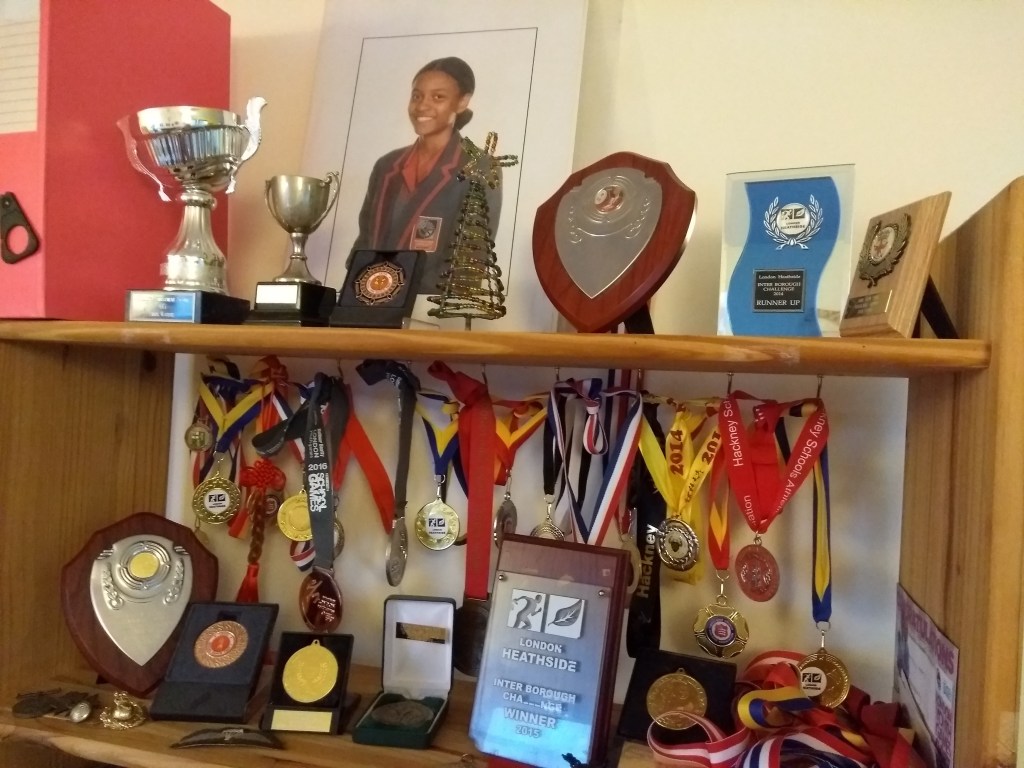
A few of Felix’s medals and trophies
If naming her Felix was to make her a strong character, it seems to have worked.
Soon she will go out into the wider world, with two identities. Felix Kate Zali Waters or, (if she is being formal), Kate Zali Felix Waters.
 writesimon
I suppose it’s hard to get around to telling all one’s tales, but now I am trying to write them down. Felix and I are desperate to visit Cameroon, but I don’t think it’ll happen this year, sadly. Great to hear from you, and best wishes to you and the family. I hope we meet up soon!
LikeLike
Great write up there, Simon. So we’ll written, but you’ve never told me this story even over a beer and during our long park or urban walks in London.
LikeLike