Researching Pygmy Healthcare during Congo’s Civil War, part 2
20 minutes
[Continued from last week:Volcanoes, Pygmies, and M23; Researching Pygmy Healthcare during Congo’s Civil War]
We could hear loud noises that sounded like artillery fire coming across the lake. According to the UN news feed, the M23 Rwandan backed rebels attacking Goma were not meeting resistance from the Congolese army. And Goma was on our route back to Bukavu. My colleague, and by now good friend, Jean Claude had left his 3 year old daughter with his sister in Goma, and needed to pick her up. But we had just started our field work, and what we were finding was vital for getting thousands of Pygmies access to life-saving healthcare, so I was profoundly reluctant to stop in the middle of such productive work…
Sunday 18th November, 2012, Minova, South Kivu, DRC
I was up early again on Sunday morning. There was a cold fog off the lake, which made the morning wash in a bucket of cold water unpleasant. I walked the 1km through town to the restaurant where we met. Though it was one of the few places to eat in town, we were often the only customers. The restaurant had a couple of secluded booths inside and half a dozen tables out back under a palm leaf awning, overlooking a yard with chickens scrabbling between the banana plants.
We were all three worried by the dangerous situation. The others had been through this before, as the civil war, and war lord rampages, had been going on for fifteen years, their entire adult lives. They had lived through the dangers directly, though they rarely spoke of it. I only knew the risks from hearing and reading about it second hand.
Minova was the first town on the only road that connected Goma to Bukavu, and the M23 were expected to attack here next. Some years ago, their previous incarnation had stormed through Minova on their way to capture Bukavu at the other end of the lake. We all had our different concerns. Bems lived in Minova, with his wife and young child, and was of course very worried that his town would become a battleground. He worked for UEFA, but was not paid when they were between contracts, so that the small amount he earned working on my project was important to him, and he also understood the value of the project. Jean Claude was the lead researcher for UEFA, and had played a key part in developing the research methodology, so he too was invested in the project. It would have been hard, but not impossible, to carry on without him. He needed to get to Goma and pick up his 3 year daughter. I had had the idea for the project nine years earlier, and had failed to get funding. Now, I had my one chance to show that Pygmies were denied healthcare. At each village we were finding, and beginning to help, half a dozen people with serious problems. But the real value would be if we could get Pygmies (and it was clear many other indigent men, women, and children) their right to health care consistently respected. This would save thousands of lives and stop enormous, unnecessary, pain and injustice. We had a lot to play for, and just this one opportunity.
It seemed that the route back through Goma was already too dangerous, and so while we tried to get more information, we agreed to do another field visit. Bems, Jean Claude and I walked the 2 km to the internally displaced persons (IDP) camp, just outside Minova.
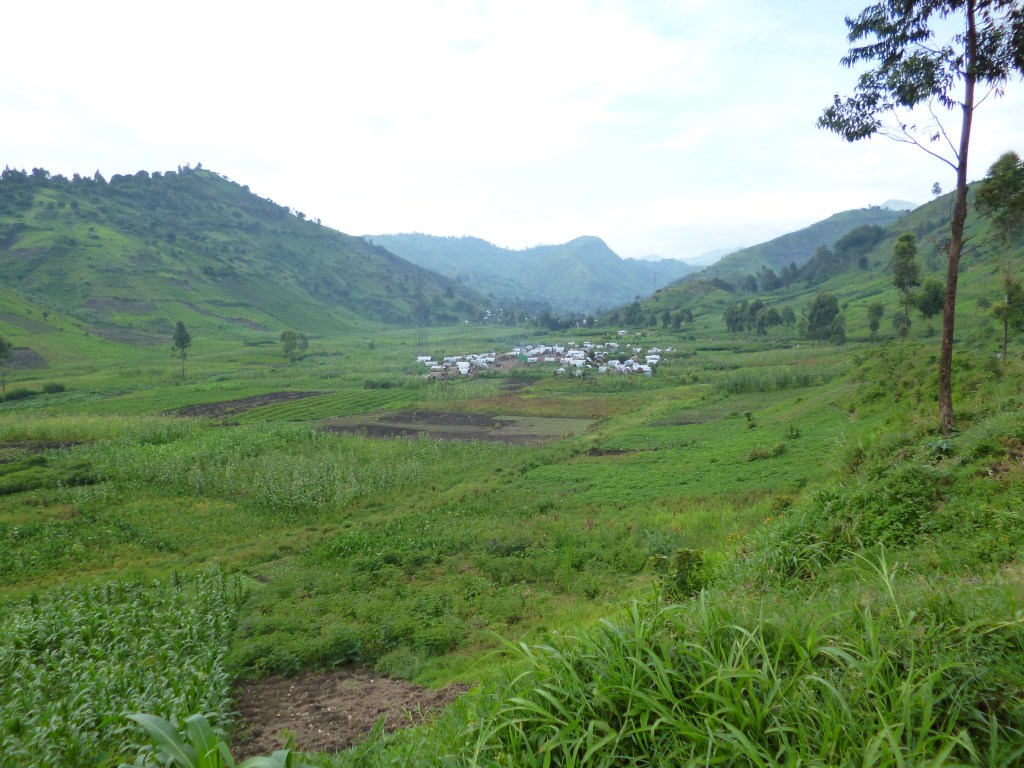
The camp was about a hundred makeshift shelters, using some reclaimed tarpaulins from the UN, even though it was not an official camp. It was occupied by people who had been displaced by the incessant fighting and pillaging further north. We went to the Pygmy section of the camp.
Meeting in Mubimbi IDP camp; 18 men, 7 women
The Pygmy IDPs have been in the camp since July 2011, having walked a hundred or more kms from Masisi, when their villages were looted by rebels. They had almost no access to healthcare, but for three months at the height of the cholera outbreak, they had got free medicines for cholera, malaria and diarrhoea from Doctors Without Borders. Though there is a water tap in the camp, it often does not have water, and they have to go 5km to fetch it. Otherwise, they use the river, which has passed through at least five villages and is polluted with human waste. There are multiple cases of water-borne diseases. They are often hungry as they have no regular source of food. The landowner wants his land back, and they will be forced to move again soon.

It was hard to focus on the research as we could hear the sound of artillery fire coming across the lake. This was particularly distressing for Jean-Claude with his daughter in Goma. As the morning progressed, the explosions were more frequent, and harder to ignore. We were also not sure if the M23 had either bypassed Goma, or at least made a move along the lake towards Minova. The artillery fire sounded closer, and I worried the M23 was already on their way….
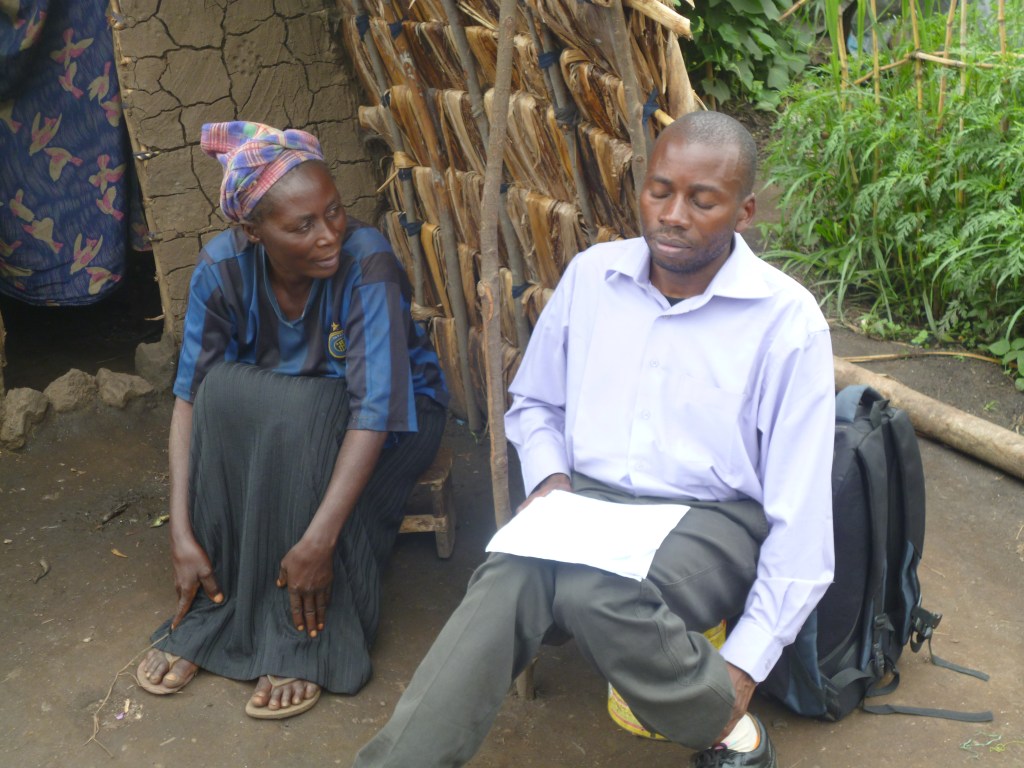
Jean-Claude, exhausted and worried. He’s listening to the bombardment of Goma where his sister and daughter are.
I was taking pictures and worrying too- both about the increasing danger, and about the consequences of leaving before we had finished our research. I had a light-hearted moment when a musician sang a song for me.
I was reluctant to leave before we absolutely had to. I had reason to be concerned with the quality of the work we might get from the other team. Matata, who was leading that team, was officially the UEFA coordinator for the whole project, but didn’t seem at all interested in his role. Godlive, who was a young recent graduate in rural development was a quick learner, but she’d come into the project a little late. And she didn’t have the experience or authority to make sure the research was carried out as well as possible. If we had three more days in Minova, we could visit 2 or 3 more villages; visit Minova hospital and see what services we could get for our already identified patients and learn what we could expect if we sent some on to Goma. Several people’s long term health and well-being depended on our being able to help them, and I felt it had to be done immediately when I was in a position to make on the spot decisions and talk directly to the medical staff.
When planning this field trip, I had met with many field workers working for international charities in Bukavu. A doctor from one of the leading health NGOs had told me she was going to Minova to run workshops for village health workers. I asked her whether she had invited any Pygmies to her outreach programme, and she had replied, “There are no Pygmies near Minova.” This was where we had just researched in three Pygmy villages. I wanted to meet up with the international health teams who had dealt with the cholera epidemic. I needed to find out if this denial of even the existence of Pygmies was common.
My mind was going in circles. I had an obligation to follow up on our patients to make sure that those we’d identified got at least the primary care they needed and to explore the costs and possibilities of taking a few patients to Goma for critical treatments. But damn, Goma was off for the moment, and I knew our time was running out.
Finally Jean-Claude said “ Monsieur Simon, You have to leave.” I realised that Jean-Claude couldn’t leave without making sure I was safe for all kinds of reasons- he was my host, and he could quite possibly be held responsible if anything happened to me. I had already suggested he leave, but I finally realised that I had to go first, so that he would feel able to go and get his daughter. We wrapped up the research hurriedly, without doing any individual interviews, and walked quickly back to Minova along the empty highway. As we got back to town, we passed a group of soldiers, milling in an undisciplined group by the road. There was real tension in the air, and the atmosphere of buzzing electricity was frightening. [The only time I’d felt a stronger buzzing electric charge was once, climbing in the Canadian Rockies, where I felt a similar crackle in the atmosphere in the last minute before I was struck by lightening]
The soldiers were scared, and about to explode. It was dangerously close to going off. Suddenly I wasn’t sure that I could get out of town without real trouble. I walked back to my hotel and in 30 minutes I was back at the restaurant with my kit. Paying my hotel bill, I used a hundred dollar note, and they had no change. I needed the change to fund our next move, but also didn’t want to hang around waiting as the situation was deteriorating fast. I asked that they brought the change to me at the restaurant. And, with great courage and honesty they did.
Back at the restaurant I stayed in the back to avoid attention. I counted my stash. I did not have much money, but there was enough to take $20 to get back to Bukavu, and $50 for emergencies. I gave just $20 or so to Bems, as he lived in town, and didn’t have emergency travel costs, promising I’d send more from Bukavu. I gave the rest to Jean-Claude (about $100 plus his travel costs) as he had the hardest journey back, and might get stuck in Goma for a while. Jean-Claude had also come with a budget, and ought to have had some of it left, as I had paid for all our expenses since arriving….
Then Bems went and got François, a moto driver he knew, and negotiated the price to get me to the next town along the lake. Most moto drivers are in their late teens or barely 20, but this was an older man of 40. I offered to double the agreed payment if he drove slowly. I didn’t want to be in an accident on top of everything else. I felt bad leaving my colleagues, but also felt the fear that seemed to fill the street. I got on the moto and set off up the slope to where the soldiers were milling, but I did not look in their direction. After we had swept, rather too slowly, out of town and around the first corner, I felt a great sense of relief. We had been under strain for days, and I had been working twelve and fourteen hours every day for almost a month. I had a wonderful journey up and over hills and back to the shores of the beautiful lake Kivu. It was a real relief to be on the open road, and I felt my stomach unknot. I got the driver to stop for a few pictures, as it was the first time since I arrived that I had not been in a rush to get somewhere.
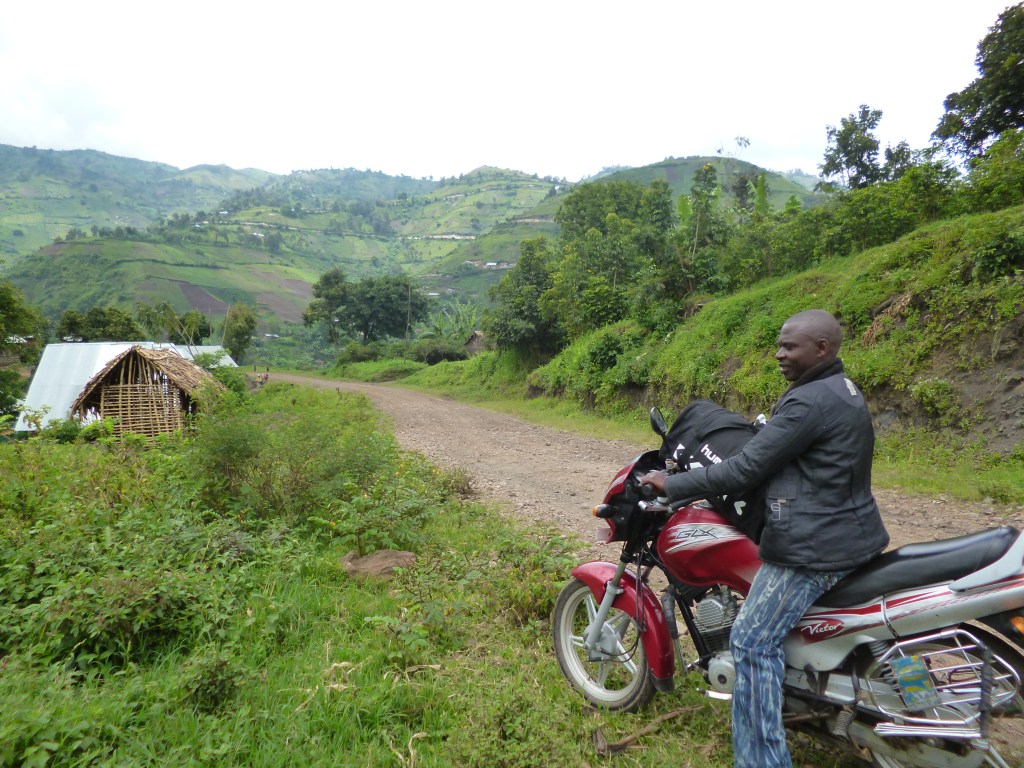
Occasionally we’d come around a corner and see a lone soldier standing by the road. I realised it wasn’t a good idea to give them the time to think, and by the time they noticed a white guy on the moto, and said stop I wanted to be as far past them as possible. So, my desire to go slow to avoid risk of accident, became dwarfed by my desire to zoom past any military before they realised what was happening. But, François would not listen to my plea to speed up passing soldiers. He’d been persuaded by my offer of double pay if he kept slow, and I was unable to explain my new reasoning as we sped along in the wind. But probably he was right, perhaps zooming past would have raised suspicions and even a shot, if we hadn’t stopped. We continued along, climbing up into the hills or careering down steep slopes to the lakeside, through small villages and past plantations of quinine, and fields of banana, plantain, and corn. It was a lovely day, and I was relieved to be out of Minova and enjoying the journey.

After 50 km, we arrived at the first town of any size, and where I’d paid to be taken. I thanked François, who had brought me safely out of immediate danger, and paid him his well deserved bonus, and went to get a beer in a restaurant in the market. Two people pulled up in a big, brand new 4×4 SUV, and after they had ordered a beer and settled in, I negotiated a ride to Bukavu for $20.
They put me in the back seat and ignored me. They were clearly important and even the young driver was well off, wearing $100 jeans and an expensive watch. I was joining members of the Goma elite making a last minute dash out of danger. The older man had a lot of authority. When we got to a road block he got out, and sauntered up to the officers and chatted amicably. Sometimes he just said a few words at a roadblock, was saluted and we were let straight through. The soldiers were still nervous, but the tension level was far lower.
In two or three hours, I was dropped in Bukavu, and took a taxi back to my lodgings at the CAP mission lodgings. I logged on to the internet to get the latest news, and looked up the Foreign Office advice -which was to get out of Bukavu NOW. I called the emergency mobile number and talked to an embassy staff-person at the border, and she said she would leave the next morning. This might be my last chance to get out, but I did not want to leave. My project depended on researching in enough villages to prove that the refusal of medical services was not just a local phenomenon, but universal. I hadn’t got enough yet, and the next week would be crucial. We had decided to focus on access to medical care, access to vaccinations and access to clean water. If we went to a Uvira, we could meet with Oxfam who had an ongoing well-building project. I had heard from Oxfam that when they built wells in communities, the villagers paid a small monthly fee that covered the costs of maintenance. This wouldn’t work with Pygmies and other indigent people. I wanted to interview field staff to see whether Oxfam was enforcing this policy, to the detriment of the most needy, or whether had they found a solution that might also be helpful in getting medical coverage for the indigent elsewhere. Given the importance of Oxfam in delivering development aid, and their name recognition, I really wanted to be able to include their work in the report (whether good or bad). I needed to know whether they were getting services to Pygmies and the most destitute. And, I have to admit, I really wanted to visit Uvira where they were working, and see the great Lake Tanganika.
I talked to the CAP staff, and from my friend the accountant I heard some horror stories about the last time rebels from Goma had rampaged through Bukavu. Tragically, there was no reason to believe that the Congolese army, would be able to stop them. And there was the substantial risk that the Rwandans would close the border, to stop a deluge of refugees, and I’d be stuck in Bukavu under rebel occupation. This risked being looted, beaten, and possibly accidentally killed. I thought of my obligations to my daughter Felix, who wasn’t yet 11. She couldn’t afford to lose her dad and I realised my responsibilities were first to her. I called the embassy emergency number again, and the embassy person agreed to wait for me until noon the next day: “But no longer.”
And so, the next morning at 11 am I bailed, crossing the border into Cyangugu, Rwanda, as a refugee. I had a packet of good biscuits, and offered them to the charming young embassy staffer in thanks for waiting for me. I took a taxi up the hill to town to the hotel she recommended, and she stopped by to talk when she left the border an hour later. She also introduced me to a VSO volunteer, an English woman in her 50s, who suggested I move to the guest-house of the organisation where she worked. The last words of advice I got from the British embassy were: “Give the biscuits to the VSO volunteer, she’ll appreciate them.” I felt I was getting value for money from my taxes.
I’d already paid for a night at the hotel, so I indulged in one night of luxury, with clean sheets, a balcony door left open for fresh air, a hot shower, a good meal and a couple of beers in the restaurant. This was living way above my pay-scale, and so the next day after breakfast, I happily went to stay at the same place as the VSO volunteer. It was enjoyable chatting in English for a change, though in a couple of days, the volunteer left for the capital. But the NGO staff were hospitable, and I had a room, access to internet and, luxury of luxuries, I could make a cup of tea anytime I felt like!
Next: Cyangugu, the congopygmyblog and fears for Jean-Claude.
For the few: there are some 2012 postings (now); the prelude to this field trip and my Pygmy Health Project report (soon) on https://congopygmyblog.wordpress.com
 writesimon
Simon, I am so glad you are putting this story out there. it needs to be shouted form the rooftops! well done you for highlighting this. I just wish there was more we could do.
LikeLike
Thank you Magne. Funnily felix asked me today, “Dad, what would you do if you had £10,000?” and I said, “I’ might just go back to bukavu…” Sadly, it’s not safe with covid etc. And I certainly dont have the energy I had then. but, I am sure I could do something useful to further this. I hope you are well.
LikeLike