Researching Pygmy Healthcare during Congo’s Civil War
15 minutes
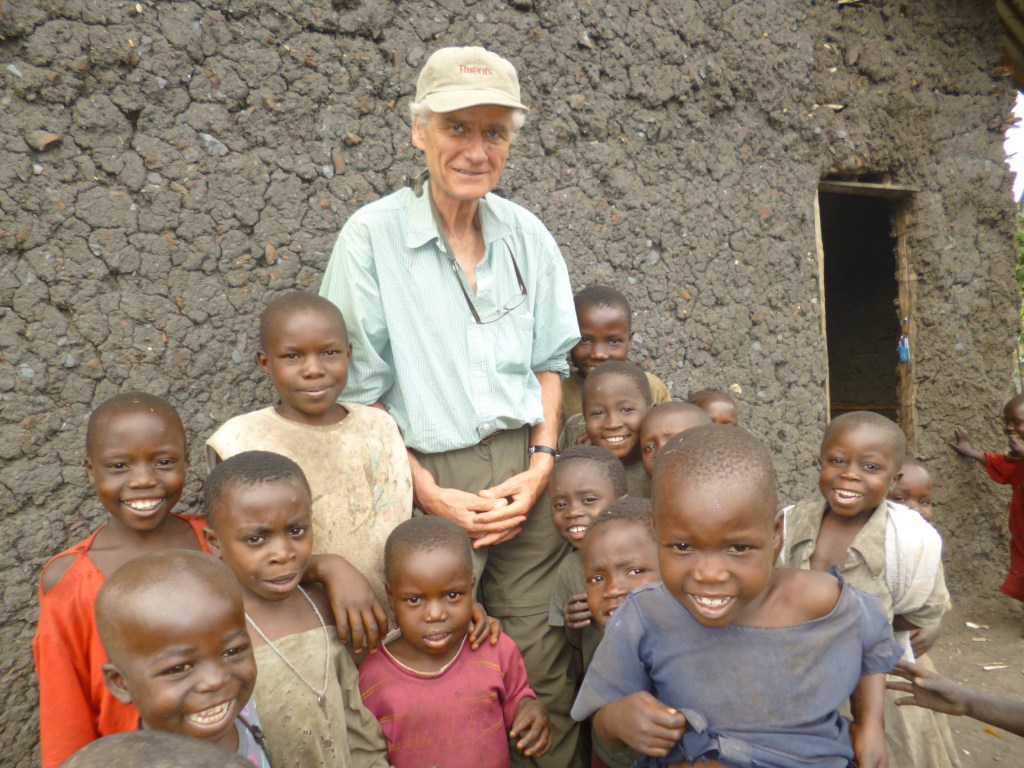
I was worried I might need to cancel my field trip in the eastern Congo, and the Foreign office travel advisory was less than reassuring:
We advise against all travel to eastern and north eastern Democratic Republic of Congo (DRC). The only exception to this is within the towns of Bukavu and Goma, where we advise against all but essential travel. In Bukavu and Goma we advise against travel at night and to avoid travelling alone at all times.
My journey seemed to ignore a few of these recommendations. I planned to travel alone from Bukavu to Goma, and then on to the small community of Minova, to spend a week visiting Pygmy villages with Congolese colleagues, only one of whom I knew. It was 2012, and I was in the DRC, setting up a small-scale research project to document whether Pygmy people were being denied access to healthcare. After running a training workshop in Bukavu, the capital of South Kivu province, we prepared research teams to visit villages in two areas where my partner organisation, UEFA, a Pygmy run woman’s organisation, had field offices. Rebels still controlled large areas, and hijackings, armed robbery and pillaging in rural areas were common.I felt at home in Bukavu, and knew my way around, but I didn’t know Goma at all (I’d just passed through once in 2002). The Foreign Office website had further cautions about armed robberies in Goma, including robberies of vehicles. I then needed to leave Goma, on public transport, again alone, and during a cholera outbreak. (In fact I’d chosen our research area to see whether Pygmies had access to the free treatment offered during the cholera outbreak). In spite of the risks, I really needed to get into the field, to make sure that the research was effective, and to get direct experience of the situation faced by Pygmies in South Kivu. There was one further danger. The M23 rebels were reportedly moving in force towards Goma, beating back the Congolese army.
I was lucky, as the accountant at the CAP Protestant mission guest-house, where I stayed in Bukavu, offered to phone his colleague in Goma and reserve me a room. He also negotiated a reduced price as I was on a tight budget. Better than that, he arranged for the director of the CAP Goma to pick me up from the boat and drop me off the next morning at the bus park for Minova.
Thursday Nov 15 2012
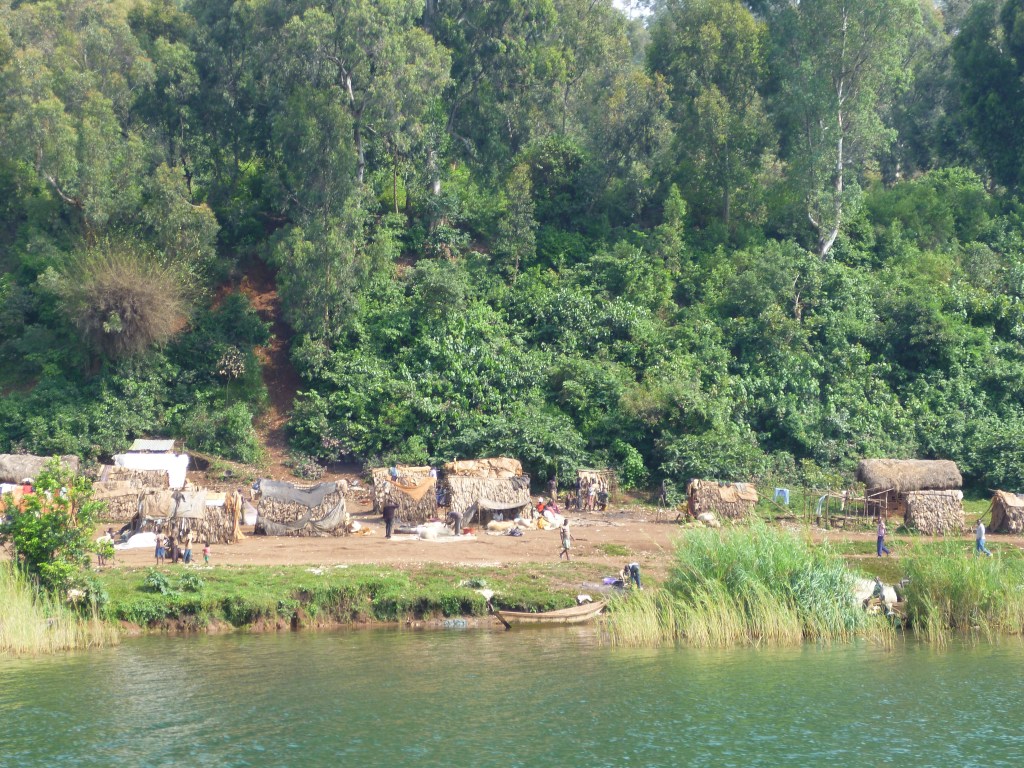
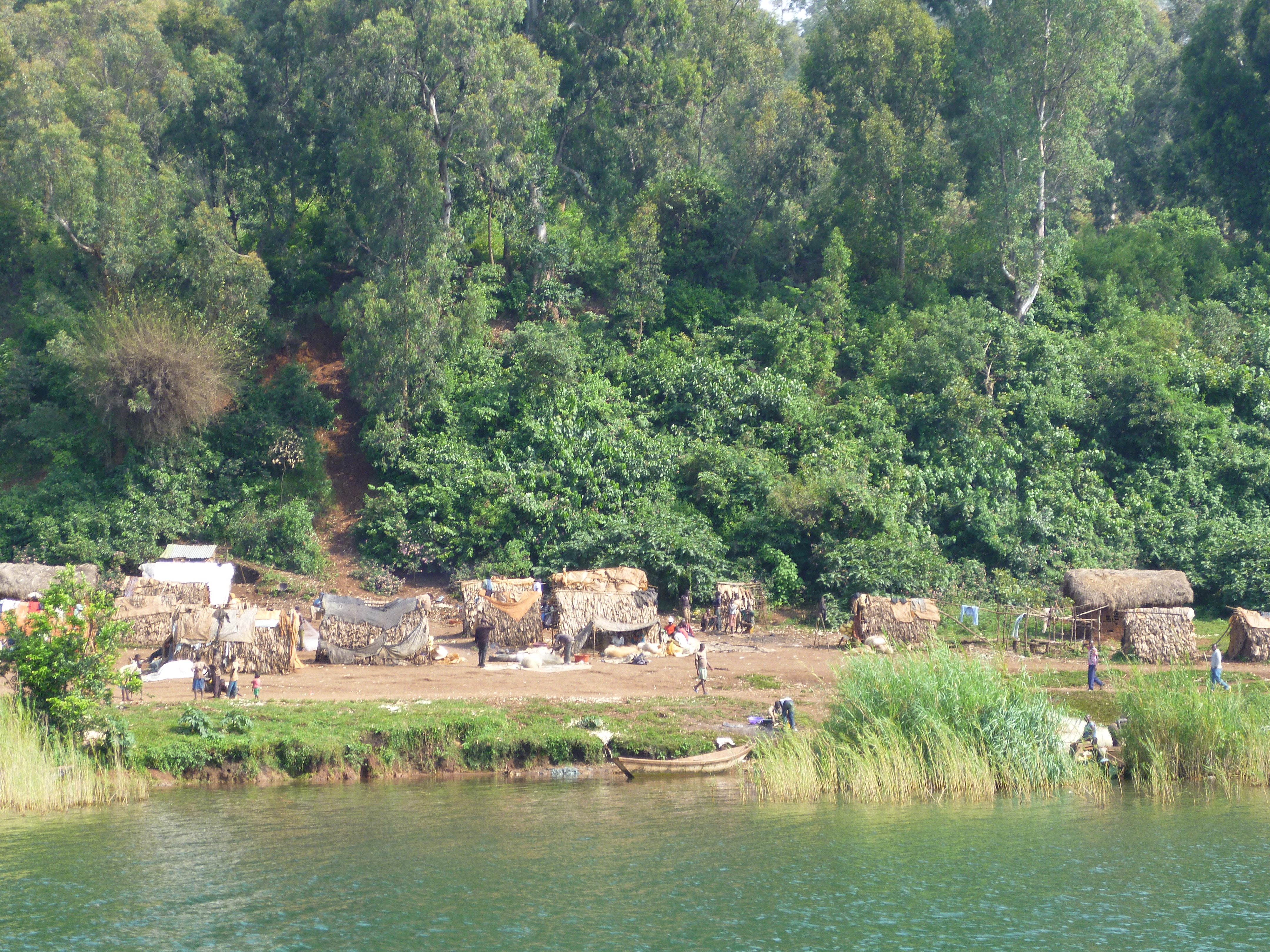
An enjoyable five hour boat ride up Lac Kivu to Goma, passing numerous islands, and the occasional dugout canoe. I had a good conversation with two fellow travellers about the disastrous situation in North Kivu, with the Rwandan backed M23 rebels on the rampage again, and the reasons the international community have supported Rwanda, in spite of its aggressive behaviour towards the DRC. I bought pineapples and green oranges from the jetty, as a gift to my new host, when we made a stop at the island of Idjwi, and also saw a couple of poverty struck Pygmy camps near the ferry stops.
Pic of Pygmy camp on Idjwi
The ferry arrived in Goma at 5.30pm. Goma, a city of half a million, had been inundated by lava just ten years earlier. The 2002 eruption of Nyiragongo volcano was the world’s most dramatic example of a lava flow through a major town. Three huge lava flows swept into the city, and destroyed perhaps 40% of Goma, including the business district and part of the international airport. Lava flows created fires in the commercial centre, as cars and petrol stations exploded. Two of the city’s four hospitals and 80 out of Goma’s 150 pharmacies were buried under two meters of lava. Tens of thousands of people were made homeless, businesses destroyed and 400,000 people evacuated.
Pics of 2002 eruption to be uploaded
The director of the CAP picked me up from the ferry and drove me through town and into a new quarter of luxury modern mansions. It was strange to see what would be million pound houses in the UK built on top of the 2002 lava flow. It was an eerie feeling knowing I was sleeping under so dangerous a volcano. That night I had a frisson of fear before I fell asleep.

Friday Nov 16
I got up at 6 and the director kindly dropped me at the mini-bus for Minova at 7. As I was one of the first in the bus, we spent 90 minutes cruising to pick up other passengers before leaving town at 8.30. The 45 mile journey was initially through a bleak landscape of shrubs growing on recent lava flows into Lake Kivu. We arrived a Minova, a small district centre with a hospital and two hotels, at 10.15. There were several other NGO teams in town, each with its 4x4s buzzing up and down the one street. Arriving on a crowded local bus, I was in a different league. Jean Claude Kateo, my colleague from Bukavu, had come to the market to meet the bus, and we immediately set off, sharing a moto (motorbike taxi) to Kalunga, 7km away. Bems the Minova coordinator and the Kalunga field worker met us in the UEFA office, a simple and almost empty wooden shack, then we walked up a steep mud track, between square, tin roofed mud houses, to the Pygmy quarter (section), of about twenty thatched mud houses, at the end of the village.
Kalunga village meeting: 16 men and 14 women.
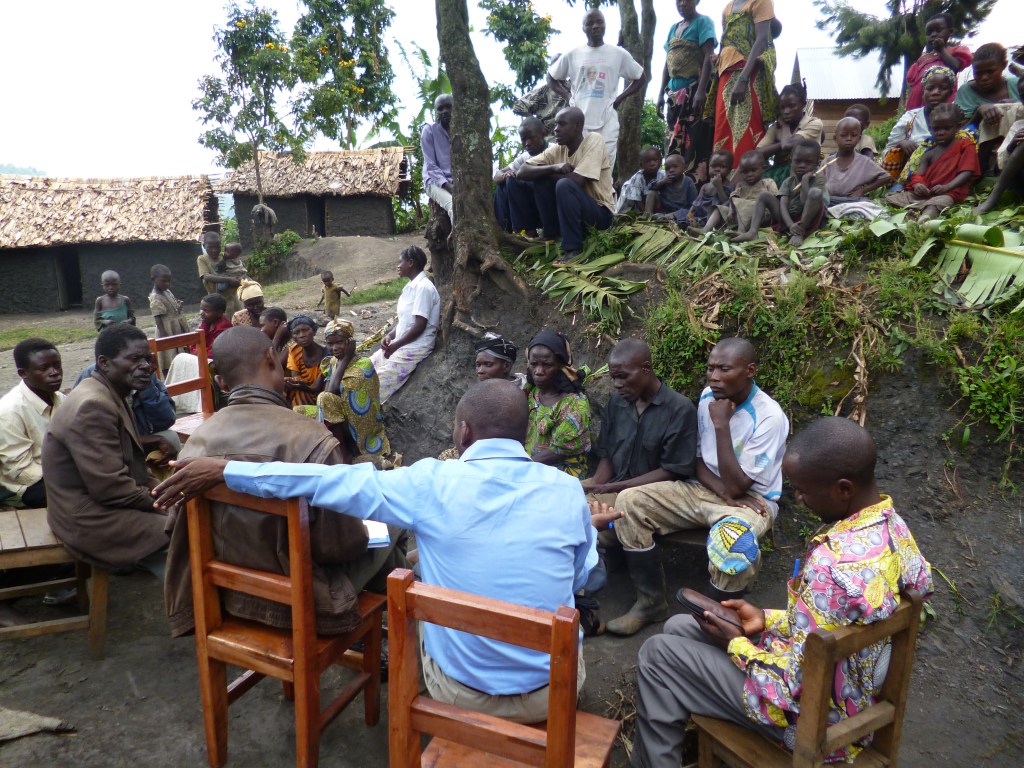
We were greeted warmly, as UEFA has worked in this village for a while. Jean Claude led the meeting, going through our village questionnaire. Then Bems took a small group of men, and Jean-Claude a group of women for smaller focus groups. Afterwards several villagers were interviewed individually. After watching and listening for a while (the meeting was in Swahili, which I don’t speak) I began to take photographs for the report. The Pygmy quarter is crowded into small space at the edge of the larger Bantu village. The Pygmies own no land, and most work on the farms of neighbouring Bantu for a small amount of food or money. They live hand to mouth, and often do not have any food that they have not earned that day. Many of the Pygmies were off working in fields to get that nights meal for their families. The researchers discovered that, in spite of the ongoing cholera epidemic, there had been no cholera prevention outreach in the Pygmy quarter. However, they had earlier benefited from the campaign of free mosquito nets. One person had used his net for fishing, and one man said he’d sold his for 200fc, (about 15p/25 cents).
In this small village, with a district hospital in the adjoining town, there were a number of untreated sick people.
A girl of 3-4 years old with a severe (treatable) eye infection, and almost blind
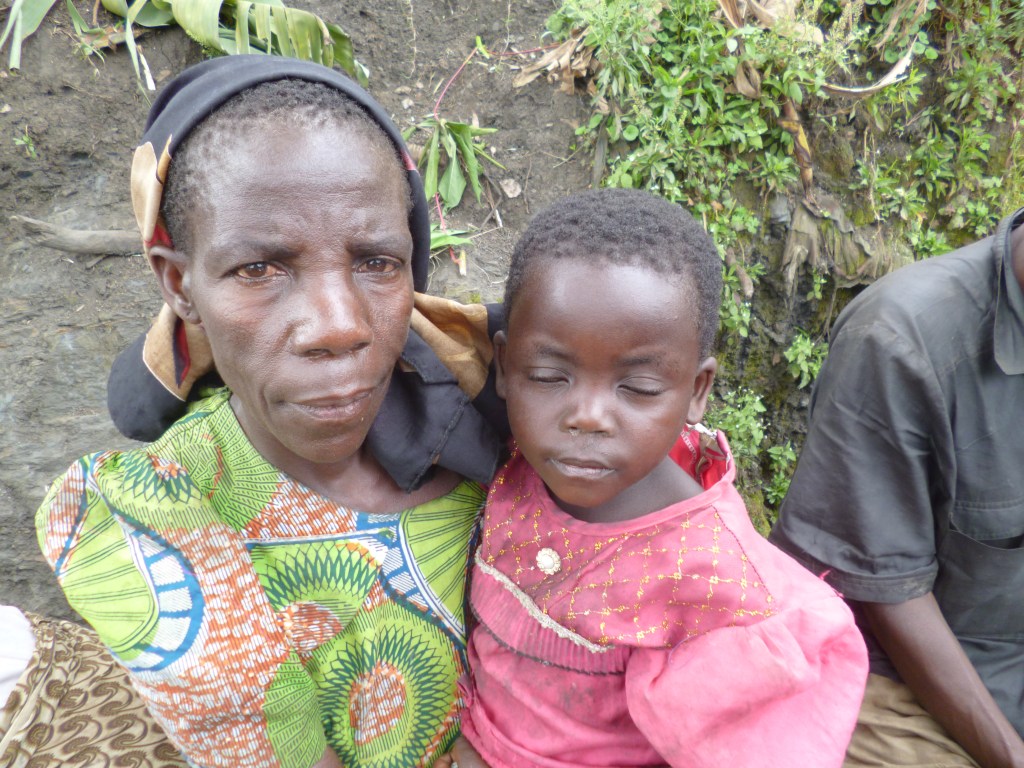
Adolescent girl of 12- 15 with a severe (treatable) eye infection, and almost blind
A man of perhaps 35-40 with a large growth on his forehead
A man of 35-40 with a very large protruding hernia
A woman of 20-25 who had recently suffered a miscarriage and was in pain
A child of 3-4 with a weeping ear infection.
The policy with health care in poor countries, promoted by the World bank and others, is that people pay towards their care. This helps fund the system and also supposedly discourages unnecessary usage. The indigent- those without any money, are supposed to be treated without cost. As all Pygmies meet this criteria, they ought all to receive this free treatment. The meetings discovered that free treatment was consistently refused at the local hospital, and so medical care was unavailable to the villagers.
At the end of the meetings and interviews, Jean Claude asked me if there was anything else I would like to ask. I thought it important to discover more about whether the mosquito net campaign had been effective. From the information already gathered, it would appear that the campaign had been a failure. One net had been used to fish (though as the village suffered from malnutrition, that was a substantial unintended benefit), and one had been sold for a miserable sum. I wished to get more details on this so we asked how many people had still got their mosquito nets. Several said they had kept them, though one woman said that she had hers hidden away, as she thought the insecticide coating was poisonous. She would use her net when the smell went away.
I offered 500fc (about 35p, but as much as a Pygmy might earn for a day’s work) to anyone who could show me their mosquito net in place. This was an adventure, as we got to explore the village and go into many houses and saw nets placed above eight beds. I noted that several of the nets were hung too high, and that mosquitoes could get under the edge. As the cord with which they were attached was already at its max, we arranged that the local staff-person would bring string on his next visit to help hang those nets more effectively.
We promised to return the next day to take the sick with long term conditions to the local hospital. We took the girl with the weeping ear infection to the hospital immediately. She was seen by a nurse, her ear cleaned out, and antibiotics were provided at a cost of $4.33. This was easy for the project to pay for, but beyond any of the village’s Pygmies. All the hospital doctors were in a meeting, so we interviewed the nurse after she’d treated the little girl. Later, the head of nursing arrived from the doctor’s meeting. She told us that as the Congolese government had not paid the doctors and nurses their salaries for many months, the hospital survived on the payments made by patients seeking treatment. Since the international NGOs (Doctors without Borders/Doctors of Africa) had begun to give free health care due to the cholera outbreak, the hospital had had almost no patients. This meant that now the hospital didn’t have the money to pay staff at the end of the month, and the head nurse feared that the doctors would all leave. This was a complication of some organisations supplying free treatment I hadn’t known about. Also the head nurse had not seen the official Ministry of Health Criteria of Indigence, which is supposed to be used by all health professionals to determine who gets free health care. She said, “According to this list, almost everybody is indigent!” As the government wasn’t paying wages and bills, and the hospital relied on fees, that would have serious consequences for the finances of the hospital unless they were properly compensated.
It was already past five. We needed to get back to Minova, eat our first meal since 6 am, and plan the next day’s activities before the curfew at 7pm. We made a rendezvous for 7am with the local animator and left.

When I had eaten and was set up in my dingy hotel room, I sat writing up the day’s events under the dim, flickering light bulb. This was my first field visit as part of this project. The process: whole village meeting, focus groups, individual interviews, interview local health professionals, appeared to produce excellent results. The lesson for me was you can only do useful research if you dig a little deeper. Had we not asked to see the mosquito nets in place, we would have left the village to report the complete failure of the free net campaign, as nets were reported to be used to fish, kept stored away and sold for a paltry sum. This inaccurate narrative reinforced negative stereotypes of untrustworthy Pygmies who resisted health care interventions and would justify the feeling that outreach to Pygmy villages was pointless.
A mosquito net in use.

Already, this one visit had demonstrated that there were a large number of chronic and urgent medical problems going untreated due to the lack of freely available health care. The cost of treatment could be very small- less than $5 for a weeping ear infection. Other treatments (eye infections/conditions) would cost more and some conditions, (such as an operation for a hernia), were not treated at this level- the patients would have to go to Goma. It was already clear that the free medical treatment promised to the indigent did not apply to the Pygmies in Kalunga.
Saturday 17th November. Before leaving the hotel, I lowered the hotel mosquito net, which had been hung too high so that mosquitoes could get under the edge- in fact at more or less the same height several Pygmies had hung theirs. I found it ironic that more than half the Pygmies had placed their nets more effectively than my hotelier.
At 6.30 am, we set off, with Jean Claude and Bems on one moto and me on the other. We stopped in Kalungu to agree when we would return to take the persons identified yesterday to the hospital. This turned out to be a mistake, as we were unable to return at the time specified, and kept a lot of people waiting unnecessarily. We continued on to a village a further 30 km along the road. Here we found that the Pygmy village had moved to Munganzo Teme 4 km further on. We went to pay a courtesy visit to the chief, but he was out. On the way to the Pygmy village we met the chief who was returning with several dozen villagers from a work-party clearing the route for a road up to a planned local health centre. The chief disdainfully checked out our authorisation from the Ministry of Health, made some rude comment about working with Pygmies, and carried on back to the village.
We continued up to the Pygmy village, which was about a km above the village proper, and set on both sides of a path. The space they have been allowed to use is tiny, and hemmed in by the fields of the Bantu, with just enough room for the houses and just one small field for growing food. These villagers had been chased from their own village by their neighbouring Bantu. They had brought a legal case, and won $6,000 for having their houses destroyed and $7,000 for the digging up of their burial sites. Following this judgement, they told us that the Bantu had appealed and then corrupted the court (both the judge and their own lawyer!) to win the case against them. They were now landless and forced to move from place to place.
We began the village meeting outdoors but it soon started to rain. Five men and 6 women moved into a hut to continue the meeting. Pygmies don’t have chiefs. But they nominate someone as such, otherwise they have no spokesperson with the authorities. Their “chief” had a positive attitude to medicine and mosquito nets. We also interviewed a father who had recently taken his two year old daughter with cholera to the local hospital but was refused care as he had no money. His daughter died two days later. It is shocking that this is still happening.
The list of sick people: Chief; problems with eyes; a woman with a massive goitre; a child with a serious skin condition; two women with pain in gut.
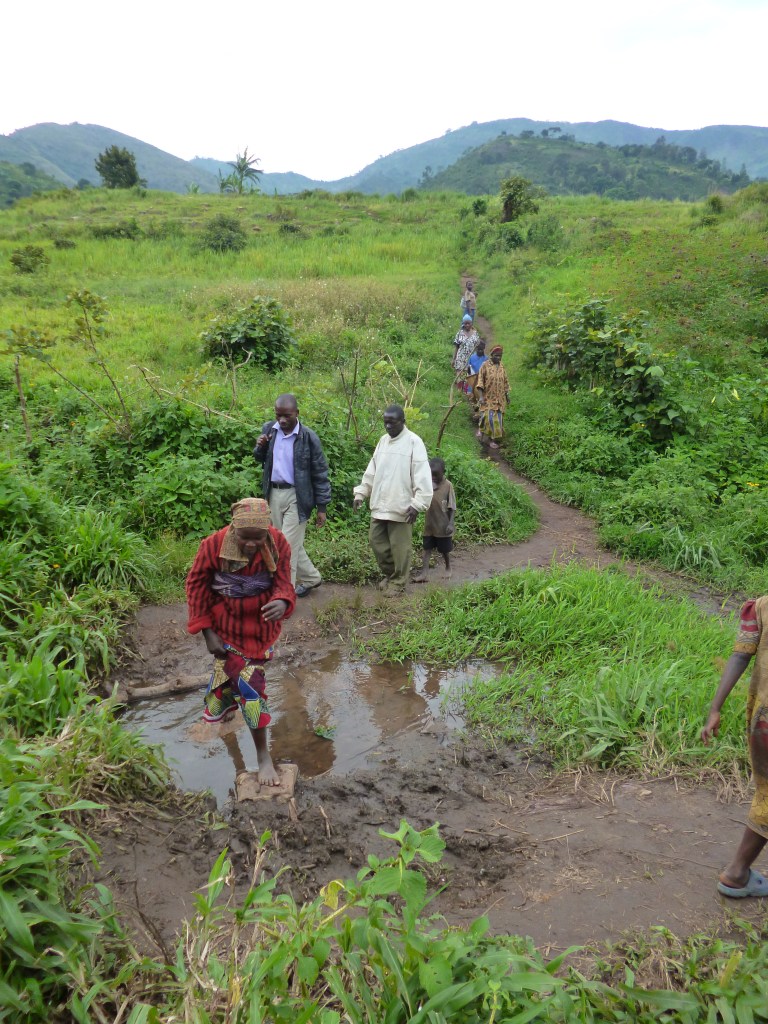
After our meeting, we set off to walk the five kilometres to the hospital with the sick patients. On the way we passed a drunken soldier who had commandeered a villager to carry his load and now ordered one of the sick Pygmies to carry the rest. Bems, the Minova staff person stood up to the soldier, and for a minute I thought it would end very badly. But the soldier backed down, and muttering venomously carried on his way. It was a Saturday, so that the hospital was only partly staffed. But the five patients got various blood tests and some got medicines right away, and the others were asked to return on Monday. We prepaid the fees for Mondays consultations, and arranged for Bems to return during the week to follow up on the care given. Again we interviewed the head of nursing and while we finished up, Bems returned to Kalungu with $50, to take the patients from the day before to the hospital where we would join them.
We returned on two motos, but it was a frightening journey as my driver was speeding and lost control badly on a gravel corner, and even after that maintained a dangerous speed. It is a mad irony that in spite of all the tropical diseases, and rebels, the greatest risk is a serious motor vehicle accident. And I had seen the quality of the medical services available, and I didn’t look forward to using them with a serious injury. Bems had also had moto problems, as his moto had broken down, and he had not made it to Kalungu in time for the hospital clinic. We went to the hospital to look for local UEFA staffer and asked him to apologise and gave him the funds to take the sick people to hospital on Monday.
We returned to Minova for the first meal of the day at 6pm, and quickly to the hotel before the curfew. There were now a lot more Congolese army soldiers in town. Many had fled the M23 forces outside Goma. Minova would be the next point on the M23 drive towards Bukavu. The soldiers seemed extremely nervous, and there was a visceral tension on the street. There were rumours that the M23 rebels had by-passed the UN peacekeepers and were already in the outskirts of Goma. We could hear loud noises that sounded like artillery fire coming across the lake. This was terrible for the people in Goma, but also bad for us. It was my safe route back to Bukavu; otherwise I would have to travel by road down the insecure west bank of the lake. It was far worse for Jean Claude as he had left his 3 year old daughter with his sister in Goma, and needed to pick her up. We had just started our research and I was reluctant to stop so soon…
Next: Visiting an internally displaced persons (IDP) camp, listening to the M23 bombardment of Goma and becoming a refugee. Researching Pygmy Healthcare during Congo’s Civil War, part 2
https://wordpress.com/post/writesimon.wordpress.com/674
 writesimon
Hi Simon,
Hope all okay with Felix and your good self.
I was getting a little worried when you had not uploaded any work onto your blog: you have been so well-disciplined in your regular weekly postings.
What a moving piece of documentary. How can I ever complain about my life situation?? Though being too human – too much a spoilt Westerner – I doubt that I will be able to break that habit. At some level, the atrocious conditions that other people/s suffer is just too difficult to comprehend and cognitive dissonance, rather than political campaigning, is the terribly-comfortable state that I/we manage to sustain.
Some people are truly heroes, and you REALLY are one of them. You have taken so many risks in an attempt to highlight the wrongs, to bring about change, and your research work with these people is one more example. Yet you do not boast, âbig yourself upâ, just clearly and confidently share your experiences.
As a piece of writing – with informing images – I appreciated the âdiaryâ style of the reporting on your research trip. This is what is most rich about your collection of up-loaded writing: the variety of content and in the style of your writing. Some feel very personal, some more detached, and certainly in this piece a mixture of the experience of the âobserveredâ and of the âobserverâ.
I am always tempted – without your consent/permission – to research some agents and/or publishers and send them a link to your WordPress blog. If only I had the audacity…The world continues to need heroes, the very human kind: real people; true adventurers with a social conscious; pragmatic, engaging, with un-sentimental sensitivity and a great sense of humour. I strongly believe that such an approach, with such a variety of material to draw upon, would inspire many others (us all -) to continue to work towards change – to believe through action it is possible to make a difference – without feeling that there is need to be a Gandhi or a Mother Theresa!
Keep on keeping my very good friend â
I will give you a ring during the week.
Love to you both,
Gary. x
Sent from Mail for Windows 10
LikeLike