Saharan Daze 4
15 minutes
[Hitch-hiking across the Sahara in 1972, I got a ride with Jacques across the most isolated part of my route, the 1,000 km from the Tamanrasset, Algeria to Agadez, Niger. We had run out of spare tires at the tiny community of Tegguiada In Tessoum, and Jacques had managed to get a ride with four flat tires and an empty jerrycan into Agadez, leaving me to look after the car until he returned. When two Germans showed up three days later with the spare tires, I’d driven off to take the car to him in Agadez. But the car stalled in the desert, and when cleaning sand out of the carburettor, I dropped a nut into the sand. I waited until morning to look for the lost nut…]
I woke up in the early dawn light, breakfasted on stale baguette and water (it was a little early for sardines) and waited until the sun came up. Then, with some trepidation, I crawled under the car to look for the vital nut I’d dropped the night before. The sand was covered in a scattering of tiny dark stones, and in the half light under the car, I had to pick up each one to be sure it was not the essential nut. Finally, poised on the sand, there it was. Whew! I reopened the hood and put the carburettor back together. Now came the critical moment. I turned the ignition and the engine coughed. I tried again and the engine burst into life. I left the engine running and threw in my sleeping kit.
I had observed Jacques method of driving as fast as he could, and smashing into various obstacles which had slowed us down so much. Instead, I decided to keep slow enough to dodge the frequent depressions or oversized rocks and avoid getting a puncture or damaging the car. But I still needed to keep going fast enough to get through any soft patches: I couldn’t afford to get stuck, as I had no one to help me push out.
In a state of exhilaration, I wondered at my luck. To be hitch-hiking across the Sahara, with no preparation or planning and yet to be driving my own vehicle, alone, with three spare tires, spare petrol and water and the excitement of sub-Saharan Africa ahead. Everything seemed more real than real, and I was conscious of everything around me and everything I was doing in an intense electric supra-awareness. I felt a wonderful lightness, as if I were floating on a magic carpet.
I had a hundred and fifty kilometres to Agadez, which might take just a few hours. But, if anything went wrong, I could be in trouble. I enjoy an element of risk. Risk keeps you alive to what’s around you, and aware of the importance and consequences of your actions, and also of chance. When there is a risk, once I identify it and, if possible, deal with it, I’m pretty good at relaxing, or at least not worrying too much. And this was fun.
I remember my fascination at seeing mountains uncluttered by vegetation, as if looking at the very bones of the earth. Without soil, geology is visible directly. And, without plants, or animals, or signs of humans, it’s the geology that dominates your experience. Geology on a vast scale and a sense of one’s frailty, though not of insignificance. In fact the absence of other life, and of human temptations, rather does the opposite, and you realise the significance of your existence, and the absolute magic of each particular moment.
In a few hours, the track became a well-made gravel road. I saw the sign to the camp-ground, 6 km before Agadez, and drove a few hundred feet off the gravel road, up a narrow track. The Camping was a small, walled oasis with a swimming pool, palm trees, cold beer and simple food. This was luxury compared to the limited services offered in Tamanrasset (a tent space, a wall, a cold water tap and a cold shower…)
Reception gave me the unwelcome news that Jacques had left with a party of Germans in two VW campers two days earlier. Damn, it must have been Jacques calling and whistling at me when I took off from Tegguiada In Tessoum the second time. I didn’t think Jacques would be happy to be abandoned in the desert. I thought it would be wise to stay at the camp-ground, both to keep the car safe, and so that Jacques could easily find me on his return.
After a couple of days lolling around the camp-site, swimming, drinking the occasional beer and with the luxury of a car of my own, I was driving a few of my mates from the campsite into town. Suddenly, a Land Rover coming the other way pulled across my path and I had to brake hard to stop from running into it. Written in large letters on the side of the Land Rover was POLICE. Out jumped Jacques and the Chief of Police!
I was in real trouble! Jacques ran up to me.
“How is the car running,” he asked
“Very well,” I replied.
“Follow us,” he said and jumped back into the Land Rover, which turned and drove back into town. I followed the police chief as he drove into the police compound!
What was going to happen now?
I let out my passengers who, picking up on my nervousness, scuttled off into town, and Jacques and I followed the Chief of Police into his large office. Fortunately, Jacques was focussed on the upcoming negotiations to sell his car, and we cleared up the misunderstanding that had led me to leave him behind in Tegguiada In Tessoum, in a few brief words. The police chief pulled out a bottle of Johnny Walker Red Label with six fingers of whiskey left in it, and poured all three of us a good shot and the two of them got down to some serious negotiation for the Renault. We finished our drinks, and were poured another large Scotch. It was not yet noon, and I don’t particularly like Scotch, drinking in the mornings, or drinking spirits in the heat, but under the insistent hospitality and the powerful personality of the police chief, we finished the remains of the first bottle and another, full, bottle was produced and placed ceremoniously on the desk.
Before the bottle was opened though the negotiations stalled, and the second bottle was hastily removed.
The police chief became bad tempered and we were quickly hustled out of his office and into the hot desert air. Jacques drove at speed out to the camp-ground, packed up the few belongings he’d left behind when he’d gone with the Germans and took off immediately for Lome, in Togo, to sell the car. I packed up too, and got a ride with him into Agadez. He dropped me off on the way through town. And spun away, in a hail of gravel.
I had a meal of macaroni and unidentified mince in a cheap eatery on the edge of the market and asked if I could leave my bag there while I went to explore. Agadez has been called the town at the gates of the Saharan desert. It is larger, more interesting, and much older than Tamanrasset. I spent my first few days exploring the newer part of town, largely one story concrete breeze block buildings, a business quarter with a few modern services (a bank, a post office, a petrol station, government offices), several truck yards, the large open air market, and numerous cheap eateries. Trucks in various stages of repair were parked here and there, propped up on blocks, with missing wheels, or dissected engines and the driver, helper and a mechanic or two camped by them. The market was largely run by Hausa stall keepers selling fruits and vegetables, mounds of unpleasant looking meat covered in flies, watches, radios, cheap clothes, cooking pots and hardware. The Hausa are the farming and trading people of the Sahel. The stall holders wore patterned and embroidered robes and Hausa was the language of the market. I met Andrew who ran a stall selling and repairing sunglasses and spectacles. He spoke English, and had a sad story. He was a Yoruba from southern Nigeria, but had been kicked out by the Nigerians in an operation to remove illegal immigrants, as he’d been born across the border in Niger, and then returned to Nigeria with his parents when he was a toddler. He was Nigerian and had been brought up in Yoruba and English, but he’d been stuck in Niger for the last several years, and had had to make a new life, without his family, or friends and even though he hardly spoke French, or Hausa the lingua franca. I met Andrew when he charged me a pittance to fix my glasses. I thanked him and said he was a good man. He replied with what became my catch phrase, “It’s good to be good.” Each day, I would stop by Andrew’s stall and we would chat. Sometimes we shared a lunch of baguette, onion and local cheese, or a tin of sardines.
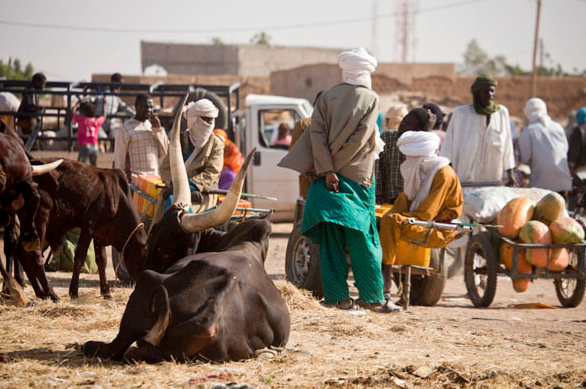
I learned my way around the market, chatting to some of the vendors who spoke French, picking up a smattering of Hausa, and buying a small pile of tomatoes or onions to go with my bread and sardines. After a few days, I knew the local price for these two items, but one day a stall holder asked for twice as much for a small pile of tomatoes (6 instead 3). I was confident I knew the “real” price so I tried a new negotiating technique by raising the price. Instead of 3, I offered him 10, and the ears of the other stall holders picked up. We then had a very entertaining public negotiation, with me offering progressively more ridiculous amounts as he embarrassedly and rather quizzically dropped the price. He dropped to 5 and I responded with 20; he looked confused, “4?” “30”, “3?” “Okwhy dadi” (good!).This greatly entertained the other market vendors, and by the time we had finished, I had made a few mates and guaranteed I would get good treatment from all the traders from then on.
In the evening, I returned to the restaurant for another meal, and took my sleeping gear out into the desert, walking two or three hundred metres to the first tree, where I laid out my bag, and slept under the stars. I returned to the restaurant in the morning, had a breakfast omelette and put my kit away. From then on, I had one meal a day there and had the benefit of a free left luggage depository.
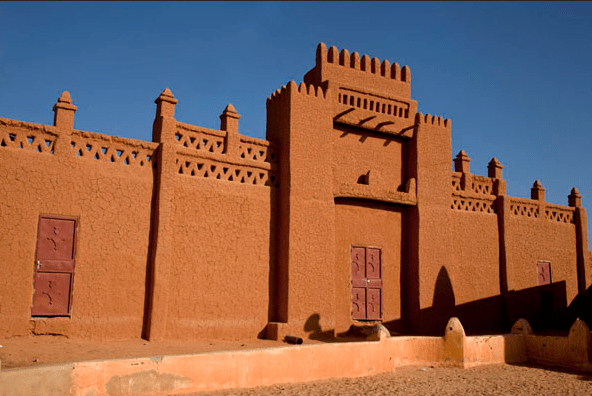
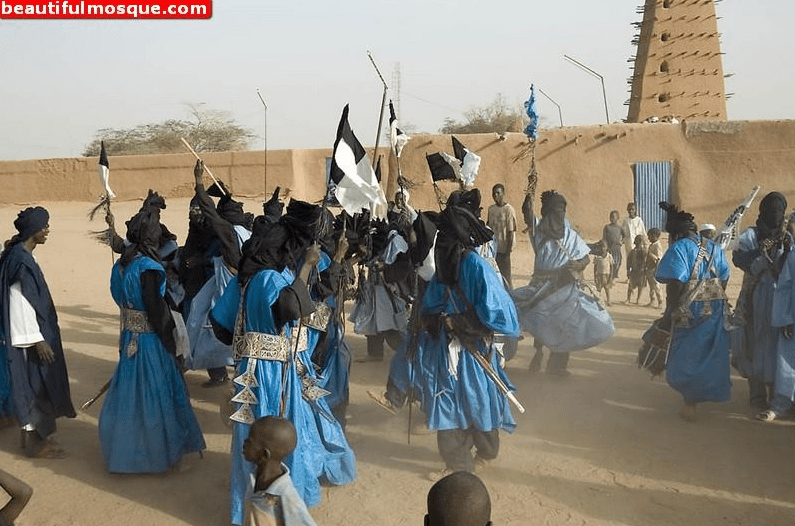
Agadez has a large medieval quarter, the pre-colonial town of traditional mud-brick houses with high mud walled alleys. It has an impressive, ancient, mud-brick mosque, and a weekly camel market. It is difficult to get around the old town, as most alleys fizzle out in dead ends. Finding a way through to the square in front of the sultan’s palace took me several days exploration, and I often still got lost. I discovered that Agadez is a town it takes a long time to get across quickly!
There were the black tents of several Tuareg camps on the edge of town. The Tuareg are the desert people, the camel herders, oasis dwellers, warriors and one time masters of the trade routes, that had criss-crossed the Sahara from the great trading cities of Djenne, Gao, Timbuctu- and Agadez, as far as Morocco and Libya. The Sahel is a transitional zone between the arid desert to the north and the belt of humid savannas to the south. A great dry was upon the Sahel, and thousands of Tuareg were unable to find grazing for their herds as they were used to. The Tuareg were having to deal with severe drought and a seriously degrading climate, and the Sahara advancing into their grazing areas. Encyclopedia Britannica says:
“In the second half of the 20th century, the Sahel was increasingly afflicted by soil erosion and desertification resulting from growing human populations that made more demands upon the land than previously. Town dwellers and farmers stripped the tree and scrub cover to obtain firewood and grow crops, after which excessive numbers of livestock devoured the remaining grass cover. Rainfall run-off and the wind then carried off the fertile top-soils, leaving arid and barren wastelands.”
This description follows a western pattern of placing responsibility on local people for their deteriorating situation, when the primary cause of desertification is climate change- something for which local people had no responsibility.
Britannica continues: “The fragile nature of agriculture and pastoralism in the Sahel was strikingly demonstrated in the early 1970s, when a long period of drought, beginning in 1968, led to the virtual extinction of the crops there and the loss of 50 to 70 percent of the cattle. In 1972 there was practically no rain at all, and by 1973 sections of the Sahara had advanced southward up to 60 miles (100 km). The loss of human life by starvation and disease was estimated in 1973 at 100,000. Severe drought and famine again afflicted the Sahel in 1983–85, and desertification progressed despite some government reforestation programs. The Sahel continued to expand southward into neighbouring savannas, with the Sahara following in its wake.”
I was travelling across the Sahara, and the Sahel in 1972, unaware that the climate was dramatically drier than it had been, and that I was watching the slow-motion tragedy of a massive climate change disaster.
Each night I slept out in the desert, usually near a tree. In the morning, I would wake up and wonder why I was surrounded by dried human shit. I tried a number of different places to sleep, and yet each morning I was again surrounded by dried shit. One day in the heat of noon, I decided to avoid the filthy lavatory at my restaurant/luggage storage, and walk out into the desert to take a crap. I found a comfortable spot in the shade. It was only then it occurred to me why I kept waking up surrounded by poop.
So, for two good reasons, I started sleeping away from the lone trees. I was fascinated by the night sky, with up to four thousand stars visible in the perfect conditions. I had watched the sky from my sleeping bag, night after cloudless night, coming down through the desert. Amidst the blaze of stars, and constellations, I noticed the moving stars. I thought I had soon identified five planets: Venus, Jupiter, Saturn, Mars, and Mercury. I watched their wanderings against the backdrop of stars, but then began to notice something very strange. Some of the planets appeared to move one way against the stars, then turn and go the other way. I paid careful attention, and this was definitely happening. Discussing this with other travellers, I was pooh-poohed. “That’s impossible.” But I trusted my observations, and found later that this is the retrograde motion of the planets. I was curious about the lack of excitement with the stunning star-scape, or at least the lack of any careful observation from the other travellers. For me, the brilliant stars swirling nightly across the sky, with wandering planets and the great swirl of the milky way was a continuing delight.
Not knowing of the slow motion destruction unfolding around me, I gazed at a low range of blue hills in the distance to the north east. This was the Air plateau, inhabited by Tuareg farmers who lived in a dozen oases in the mountains. The hills were 100 miles away and required permission to visit. I wanted to travel there by camel. This turned out to be too complicated to arrange on short notice, and too costly for my remaining funds, so I decided to visit on my return north. But for now I had places to go and things to see.
Next onwards to Niamey and the wonderfully named Ouagadougou
 writesimon