(Summer 2014)
Simon Waters; 15 minutes
As we left Assok, morning light streamed down through the rainforest tree tops. Soon the trail crossed a wide mud-brown river on a fallen tree trunk and Etienne strolled unconcernedly across. Although my pack was lighter than Etienne’s, I needed to protect my iPhone, and digital camera, so I half crawled across the log, which made Etienne laugh.
Soon after, we stopped in a small clearing where Martin, another Baka from Assok, had brought a plastic jerry of palm wine out of the forest to lubricate our journey. Joseph, who had left the village before us carrying a regime of plantain, was also waiting, and we four drank the fresh, sweet palm wine, after clearing off the floating ants and palm chips. After a couple of cupfuls, I set off along the trail first, to get a head start and gain a respite from the relentless ease with which my Baka companions walked through the forest. The path was frequently hidden by undergrowth at ankle and knee height, through which rattan snaked, and so a real trip hazards for the unwary. The three others soon caught up.
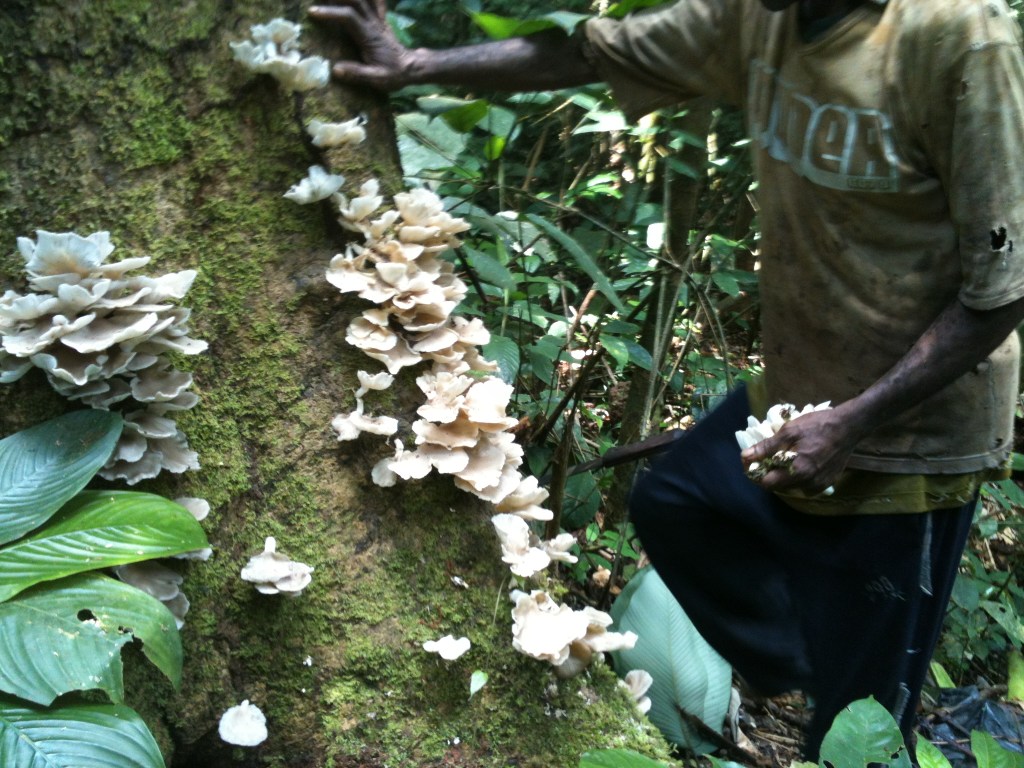
We stopped after a while and Joseph picked handfuls of mushrooms which resembled Chanterelles from a trail side tree, and Etienne wrapped them in leaves from a nearby shrub and tied them to his rattan backpack. After an hour or so we had another break, this time so that Etienne, Martin and Joseph could each swig a small plastic sachet of Cameroonian “whiskey”. And so the walk continued at a fast pace, me often stumbling on hidden roots, or snagging low hanging vines, between hourly pit stops so my three Baka companions could swig another whiskey.
Returning to Cameroon after ten years, I had wanted to visit my Pygmy friend, Etienne Mopolo, a Baka who lived in the east province. I had first met Etienne in 2000 when he had guided me into a village-run gorilla habituation project. In 2002 I had visited him in his village in the UNESCO World Heritage Dja Reserve. In the Dja, Djengi the spirit of the forest had danced in the moonlight as Baka women sang their intricate polyphonic songs. I hoped Etienne would again take me into the rainforest to stay in a Baka camp and further explore the Dja reserve.
I showed Etienne’s picture to my host Samuel Nnah in Yaounde. Samuel has worked with Baka, Bagyeli, Twa and other forest people across central Africa for fifteen years and he recognised Etienne. After a few calls to colleagues, Samuel found he was now living in the village of Assok, in the south region, and got a message through that I was coming to visit.
Assok is a small village that stretches along the road to the Congo 100 km past Djoum, the last town of any size. Assok is in two parts: a Baka village a couple of hundred metres before the river, and a Bantu village five hundred metres past it. Both parts of the village use the river to wash themselves and their clothes and to get their water. The Baka are hunter gatherers, one of a number of Pygmy peoples who live a semi-nomadic life in the rainforests of central Africa. The Cameroon government has relocated the Baka along the roads, where most now live near Bantu villages. They are often seen as ‘possessions’ by the Bantu, who consider them inferior, and primitive. Racism against Pygmies in central Africa is substantial and most Bantu will not eat food cooked by a Pygmy. As long as the Baka live a large part of the time in the forest, and can hunt game to exchange for village goods, they can maintain a reasonable amount of independence. But once the rainforests are degraded, and most of the game hunted out to feed logging camps or mines, the Baka often live an impoverished life working as agricultural labourers for tiny wages, often in permanent debt to a villager who considers them ‘my Baka’.
After a day and a half’s journey from Yaounde, I arrived at Etienne’s house, a typical rainforest roadside construction of a wood frame covered in mud daub, but larger than any other house in the Baka village. I was never quite sure who lived there, but there were at least twelve, including his wife Salome, their five children, his wife’s sister and her baby, his father in law, and several other adults.
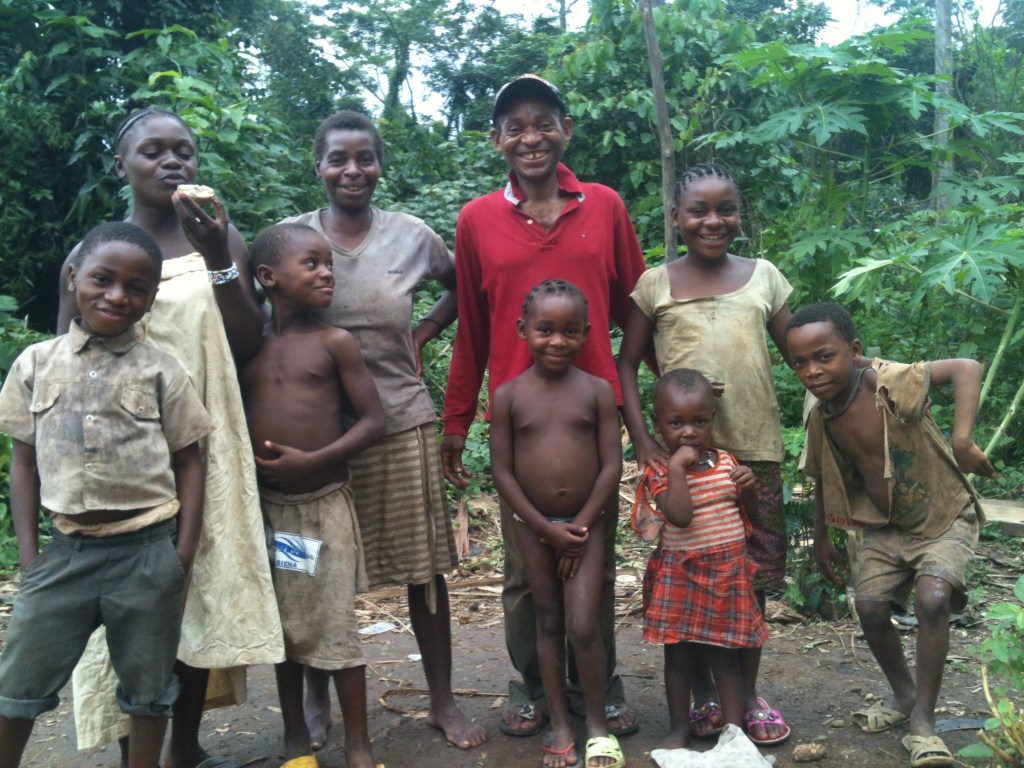
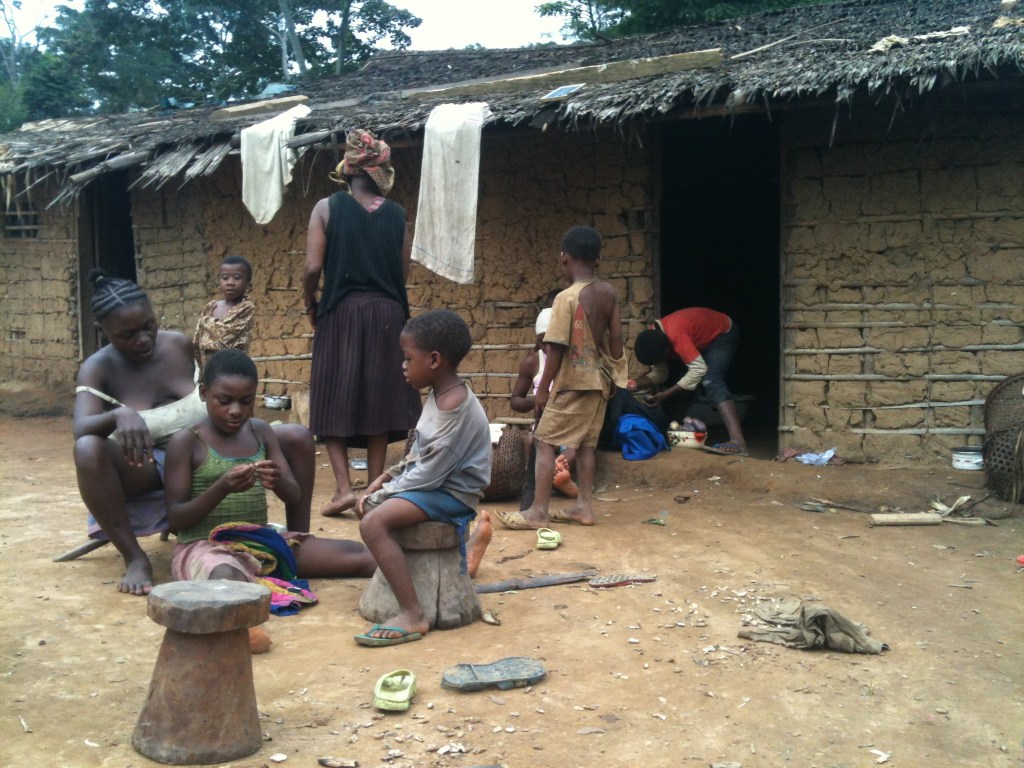
As dark fell, people arrived from the rest of the village. Etienne took out his guitar and sang an upbeat hymn, accompanied by several of the older children on an upturned pot or wooden block. The lively chatter, the music’s changes of pace and rhythm, combined with plenty of palm wine, and the light from a full moon and open fire, made for an engaging evening. I went to bed under a mosquito net in a windowless room on a sagging rattan bed covered in several small pieces of thin foam and the sheet I’d brought. The room had no ceiling, as the walls did not reach the roof, and so sound travelled well between rooms. Conversation in the hut continued for over an hour as people called, jested, laughed and shouted between the rooms. The two babies occasionally cried, and were nursed and sung lullabies, and the kids played outside in the moonlight until late. Slowly it grew quiet. But throughout the night there were moments of conversation, lullabies sung to one or other of the babies and occasional laughter.
Back on the hike, the path continued through twenty or thirty metre high forest and crossed occasional small streams, some surrounded by wide areas of wet ground. I tried to keep my boots dry, following Etienne as he detoured or hopped across the puddles, but the flooded areas increased in size and there were a few wide areas flooded about a foot deep. Soon I stopped bothering and waded through the water. Etienne had a pair of plastic shoes, and both Martin and Joseph had bare feet, but my light goretex hiking shoes were soon sodden, and heavy. The forest was dense, but where trees had fallen, small patches of light filtered down from a cloudy sky. After about four hours, we arrived at a forest camp, where half a dozen mongolou (round leaf-covered huts) stood in a small clearing surrounded by avocado and papaya trees. Here we had a break, and Etienne collected some avocados, and drank another sachet. After more walking, much of it wading through foot deep water, we arrived at Etienne’s trapping camp, a small clearing with a low flat roofed shelter and two mongolou with most of their leaves missing. I was exhausted from the pace and lay down in the shelter, while Etienne and Martin went off to check their snares, and Joseph got a fire going and boiled some of the plantain he’d carried from the village.
The camp was set in a clearing under a particularly unpleasant tree. Large seed pods whistled to the ground and landed with a violent whoomf! Joseph told me that they were dangerous if they hit you on the head, but sat untroubled by the fire. I crept into the shelter when not needing to be outside, and listened to the loud crack when they landed on the roof.
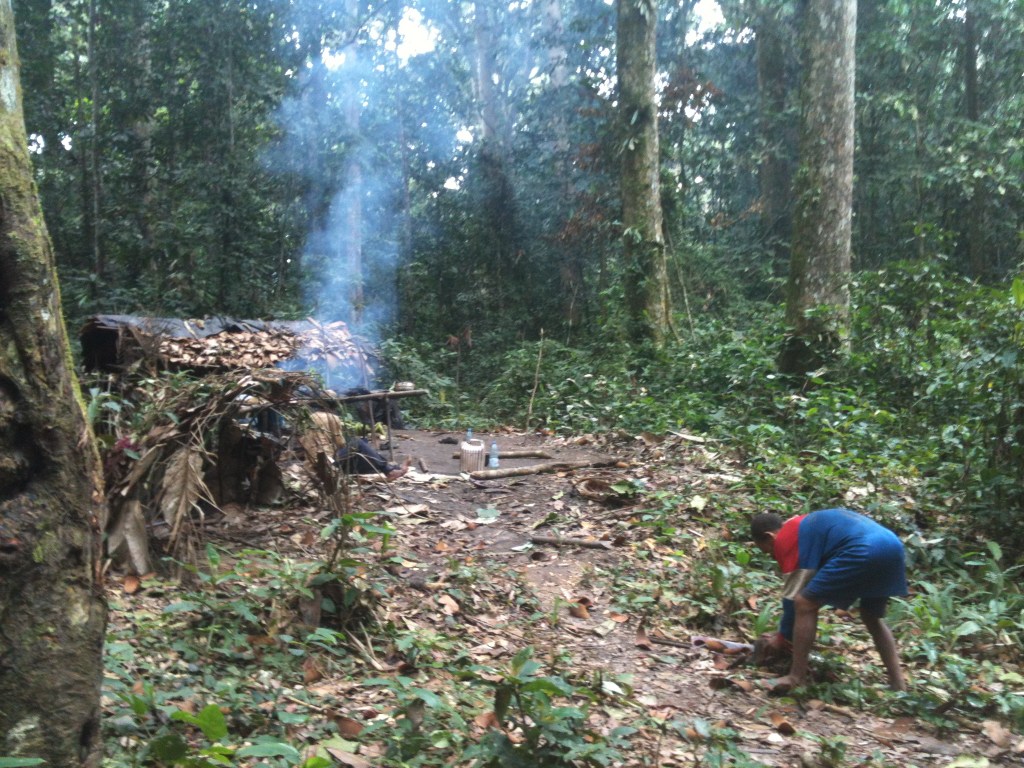
Etienne returned in the dusk with three Lièvre, small forest deer, and told us he’d seen a leopard very close. He skinned and cut up one of the Lièvre, and Joseph cooked it in a sauce with some of the mushrooms we’d collected. The other two he skinned and halved and set above the fire on the smoking rack. Martin returned in the dark. He’d found nothing in his snares. Sitting around the small fire in the dark, we ate a delicious dinner of Lièvre, mushroom and plantain, before going to bed.
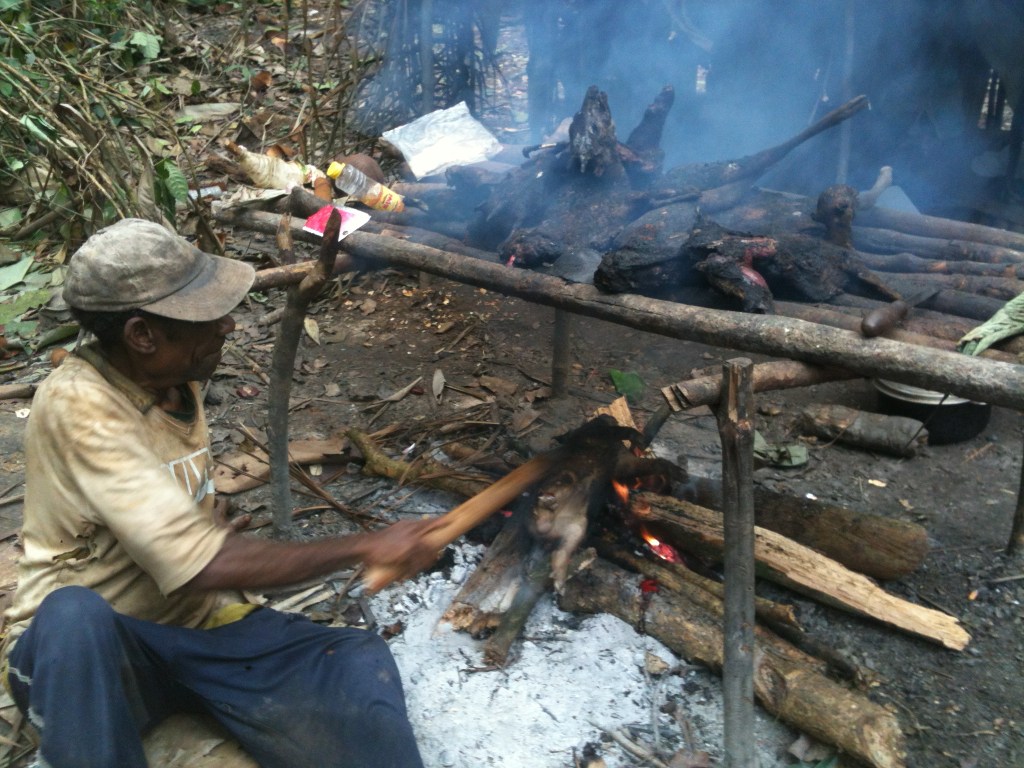
I shared the small shelter with Etienne and Martin, lying on the too-short bed made of split wooden slats. Joseph slept by the fire on a few large leaves. I had forgotten to bring a sleeping mat or cover, and so slept directly on the slats like the others, and spent a cold and uncomfortable night, but enjoyed the forest sounds. For breakfast we reheated the rest of the Lièvre with more boiled plantain, and after a wash in the nearby stream, set off to check the rest of Etienne’s triplane. We visited more than a dozen snares, passing a gorilla’s tracks, and finding several edible fruits, including a Moabi, which is like starchy sweet custard.
Etienne had snared many more Lièvre, a Biche (a larger and very tasty antelope), and a small wild pig. For lunch we cooked the pig, while Etienne finished off the Lièvre. During the day, Etienne, Martin and Joseph checked their snares, peeled plantain, gathered firewood, cooked, ate and fed the fire. Twice I saw Joseph make a tool, once cutting a piece off the bed slats to make a knife to peel plantain, and once turning a piece of firewood into a pestle to pound the plantain into fou-fou. I spent my time eating, sleeping, taking pictures, recording forest sounds and Baka conversation, and following Etienne around to his snares. That evening Etienne caught four more Lièvre and a porcupine.
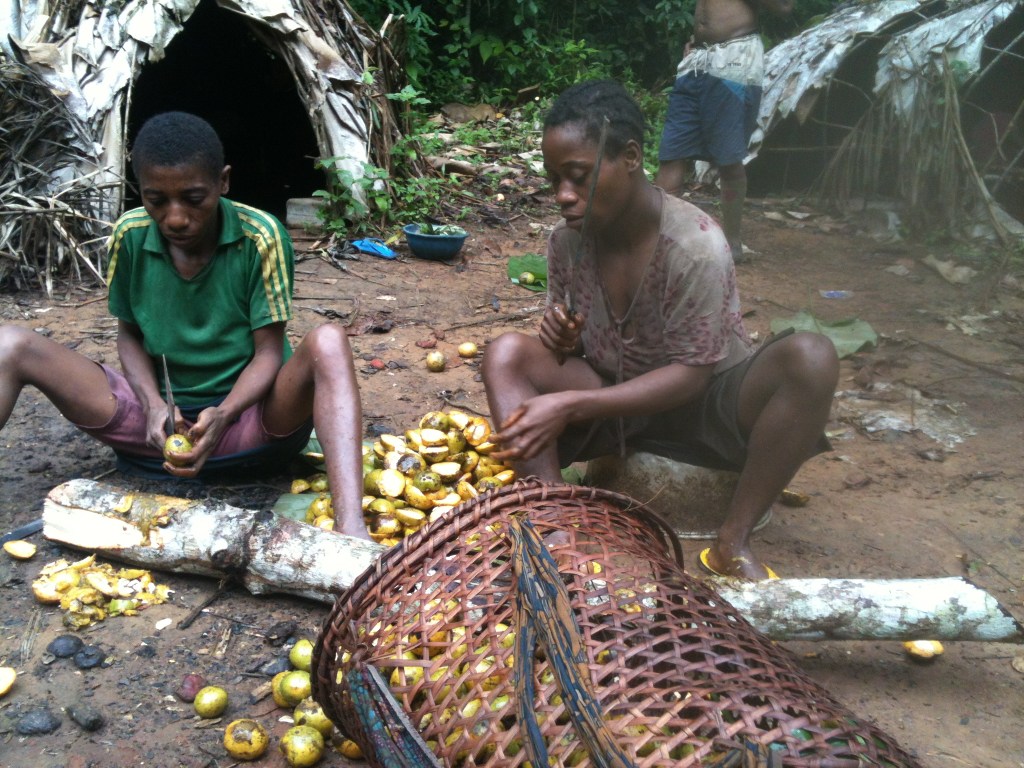
The next morning was chill and grey. After another tour of Etienne’s snares, we set off for the village, ploughing on as a light rain increased, finally descending in a deluge that soaked us to the skin. I stopped to break off some wide leaves as an umbrella, but we were almost at the mongolou camp. Here we cowered in one of the shelters, which had most of its roof intact. A fire was started, and Etienne began to dismantle the drying rack and feed it into the fire- another could easily be made when needed. Soon after, two women, a young girl and a baby arrived and joined us by the fire. When the rain stopped, the women went off to collect wild mangos, and then sat and split them to extract the seed, which make a delicious sauce.
When we returned to Assok, Etienne’s wife Salome told him their toddler “little Salome” was very ill. She began daily visits to the local health centre in Mintom where she was treated with injections for malaria.

After three days I left to return to Yaounde. I stopped at Djoum, and bought a mobile phone for Etienne as he’d asked, and sent it back in the car I’d come in. That night I phoned Etienne, to make sure he’d got the phone and to ask how little Salome was. She was still lethargic and still unable to stand. I phoned Yaounde and asked my host Samuel if he could send me some money to be repaid when I got back. Next morning I called Etienne again and asked him to bring little Salome to Djoum. The next day we went to the Military hospital where she was diagnosed with not only malaria, but also intestinal problems and malnutrition. I spent a few days with the family in Djoum, making sure they, and especially little Salome, were well fed and receiving treatment. I spent both afternoons and nights visiting the Baka village where they were staying with relatives. The cost of Salome’s treatment which I paid for (including the family’s travel costs and the expense of staying away from home) was about £80, more than Etienne made in three months, even though he is an excellent hunter. Because healthcare is so unaffordable, most Baka children don’t get proper treatment, or any treatment, when they are sick, and many die of easily curable diseases such as malaria. Two years earlier, I had carried out research in the DRC on Twa Pygmies access to healthcare. I had come across numerous cases where children died unnecessarily of diseases when the treatment was available, due to the inability to pay and discrimination in provision. Fortunately, a call to Etienne’s new phone a few days later gave me the good news she’d made a full recovery. Salome was toddling around with the other children, as right as rain.
 writesimon